Artist Led, Creatively Driven
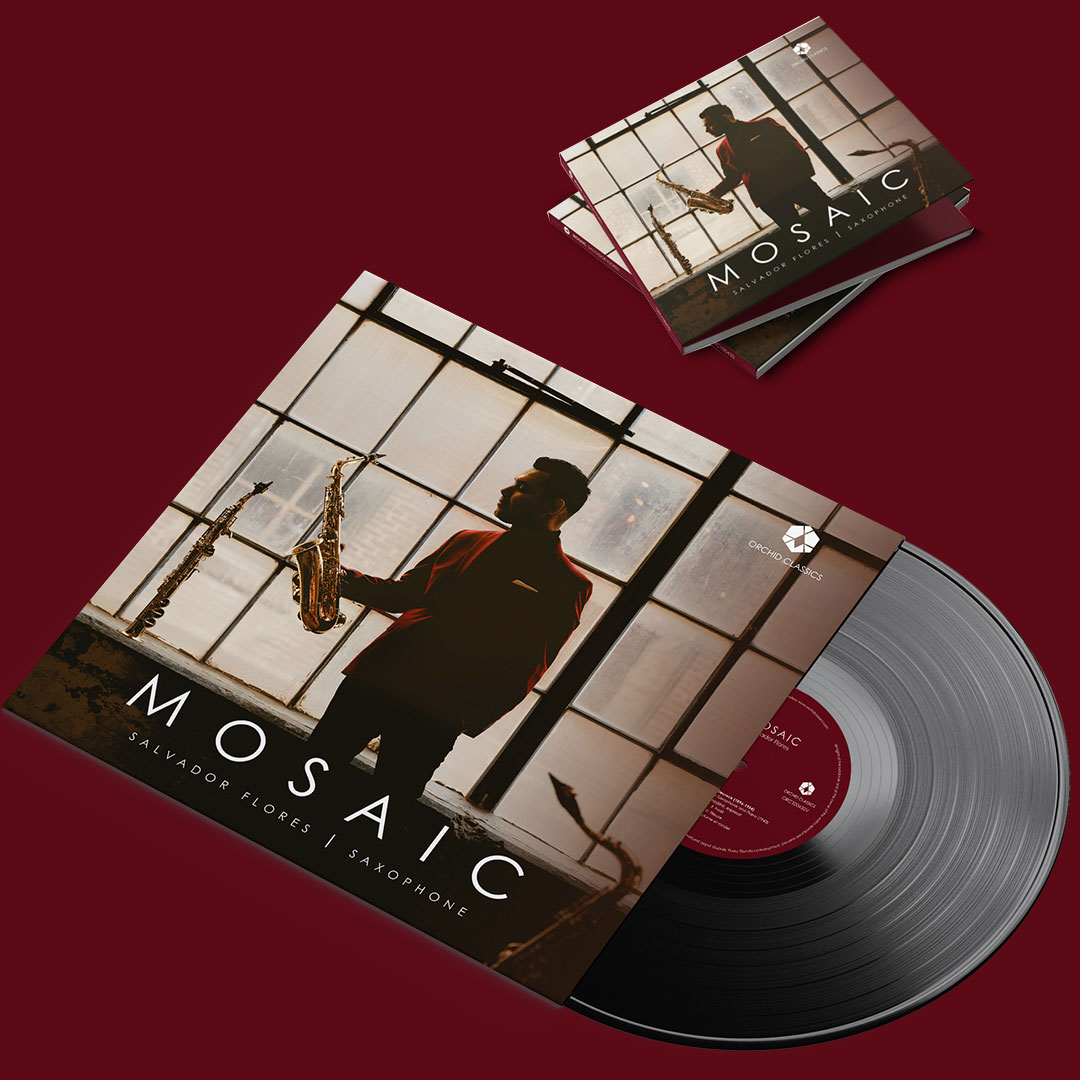
MOSAIC
Salvador Flores, saxophone
CD / double vinyl
Release Date: 12th June
ORC100432

Fernande Decruck (1896-1954)
Sonata in C# for Alto Saxophone and Piano
1. I Très modéré, expressif
2. II Noël
3. III Fileuse
4. IV Nocturne et rondel
Alex Tedrow (b.1999)
5. Andisol
Salvador Flores (b.1999)
6. Interlude I
Maurice Ravel (1875-1937)
7. Pièce en forme de Habanera
Salvador Flores
8. Interlude II
Astor Piazzolla (1921-1992)
9. Tango Études: No. 3, Molto marcato e energico
Salvador Flores
10. Interlude III
Álvaro Carrillo (1919-1969)
11. Sabor a Mí
João Donato (1934-2023)
12. Minha Saudade
George Gershwin (1898-1937)
13. Summertime
E rroll Garner (1921-1977)
14. Misty
Salvador Flores
15. Interlude IV
McCoy Tyner (1938-2020)
16. Passion Dance
Salvador Flores, soprano, alto & tenor saxophones
Liz Ames, piano
Nadia Pessoa, harp
Wilson Childers, trumpet
Melinda Rose, vocals
Frenchy Romero, piano
Jan Knutson, guitar
Jonathan Keith, double bass
Eric Tapper, drums
I am thrilled to share with you my solo debut album, Mosaic, a project that I have been dreaming up for many years. Someone once told me a solo debut album should be a portrait of the artist – a musical image that displays who they are, where they are from, and why they do what they do. For me, that portrait is made up of many pieces, a Mosaic of experiences, stories, and sounds.
My musical career has been a bit of a roller coaster, shaped by a wide variety of musicians, genres, and experiences. Sharing the stage with the incredible musicians of the National Symphony and Opera Orchestras, playing for hundreds of thousands of people on national tours with Mexican norteño groups, and even performing for church services amidst many push-ups I did at the command of my Drill Sergeants while at U.S. Army Basic Combat Training, are just a few of the many experiences my instrument and I have shared. For my solo debut album, I aspired to capture this story in a single musical portrait.
Mosaic recounts this story through the multi-faceted voice of the saxophone. From Fernande Decruck’s stunningly captivating Sonata in C# for Alto Saxophone and Piano to Álvaro Carrillo’s romantic bolero Sabor a Mi, each individual track represents not only a small slice of my life, but yet another reason why I fell in love with this instrument. Glued together by my short compositions and improvisational interludes, the works jointly illustrate an image of my experiences and what I believe makes the saxophone so incredibly special.
Every musician involved in this project has my deepest admiration and gratitude. From colleagues I met during my studies at the University of Michigan to my collaborators serving alongside me in the U.S. Army Band “Pershing’s Own,” I am honored to showcase this cast of world-class artists and their extraordinary dedication to this project.
I hope you, the listener, enjoy this project as much as I’ve enjoyed putting it together. Whether you experience this portrait of sounds and stories as a whole or as individual pieces, I hope the music of Mosaic resonates with you as deeply as it does with me.
__________________
Born in 1896, the young Fernande Decruck was a remarkable child prodigy, earning numerous prizes at the Toulouse Conservatory after enrolling at just eight years old. She later applied – and was immediately accepted – to the Paris Conservatory, where she studied with distinguished teachers including Xavier Leroux and Jean Gallon. She also began studying organ with the newly appointed Paris Conservatory Professor of Organ Marcel Dupré, through whom she discovered the art of improvisation. In her early thirties, she was invited to perform an extensive concert tour in the United States, notably New York City.
Around the same time, her husband Maurice Decruck was appointed Principal Double Bassist of the New York Philharmonic and also served as one of the ensemble’s earliest official solo saxophonists under the direction of Arturo Toscanini. Shortly thereafter, Fernande began composing more prolifically for the saxophone, ultimately writing her Sonata in C# for Alto Saxophone and Piano, one of the most beloved additions to the classical saxophone repertoire. Dedicated to Marcel Mule, Professor of Saxophone at the Paris Conservatory, the Sonata is written in four movements and displays an almost impressionistic language. The first movement unfolds with a sense of mystery that gradually gives way to a warm, pastoral lyricism. The second movement, entitled “Noël”, makes reference to “Noël Nouvelet” (“A New Song for Christmas”), a traditional French Christmas carol which celebrates the birth of Jesus Christ. In place of a traditional scherzo, the third movement, “Fileuse” (“Spinning”) features gentle yet virtuosic interplay between the saxophone and piano. The final movement unfolds in two sections: a shadowed Nocturne, evocative of a funeral march, which transitions seamlessly into the following Rondel, driving the work toward a triumphant conclusion.
Alex Tedrow, originally from Shoals, Indiana, is a multi-award-winning composer, arranger, and educator who serves as a Staff Arranger for the U.S. Army Band “Pershing’s Own.” In 2024, he embarked on a journey to Iceland and the Faroe Islands with Salvador, during which they experienced an erupting volcano (from a safe distance). When approached by Salvador for a new commissioned work, his mind immediately returned to this shared, transformative experience.
Written for alto saxophone and piano, Andisol explores the eternal cycle of creation. Deep, rumbling piano chords evoke the immense power generated by an actively erupting volcano, while sections of beauty and tranquility unveil the vast, eternal expanse of the cycle. Dissonant running note structures imitate the violent bursts of lava ejected from these powerful events. A byproduct of this is Andisol, a nutrient-rich, fertile soil on which new life may begin. As life continues to evolve and adapt, Andisol symbolizes this newly formed layer upon which future beauty will emerge. Ending with a musical question mark, the work closes with a tinge of dissonance atop a gentle major chord – a nod to the resetting cycle of creation.
Maurice Ravel, like many other French composers of this period, was deeply fascinated by the music of Spain. Influenced by the distinctive musical characteristics of the popular Habanera, a sultry dance style that traveled from Cuba to Spain, Ravel composed his 1907 vocalise étude Pièce en forme de Habanera, originally written for bass voice and piano. Arranged for a wide variety of instruments and ensembles, his Pièce en forme de Habanera remains a staple of the classical music repertoire, celebrated for its elegant blend of French impressionism and Latin-inspired rhythm.
Born in 1921 to immigrant Italian parents, Astor Piazzolla was an Argentine composer and Bandaneón virtuoso known for having re-invented the traditional tango into the widely popularized Nuevo Tango – a bold fusion of tango, jazz, and classical music. Amongst his many compositions was the celebrated set of Tango Études written in 1987 for Solo Flute (or solo violin), which he shortly adapted for solo alto saxophone (or solo clarinet) in collaboration with saxophonist Claude Delangle. Echoing the requests of flautists, Delangle asked the composer if he might write a harmonized edition of the études, shortly receiving the following reply:
“Dear friend, I finished the piano part of the Etudes Tanguistiques for saxo alto and piano… Good luck to Mr. Delangle and please tell him to forgive my music handwriting. I was in a hurry and could not do it better… Please let me know if you received the music.”
– Astor Piazzolla
Days later, a handwritten piano accompaniment manuscript arrived, remaining undeciphered for years due to its nearly illegible notation. As a result, this harmonized version of the set, including the fiery third étude Molto marcato e energico, was not premiered until long after Piazzolla’s death in 1992.
Álvaro Carrillo was a highly celebrated composer, guitarist, and singer-songwriter, born in Oaxaca, Mexico in 1919. His compositions shaped the Latin music landscape, performed by iconic artists such as Vicente Fernández, Luis Miguel, and even Frank Sinatra. In 1958, Carrillo composed Sabor a Mí (“Essence of Me”), inspired during a candlelit dinner with his fiancée Ana María Incháustegui. When a kiss from Carrillo carried the lingering taste of liquor, Ana asked him to stop drinking, to which he replied, “What you carry in your mouth is not the taste of liquor… but the essence of me.” Both poets and artists at heart, they instantly recognized the phrase’s artistic potential, and Carrillo soon began composing the song. A timeless story of enduring love, Sabor a Mí tenderly expresses the depth of affection between two souls so intertwined that even across the vast expanse of eternity, they continue to carry one another’s essence within their hearts.
Born in 1934, João Donato was a legendary Brazilian jazz pianist, trombonist, accordionist, and composer whose musical style defied boundaries. Praised by artists such as Antônio Carlos Jobim and João Gilberto, Donato was renowned for seamlessly fusing genres and was no stranger to trying new grooves and textures. One of Donato’s bossa nova compositions, Minha Saudade, translates roughly to “My Longing.” Lyrics were later added by the famous João Gilberto, transforming the tune into an intimate narrative of unrequited longing of a previous partner following separation.
George Gershwin, born in 1898 in Brooklyn, New York to Russian Jewish immigrants, remains one of the most significant and influential American composers of all time. Known for lacking in studious qualities as a child, Gershwin left school at the age of 15 to work as a Tin Pan Alley song plugger, likely one of the youngest in the field. Over the following years, Gershwin would compose an extraordinary collection of American classics, including Swanee, I Got Rhythm, Rhapsody in Blue, and It Ain’t Necessarily So. Among his many memorable numbers, none has resonated more deeply with audiences than Summertime. This jazz-inflected lullaby, sung by the young mother Clara to her child under the evening twilight, expresses themes of resilience, escape from hardship, and hope for a brighter future.
Porgy and Bess – and thus Summertime – was composed on a 1933 Steinway Model A piano housed in Gershwin’s mother’s Manhattan apartment after his death. That instrument was later gifted to the University of Michigan Gershwin Initiative by his nephew, Marc Gershwin. This very piano is featured in Mosaic’s thirteenth track, Summertime, in an arrangement by Salvador Flores inspired by his friends’ performances and the composition’s rich history.
One of the most influential jazz musicians of his generation, pianist and composer Erroll Garner was born in Pittsburgh, Pennsylvania in 1921. He is perhaps best known for his iconic tune entitled Misty, recorded by artists such as Ella Fitzgerald, Stan Getz, Laufey, and Samara Joy. Garner recounted that the tune was inspired during a long airplane flight, where he gazed at drifting clouds just outside of his window while thinking about his wife. Because he couldn’t read or write music, he committed the tune to memory until he could record and transcribe it. Performed here on tenor saxophone and harp, this arrangement draws inspiration from many celebrated interpretations of the tune. The warm, hazy sound of the saxophone combined with the harp’s delicate, airy texture creates a dreamy atmosphere, evoking the image of drifting clouds – the very scene that sparked the creation of Misty.
A legendary pioneer of modern jazz, McCoy Tyner revolutionized the genre through his explosive rhythmic ideas and sophisticated harmonic language. Born in Philadelphia, Pennsylvania in 1938, Tyner is widely recognized as one of the most pivotal figures in the development of modal jazz, a style that pushed the boundaries of bebop characterized by quartal harmony, block chords, and a forward-driving energy. A cornerstone modal jazz album featuring some of his most brilliant work is entitled The Real McCoy, his first solo release on the Blue Note record label following his departure from the John Coltrane Quartet. Kicking off the album is a tune entitled Passion Dance, a fiery work that immediately captures the listener’s attention and exemplifies Tyner’s unmistakable compositional voice. Heard in Mosaic is a rendition of this tune, incorporating elements of free jazz while preserving the modal framework that has helped cement Passion Dance into the list of timeless jazz standards.
Interwoven throughout the album are various interludes composed and improvised by Salvador Flores, serving as small transitional moments that provide the improvisatory glue binding the album together. Each of the interludes is shaped by their surrounding context, from whimsical elegance to fiery passion, guiding the listener from one work to the next in a seamless musical portrait that is Mosaic.
© Salvador Flores, 2025
Salvador Flores
Composer and Soprano, Alto & Tenor saxophone
Originally from Houston, Texas, Salvador Flores is a saxophonist, performer, and educator based in Washington D.C. Recognized as one of the leading saxophonists of his generation, he has been featured multiple times on America’s most popular classical music radio program, Performance Today, reaching millions of listeners nationwide.
Flores has received numerous prestigious awards, including First Prize in the 2020 North American Saxophone Alliance Solo Competition and Gold Medalist in the 2021 Fischoff Chamber Music Competition. He was also named the second saxophonist to receive the University of Michigan’s distinguished Albert A. Stanley Medal, following his teacher and GRAMMY-winning saxophonist, Timothy McAllister.
He currently serves as a member of the U.S. Army Band “Pershing’s Own” saxophone section and is an active freelancer throughout the National Capital Region, where his work ranges from maintaining a private studio of young students to sharing the stage with the National Symphony and Opera Orchestras. In addition to his classical engagements, Flores has toured and recorded extensively with many norteño music groups in virtually every major city in the United States, most notably Kikin y Los Astros, Conjunto Azabache, and La Firmeza Norteña.
He holds degrees in Saxophone Performance and Improvisation from the University of Michigan, where he studied with saxophonists Timothy McAllister and Andrew Bishop, and is a Yamaha Performing Artist.
similar Artists & Albums