Artist Led, Creatively Driven
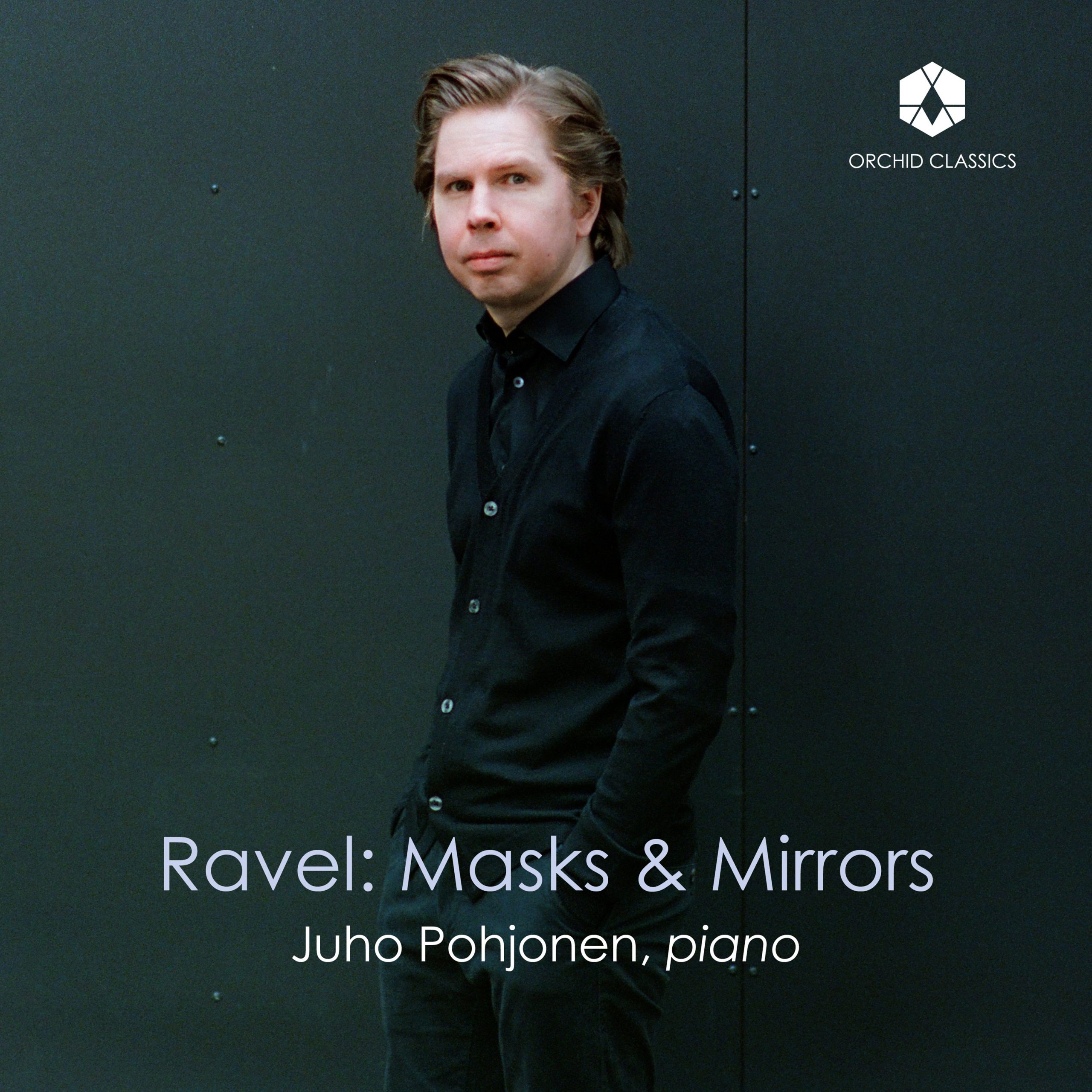
Ravel: Masks & Mirrors
Juho Pohjonen, piano
Release Date: Sept 18th
ORC100492

Maurice Ravel (1875 – 1937)
1 Menuet antique (1895)
2 Pavane pour une infante défunte (1899)
3 Jeux d’eau (1901)
Gaspard de la nuit (1908)
4 Ondine
5 Le gibet
6 Scarbo
Le tombeau de Couperin (1914–1917)
7 Prélude
8 Fugue
9 Forlane
10 Rigaudon
11 Menuet
12 Toccata
Juho Pohjonen, piano
A satisfying phrase rarely arrives on the first attempt. In my practice it emerges from a quieter process: trying out alternatives, comparing them against one another, listening for the one that takes hold. Any phrase admits of countless valid readings; only a few have a claim on me in any given moment. The work is finding those few.
I have come to recognise something of this method in Ravel. He was a devoted reader of Edgar Allan Poe’s Philosophy of Composition, the essay in which Poe argued that great art is not the issue of spontaneous passion but of patient calculation – that the artist works backward from intended effect, choosing each element for what it will do. Stravinsky famously called Ravel a Swiss watchmaker. The phrase was meant as a barb; it has since been embraced as a compliment. Ravel’s music is the work of a maker who selects and arranges with extraordinary precision, in the service of colour, narrative, architecture, and feeling all at once.
Every piece on this disc is at once a mask and a mirror. The Menuet antique and the Pavane wear the costume of an imagined past; Jeux d’eau answers Liszt with a new language for the piano; Gaspard de la nuit gives Bertrand’s Romantic phantasmagoria a strict formal scaffolding; Le Tombeau de Couperin clothes the grief of the First World War in the steps of a Baroque dance suite. Each borrowed form was a chosen constraint to push against, and each reflects, however old the costume, an unmistakably modern hand. The most striking case is the last: a memorial for friends killed in the war that refuses to sound like mourning. The dead, Ravel wrote, are sad enough in their eternal silence.
This is my second solo recital for Orchid Classics. The first, Visionaries of the Keyboard, reached across two centuries to put Rameau and Scriabin in dialogue. This one stays inside a single composer, but it crosses twenty-two years and one historical rupture. I hope these five pieces, heard together, repay the same kind of listening they ask of us.
The five works on this disc span twenty-two years of Maurice Ravel’s piano writing, from a Conservatoire student of twenty to a forty-two-year-old veteran emerging from the First World War. The mature Ravel is already audibly at work in the first piece. What changes across the span is not the method but its purpose – culminating, after the war, in a memorial whose bright surface belies its grave intent.
The Menuet antique of 1895 was Ravel’s first published composition, dedicated to and premiered by the Catalan pianist Ricardo Viñes, who would also give the first performances of the Pavane, Jeux d’eau and Gaspard de la nuit. Conceived as a homage to Chabrier’s Menuet pompeux, it wears the costume of the eighteenth century only loosely. The “antique” character comes largely from the flattened leading notes at its cadences, but the piece opens with a striking dissonance that no eighteenth-century minuet would have countenanced, and that single gesture already marks the young Ravel’s distance from his model. In the central musette section, the two principal themes – the stern and uncompromising menuet theme and the more lyrical musette theme – are made to sound at the same time, fitted together so that they harmonise perfectly. This piece of constructional ingenuity occurs at the very end of the musette, and the older Ravel would revisit it, twenty years later, in the Menuet of Le Tombeau de Couperin. Even at twenty, Ravel was reaching for the elements he would keep: the modal cadence, the piquant dissonance, the contrapuntal sleight of hand.
Pavane pour une infante défunte (1899) is the most familiar piece on this disc. Its title is also the most misleading: Ravel said the words were chosen for their sound, and when a pianist once played the work too slowly he told him drily that it was “Pavane for a dead princess, not a dead Pavane for a princess.” The piece does not mourn a real historical figure; it imagines an Infanta out of a painting by Velázquez, danced as the Spanish court might once have danced. Ravel dedicated the work to his patron the Princesse Edmond de Polignac, heiress to the Singer sewing-machine fortune and one of the great Parisian salonnières of the era. He later grew impatient with the piece’s immense popularity; in a 1912 review of another pianist’s performance, he diagnosed its “rather poor form” and the “too obvious” influence of Chabrier. His own piano-roll recording from 1922 is markedly quicker than the elegiac tempo that has become customary, suggesting a Pavane not for lament but for movement, much closer in spirit to the courtly dance it imagines.
Jeux d’eau, completed in November 1901 and dedicated to Gabriel Fauré, marks the moment Ravel found a new pianistic idiom essentially of his own making. The piece predates by several years the published water-pieces of Debussy that are often heard as its companions, and it stands as Ravel’s most groundbreaking act of invention at the keyboard: a texture built from cascading arpeggios, whole-tone inflections, and the luminous major-seventh sonority that frames the entire work. The score carries an epigraph from Henri de Régnier: Dieu fluvial riant de l’eau qui le chatouille – river god laughing at the water that tickles him. The “river god” is the goddess Latona, sitting nude on the back of a tortoise; the fountain is the Latona Fountain at Versailles. Behind the French inspiration, however, stood a foreign model: Liszt’s Les jeux d’eaux à la Villa d’Este. Ravel admired Liszt openly, refused Wagner, and answered the question of how Jeux d’eau should be played with: “like Liszt, of course.” Yet what he made of the Lisztian model was something the older composer could not have foreseen, and what came after – Debussy’s Reflets dans l’eau, Ravel’s own Ondine, the whole twentieth-century vocabulary of pianistic water – flows from these five minutes of music. When Henriette Faure played the work for Ravel after the war he complained that her fountains were sad ones. The river god, he insisted, is laughing.
Gaspard de la nuit (1908) takes its title and its three movements from the posthumous collection of prose poems by Aloysius Bertrand, Fantaisies à la manière de Rembrandt et de Callot. Bertrand (1807–41) is now recognised as the inventor of the French prose poem and an acknowledged influence on Baudelaire; Ravel was drawn to the Rembrandt chiaroscuro and Callot grotesquerie that govern his pages. “Ondine” returns to the water of Jeux d’eau, but the resemblance is largely on the surface: where the earlier piece had set out to evoke an inanimate fountain catching the light, “Ondine” gives the water a voice and a will: a nymph who sings to seduce a mortal observer down into her lake. “Le Gibet” is dominated by a tolling B♭ that sounds without cease over 150 times, marked una corda throughout: Ravel wanted the bell distant, on the horizon, framing Bertrand’s image of a hanged man’s corpse swinging in a reddening sunset. The observer in the poem strains to identify the persistent sound; the music is almost motionless, and what moves is only the impression of light and shadow. “Scarbo” – the nocturnal goblin who flits and scratches at the curtains of a sleeper’s bed – Ravel intended to be more difficult than Balakirev’s Islamey, then the byword for unplayable virtuosity. He admitted later: “I wanted to make a caricature of romanticism. Perhaps it got the better of me.” At the centre of the poem stands an extraordinary image: the dwarf, thought vanished, suddenly growing between the moon and the observer “like the bell-tower of a Gothic cathedral.” Ravel answers this in pianistic terms: vast eruptions of sound punctuated by abrupt full silences, the creature waxing into massive presence and shrinking back into nothing.
Le Tombeau de Couperin, composed across the years of the war (1914–17), is the disc’s gravest work. Ravel had served as an ambulance driver near Verdun; Marguerite Long, who gave the premiere on 11 April 1919, found him afterwards “depressed, thin and suffering from neurasthenia.” Each of the six movements bears a dedication to a friend killed in the war: the Prélude to Jacques Charlot, who had transcribed Ravel’s Ma mère l’Oye; the Fugue to Jean Cruppi; the Forlane to the Basque painter Gabriel Deluc; the Rigaudon to the brothers Pierre and Pascal Gaudin, killed by the same shell on their first day at the front; the Menuet to Jean Dreyfus, at whose family’s home Ravel finished the work; and the Toccata to the musicologist Joseph de Marliave, husband of Marguerite Long.
The suite departs from the standard form of a Baroque dance suite: a Prelude – a moto perpetuo in the manner of the French harpsichord school – and a Fugue stand at the head, before the three central dances (Forlane, Rigaudon, Menuet) and the closing Toccata. The Fugue is unusual in Ravel’s output, and unusual in itself: its three voices do not behave as independent agents but seem to flock around a central gravitational pull, as if the composer were drawing each voice with the same brush.
Of the three dances, the Forlane is the most enigmatic. An eighteenth-century Venetian form Ravel had encountered while transcribing a forlane from Couperin’s Concerts royaux, it had unexpectedly become topical in 1913 when Pope Pius X recommended the dance to Catholic society as a wholesome replacement for the tango. Ravel wrote drily to a friend that he would “see about getting it danced at the Vatican.” Yet the movement that came out of this circumstance is among the most ambiguous Ravel ever wrote: its harmonies deny the ease the dance-form suggests, its cadences never quite resolve the tension beneath them, and the result is at once courtly, tender, and shadowed.
After the boisterous, vivacious Rigaudon, the Menuet returns to the contrapuntal device of the Menuet antique and takes it one step further. Where the young Ravel had let the trio close and the menuet reprise begin cleanly afterwards, the older Ravel overlaps the seams: the menuet enters eight bars before the musette has finished, and lets the reprise depart from the original key, modulating up a major third before regaining it only at the close of an extended coda. The reprise in the Menuet antique had been an exact return; here the return is hard-won, and arrives changed by the journey. The Toccata that brings the suite to a brilliant close turns once more to the flattened cadences of an imagined antiquity – the same device that opened the Menuet antique twenty-two years before, now harnessed to propel the music forward rather than to look back.
Juho Pohjonen
Juho Pohjonen is regarded as one of today’s most compelling pianists, admired in particular for his interpretations of Scandinavian repertoire and for the refinement and insight he brings to programmes ranging from the Baroque to the present day. He studied at the Sibelius Academy in Helsinki under Meri Louhos and Hui-Ying Liu-Tawaststjerna, and was selected by Sir András Schiff as the winner of the Klavier Festival Ruhr Scholarship.
He has appeared as a soloist with major orchestras including the Cleveland Orchestra, Los Angeles Philharmonic, San Francisco Symphony, and the Philharmonia Orchestra in London, working with conductors such as Marin Alsop, Marek Janowski, and Osmo Vänskä. On the recital stage he has performed at Carnegie Hall, the Kennedy Center, and Wigmore Hall, and at festivals including Lucerne, Marlboro, and Savonlinna. He enjoys a close relationship with the Chamber Music Society of Lincoln Center, where he is an alumnus of the Bowers Program, and is a founding member of the Sibelius Piano Trio.
His discography on Orchid Classics includes Visionaries of the Keyboard, exploring connections between Rameau and Scriabin, and Unspoken, a duo recording with Wu Qian of music by Westenholz, Chaminade, Beach, and Mendelssohn. He is also the developer of MyPianist, an AI-driven app providing interactive piano accompaniment.
similar Artists & Albums