Artist Led, Creatively Driven
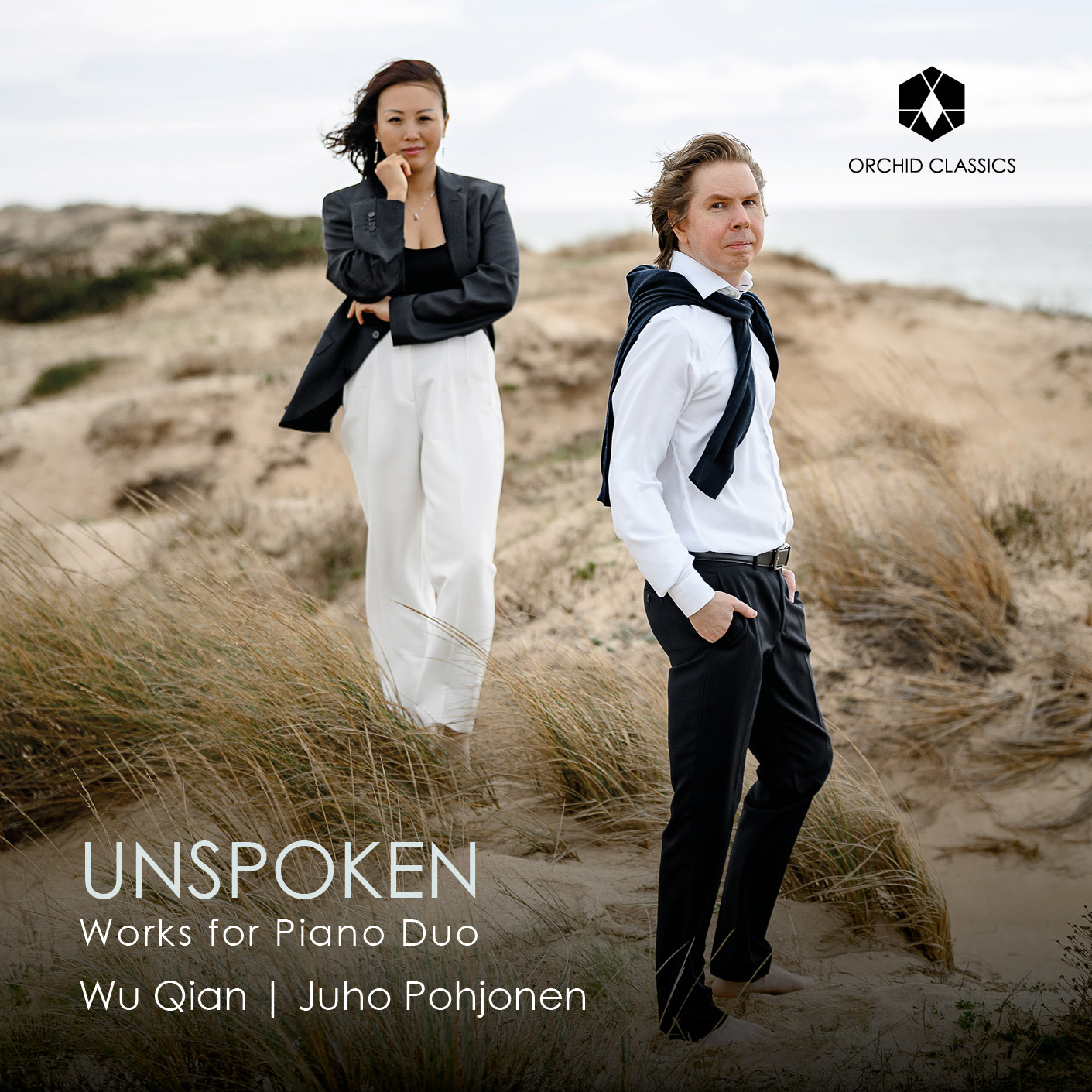
UNSPOKEN
Wu Qian, piano
Juho Pohjonen, piano
Release Date: May 8th 2026
ORC100452

Sophia Maria Westenholz (1759-1838)
Sonata for Piano 4 Hands, Op. 3
1. I Allegro
2. II Andante grazioso
3. III Allegro molto vivace
Felix Mendelssohn (1809-1847)
4. Andante and Variations, Op. 83a
5. Andante and Allegro brillant, Op. 92
Cécile Chaminade (1857-1944)
Pièces romantiques, Op.55
6. Primavera
7. La chaise à porteurs
8. Idylle arabe
9. Sérénade d’automne
10. Danse hindoue
11. Rigaudon
Amy Beach (1867-1944)
Summer Dreams, Op. 47
12. The Brownies
13. Robin Redbreast
14. Twilight
15. Katy-dids
16. Elfin tarantelle
17. Good night
Wu Qian, piano
Juho Pohjonen, piano
A Note from the Performers
Our musical partnership began over a decade ago, a happy collision of paths for which we owe a debt of gratitude to the Chamber Music Society of Lincoln Center. Since that first introduction, the piano duet has held a special place in our artistic lives. It is perhaps the most intimate form of chamber music – two musicians sharing a single instrument, breathing and moving in a shared space. After years of collaboration, we felt a compelling desire to capture this synergy and leave our own mark on this unique genre.
The seed for this album was planted by our shared love for Felix Mendelssohn. We knew we wanted to record his two masterworks for four hands – the only significant duets he wrote – which balance domestic intimacy with stage-ready brilliance. But the program took its true shape through a chance discovery: the music of Sophia Maria Westenholz.
We were immediately taken by the strength, virtuosity, and sparkling lyricism of her Sonata. It was a revelation to find such a confident voice from the classical era that had been largely lost to history. Her artistry inspired us to expand our horizon and dedicate the rest of the album to remarkable female composers. From the Parisian charm of Chaminade to the American naturalism of Beach, we wanted to celebrate these distinct voices and share their achievements with the world.
This recording is a labor of love – a celebration of friendship, discovery, and the joy of making music together. We hope you enjoy listening to it as much as we enjoyed creating it.
Wu Qian & Juho Pohjonen
Sophia Maria Westenholz (1759-1838)
Sonata for Piano 4 Hands in F Major, Op. 3
Sophia Maria Westenholz occupies a unique – and unjustly neglected – position in musical history. While virtually unknown today, she was a formidable presence in the late 18th century. A singer and pianist at the court of Ludwigslust, she effectively assumed the duties of Kapellmeister following her husband’s death – a role of leadership exceptionally rare for a woman of her era. Her Sonata for Piano 4 Hands in F Major, Op. 3 (c. 1806), demonstrates a command of form that bridges the Classical style of Mozart with emerging Romantic textures.
The opening Allegro begins with a commanding unison, establishing a tone of orchestral breadth. While the writing adheres to the conventions of the time – often favoring the Primo with brilliant passagework – the architecture is sophisticated. Most notable is the daring development section, where Westenholz leads the listener on a harmonic journey through a kaleidoscope of remote keys before settling in a resonant D-flat major – a tonal excursion anticipating the landscapes of Schubert.
The Andante grazioso in B-flat major is a study in contrasts. A tender, lyrical melody reflects the composer’s vocal background, but is soon interrupted by a dramatic middle section of surprising weight; characterized by repeated chords and terraced dynamics, it suggests the grandeur of a symphonic transcription. The sonata concludes with an Allegro molto vivace, a spirited Rondo in 6/8 driven by propulsive energy. The substantial central episode acts as a second development, cycling through various moods before bringing the work to a virtuosic close.
Felix Mendelssohn (1809-1847)
Andante and Variations, Op. 83a
Andante and Allegro brillant, Op. 92
For Felix Mendelssohn, the piano duet was a genre deeply intertwined with personal relationships. While he created many arrangements of his symphonies, he wrote only two large-scale original works for four hands: Op. 83a and Op. 92.
The Andante and Variations in B-flat Major, Op. 83a (1844), is a substantial reimagining of his solo Variations (Op. 83), composed specifically for performance with his sister Fanny at her Sunday musicales. It comprises a theme, eight variations, and a coda. The theme, marked Andante tranquillo, is shared conversationally between the players. As the variations unfold, the texture becomes increasingly elaborate, traversing a wide emotional spectrum. Notable is the sixth variation, which shifts into the parallel G minor to evoke the somber tread of a funeral march. The intensity peaks in the eighth variation, cast in the stormy key of B-flat minor, before the music brightens for a brilliant coda that transforms the gentle opening theme into a display of effervescent energy.
In stark contrast stands the Andante and Allegro brillant, Op. 92 (1841). This work was intended not for the salon, but for the stage; Mendelssohn wrote it to perform with Clara Schumann at a benefit concert for the Leipzig Gewandhaus Orchestra. Interestingly, for over a century, this piece was published only as a single movement (Allegro brillant). The opening Andante – one of Mendelssohn’s most beautiful lyrical creations – was omitted from the first posthumous edition and only reunited with the fast movement in 1994. We present the work in its complete form.
The Andante in A major functions as a “Song Without Words” for two players, creating a necessary calm before the eruption of the Allegro brillant. True to its title, the fast movement is a tour-de-force of technical dexterity, filled with rapid, interlocking figurations. Unlike the domestic variations, this is concert music of the highest order, demanding that two distinct musical personalities merge into a single, virtuosic entity.
Cécile Chaminade (1857-1944)
6 Pièces romantiques, Op. 55
By 1900, Cécile Chaminade was a global phenomenon – a favorite of Queen Victoria and so popular in the United States that fan clubs sprang up across the country and chocolates were even branded with her name. While history later marginalized her as a creator of “salon music,” the 6 Pièces romantiques, Op. 55 (1890), reveals her mastery of the “character piece,” evoking specific scenes with precision and elegance.
The suite functions as a musical travelogue. It opens with Primavera, a bubbling evocation of spring, before shifting to the 18th century with La chaise à porteurs (The Sedan Chair). Here, Chaminade creates a witty Rococo pastiche, mimicking the trotting gait of porters carrying a sedan chair with crisp articulation that conjures images of powdered wigs and courtly humor.
The journey continues to the exoticized East with Idylle arabe, using bass drones and winding melodies to evoke a desert atmosphere. This is followed by the Sérénade d’automne. Marked semplice, the Primo sings a heartfelt melody over a gentle accompaniment, interrupted by a central section where rhythmic, guitar-like strumming drives a dancelike, coquettish interlude. The «Oriental» theme resumes with Danse hindoue. In a fascinating parallel to Sir William Jones, who as early as 1792 identified Indian music as fundamentally modal, Chaminade employs the Aeolian mode here rather than the cliché of augmented intervals. This creates a sound world that feels ancient and elemental, driving a dance of fierce rhythmic energy. The collection concludes with Rigaudon, returning to the French Baroque style with festive grandeur.
Amy Beach (1867-1944)
Summer Dreams, Op. 47
Amy Beach holds a pioneering place in American music history, yet Summer Dreams, Op. 47 (1901), turns away from symphonic grandeur to explore the intimate world of childhood. Dedicated to her niece, Marion, these six duets are each prefaced by a poetic epigraph, transforming each miniature into a vivid musical story.
Beach was a synesthete who associated musical keys with colors. Combined with the poetry, the suite becomes a multi-sensory experience. The opening The Brownies is a playful scherzo. Prefaced by lines from the close of Shakespeare’s A Midsummer Night’s Dream, the music inhabits the hush of that final scene, with scurrying figures and flickering articulations evoking the “glimmering light” of sprites hopping through a sleeping house.
Nature takes center stage in Robin Redbreast. Cast in G major – a key the synesthetic composer perceived as the color red – the upper register mimics the bird’s call against a rolling accompaniment. Beach provides her own verse for Twilight, a study in atmosphere set in a flat key (associated with darkness) to capture the deepening shadows.
For Katy-dids, Beach turns to Walt Whitman. The music relentlessly mimics the insect working its “chromatic reed,” creating a hypnotic summer soundscape. The energy spikes in Elfin Tarantelle, where Beach returns to Shakespeare to depict “moonshine revelers” in a breathless dance. The suite concludes with Good Night, a lullaby inspired by the poetry of Arthur John Lockhart, where the complexity melts away into a peaceful, fading farewell.
The Brownies
Through the house give glimmering light
By the dead and drowsy fire,
Every elf and fairy sprite
Hop as light as bird from brier.
– Shakespeare
Robin Redbreast
In country lanes the robins sing,
Clear-throated, joyous, swift of wing.
From misty dawn to dewy eve
(Through cares of nesting vex and grieve)
Their little heart-bells ring and ring.
– Lüders
Twilight
The birds have hushed themselves to rest
And night comes fast, to drop her pall
Till morn brings life to all.
– Amy Beach
Katy-dids
The katy-did works her chromatic reed
On the walnut tree over the well.
– Whitman
Elfin tarantelle
Fairies, black, gray, green, and white,
You moonshine revelers, and shades of night.
– Shakespeare
Good night
Goodnight! The crimson scented rose
Droops low her pretty head,
And the little grasses long ago
Their evening prayers have said.
Night’s starry eyes are blinking
At the moonbeams silvery light,
While the lily hides her golden heart,
And whispers soft. – “Goodnight.”
– Lockhart
Wu Qian
Piano
Born in Shanghai, Wu Qian began her training at the Shanghai Conservatory before moving to England to study at the Yehudi Menuhin School and the Royal Academy of Music. She has since established herself as a versatile artist, appearing as a soloist in venues such as the Wigmore Hall and Royal Festival Hall in London, the Amsterdam Concertgebouw, and the Kennedy Center in Washington D.C. Her orchestral engagements have included performances with the Philharmonia Orchestra, the Konzerthausorchester Berlin, and the Brussels Philharmonic.
A dedicated chamber musician, Qian is a founding member of the Sitkovetsky Trio, with whom she has received the Nordmetall-Ensemble Prize and won the Trio de Trieste Competition. She is also a recipient of the 2016 Lincoln Center Emerging Artist Award. Her collaborative work has led to critically acclaimed releases on the BIS and Wigmore Hall Live labels, covering repertoire from Beethoven and Mendelssohn to contemporary commissions. Beyond her performing career, she is the co-founder and director of the Surrey Hills International Music Festival. Her solo discography includes a debut recital of Schumann, Liszt, and Prior on the Dal Segno label.
Juho Pohjonen
Piano
Celebrated as one of Finland’s most exciting instrumentalists, Juho Pohjonen is known for his interpretation of Scandinavian music and a broad repertoire ranging from Bach to Salonen. A graduate of the Sibelius Academy under Meri Louhos and Hui-Ying Liu-Tawaststjerna, he was selected by Sir András Schiff as the winner of the Klavier Festival Ruhr Scholarship. He has appeared as a soloist with major orchestras including the Cleveland Orchestra, Los Angeles Philharmonic, San Francisco Symphony, and the Philharmonia Orchestra in London.
Pohjonen enjoys a close relationship with the Chamber Music Society of Lincoln Center, where he is an alumnus of the Bowers Program. He frequently performs at festivals such as Marlboro, Bridgehampton and Santa Fe, and has given recitals at Carnegie Hall, the Kennedy Center, and Wigmore Hall. His discography features Visionaries of the Keyboard (Orchid Classics), which explores the connection between Rameau and Scriabin, as well as recordings with the Sibelius Piano Trio, of which he is a founding member. In addition to his performance work, Pohjonen is the developer of MyPianist, an AI-driven app designed to provide interactive piano accompaniment.
similar Artists & Albums