Artist Led, Creatively Driven
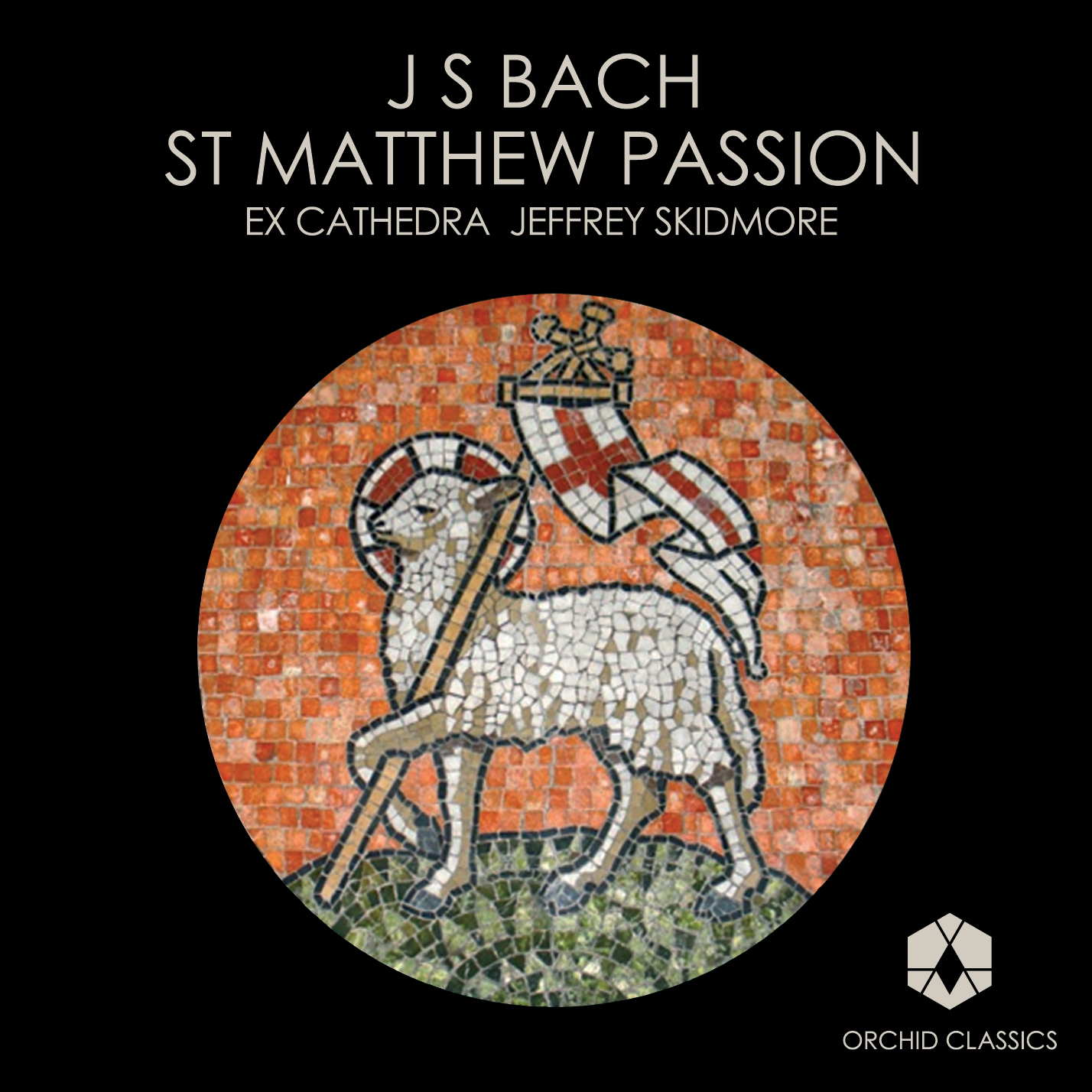
Bach
St Matthew Passion
Ex Cathedra
Jeffrey Skidmore
Release Date: November 2009
ORC100007

Johann Sebastian Bach
St Matthew Passion, BWV244
Sleeve Notes by Jeffrey Skidmore
English translation of the St Matthew Passion by Nicholas Fisher and John Russell
ST MATTHEW PASSION
Johann Sebastian Bach (1685-1750) is the most revered European composer of all time. Since the 18th century he has been praised by the leading composers from Mozart to Wagner, Haydn to Schoenberg, and a host of contemporary musicians. St Matthew Passion is his most extended work and is supremely rewarding to study, rehearse and perform. The work brings together Bach’s many fine musical qualities. It is a musical icon for the Christian world but at the same time expresses feelings common to the whole of humanity. The world currently seems to be searching for spiritual meaning and significance. It can surely be found in this music which has the potential for universal appeal and is an uplifting and inspiring example of what Man can achieve. It portays an extraordinary range of feelings: love, treachery, anger, injustice, sacrifice, betrayal, suffering, remorse, cruelty, helplessness and shame. All are consistently sustained and expressed in the most sublime and emotionally charged music imaginable.
St Matthew Passion is a complex work lasting from just under three hours to almost four depending on your preferred approach! It demands our full attention, and appreciation grows with every hearing. It is Bach’s largest score, calling for two four-part choirs, two orchestras of strings, with viola da gamba, and double-woodwind with flutes doubling recorders and the oboes doubling oboe d’amore and oboe da caccia, two continuo groups, a “ripieno” choir, and two choirs of expert soloists to represent the twelve named characters and who also sing songs reflecting on the action. Bach, with his extraordinary imagination, explores every musical possibility in this luxurious set-up.
The use of contemporary dance forms provides momentum and keeps our feet on the ground. The opening, melancholic but insistent siciliano invites the gathering crowd to witness the action; a passionate sarabande sensuously expresses the personal loss of a loved one at the beginning of the second part; and the flowing rondeau of the final chorus perfectly captures the flowing tears and optimistic anxiety that suggests this is not the end: a bitter-sweet conclusion to a monumental masterpiece!
Appreciation does not always come easily, but some movements have immediate impact, including the three magnificent and colossal framing choruses, the numerous dialogue movements in which soloists from Choir I interact with Choir II, and the scathing mockery of dramatic double-choir crowd interjections. The spine-chilling sparseness of the choral exclamation ‘Barabbas’, stripped of its orchestral support, and the short, achingly beautiful setting of ‘Truly, this was the Son of God’ also command our immediate response.
The chorale settings are placed at significant moments in the story and are poignant, personalised moments of involvement. There are five different harmonisations of the so-called “Passion” chorale which are performed here by the whole company.
The story is delivered in an expressive form of recitative by the Evangelist, who has many wonderful moments. He introduces the words of Jesus, whose music is highlighted by an accompaniment of strings, and the other characters, who sing short phrases which are some of Bach’s most perceptive invention.
The solo arias are mostly operatic in conception and are meditations on the action. Time seems to stand still, giving us opportunity to reflect on what has happened. These sections are often more demanding and searchingly challenging. Some can also make a life-changing first impression. I can clearly remember the performances in Birmingham Town Hall which I heard as a young teenager in the early 1960s. John Georgiadis’ exquisite violin solo in ‘Have mercy, Lord’ and John Shirley-Quirk’s majestic rendition of the final bass solo ‘Cleanse yourself, my heart’ stand out in my memory. It has taken longer to come to terms with other arias, but understanding grows with every listening and every performance.
St Matthew Passion was composed in the 1720s and first performed in1727. A further performance of this early version was given in 1729. A later version, the one with which we are familiar today, was given in 1736 and again in the 1740s. A beautiful score and parts have survived from this later version and the material provides valuable insight into performance practice. All singers and players performed from part-books, which contained only their single line of music. The Evangelist and Jesus were clearly expected to sing their part and choruses and arias in Choir I. Other solo parts are linked with a specific choir and the soloists also performed duties in their respective choirs. There were separate part-books for the two maids, Pilate’s Wife, the two priests, Caiaphas, Judas, Peter and Pilate. This was clearly part of Bach’s dramatic design.
In Bach’s day the Passion story was performed liturgically as part of Vespers on Good Friday, after a period of musical abstinence during Lent. Three of his settings of the crucifixion story survive and he had in his possession Handel’s Brockes Passion and several anonymous settings. Performances alternated annually between St Nicholas’ Church and St Thomas’. The contemporary Lutheran response in Leipzig was, however, not always favourable, and Bach’s Passion music was criticised at that time for its complexity, length and theatricality. The service began at 1.45pm and, in addition to the two parts of the Passion story separated by a sermon, it included three hymns, a motet, prayers and a biblical reading!
OUR APPROACH
In recent years Ex Cathedra has established a reputation for what is now perhaps sensitively called “historically informed performance practice”. It has never been our intention, however, to seek the “virtual reality” of a reconstruction, and, interesting as that process may be, it seems to me that music has to be for our time and that to simply travel back in time is to observe history and not necessarily understand it. The sound picture of this performance is from the eighteenth century with the use of period instruments, low pitch, and two small choirs with soloists stepping out from each choir. However, there is no attempt to reconstruct Bach’s first performance. For example, he almost certainly used fewer singers, they were all male, and most were even younger than the members of Ex Cathedra. His performance was in a church and we had the perfect acoustic and comfort of Symphony Hall, one of the world’s great concert halls. And of course his singers sang in their own language to a congregation who spoke the same language and were steeped in the melodic and linguistic imagery of that time. We can only hear it with the ears, mind, and heart of a twenty-first century listener.
There have been several distinguished recordings of Bach’s St Matthew Passion in English: Koussevitsky (1937), Bernstein (1962) and Willcocks (1979). This recording is of a live performance given by Ex Cathedra in Symphony Hall, Birmingham, on Good Friday 2009.
We have used a recently created translation by Nicholas Fisher and John Russell. Nicholas Fisher is a Visiting Research Fellow at the Institute of English Studies, University of London, and a life member and former chair of Birmingham Bach Choir. John Russell, a member of Birmingham Bach Choir for many years, is a retired parish priest with long-standing links to the German Lutheran Church. Their aim was to use language close to that currently spoken, believing this would more effectively communicate the Passion narrative. Their work has been highly praised by many, including John Butt, a well-known Bach Scholar and writer, distinguished performer and interpreter, and Professor of Music at the University of Glasgow:
Any translation of Bach’s St Matthew Passion has to address three challenges simultaneously: to preserve as much as possible of the sense and meaning of the original words; to fit the shapes and nuances of Bach’s musical lines; and, most importantly of all, to speak to modern audiences with an immediacy and expressiveness that matches the way the text would have worked in Bach’s Leipzig. This new translation manages to balance these three tasks in a remarkable way, resulting in a text that sounds contemporary yet poetic enough to match some of the most powerful music ever written.
The path Ex Cathedra has trodden to this performance has been particularly interesting, involving many local links over a long period of time.
We have performed St Matthew Passion, almost always in English, throughout our 40-year history, previously using Edward Elgar’s 1911 translation made in collaboration with Worcester Cathedral Organist Ivor Atkins. Elgar was Peyton Professor of Music at the University of Birmingham and with Atkins sought to champion ‘the noblest of sacred works’ hoping for it to be, one day, as popular as Messiah and Elijah. Elgar is a local hero and this recording coincides with a time in which Ex Cathedra is exploring a “period” interpretation of The Dream of Gerontius. (When Julius Buths conducted the successful German premiere of Gerontius in December 1901, it was performed in his own fine translation which, according to the Düsseldorf press ‘satisfies musical aims and at the same time remains stylistically pure and in understandable German.)
The recording also follows hot on the heels of our reconstruction of Mendelssohn’s first version of Elijah, which was premiered in Birmingham Town Hall in 1846. Elijah was originally conceived in German and the composer’s detailed and agonised correspondence with William Bartholomew, the English librettist and collaborator for the English first performance, proved to be a fascinating and inspiring study. It confirmed that performance in translation was desirable, necessary, and a constantly evolving process. Like Mendelssohn we were experimenting, up to the final moment, with new ideas for our performance of St Matthew Passion, changing Bach’s rhythms, underlay and instrumental articulation, when absolutely necessary, to work with the new language. Mendelssohn’s crucial role in the revival of St Matthew Passion in 1829 is well documented.
Ex Cathedra is a unique community of musicians which has evolved over its 40-year life-time, absorbing the generous influence and inspiration of many distinguished singers and players along the way.
In the early years “modern” leaders included Felix Kok and Paul Willey from CBSO and Louis Carus, Principal of Birmingham Conservatoire. “Period” players John Holloway, Richard Gwilt, Margaret Faultless and Nicolette Moonen took us in new directions and Micaela Comberti led the Ex Cathedra Baroque Orchestra for almost twenty years before her untimely death in 2003. Mica played in Ex Cathedra’s first ever period instrument performance in 1983. Mica was an influential member of The English Concert, the Salomon Quartet and Collegium 90. The Ex Cathedra Baroque Orchestra is a blend of leading players who have supported our work over many years, and young players who are clearly the talent of the future.
Ex Cathedra has always encouraged young singers. Many have gone on to ‘stardom’ and the current crop is as good as ever. We have some of the best young soloists around; they are regular singers with Ex Cathedra and they sing from within the choir, which is a unique blend of professional, professionally-trained amateur and student musicians. We also link with our two academies who provide the ‘ripieno’ choir and are given an enhanced role to involve them in the whole work. This is not historically significant but enables us to perform this wonderful and special work as a musical family with stylistic and emotional consistency. I should like to think Bach might enjoy the approach and the performance.
© Jeffrey Skidmore, 2009
This recording is dedicated to Micaela Comberti (1952-2003) who led the Ex Cathedra Baroque Orchestra for almost twenty years. No-one who heard it will ever forget her exquisite solo in ‘Erbarme dich’. She was a beautiful player and made the sweetest sound. Mica was a wonderful colleague and a true friend. She praised and she criticised, and was truly inspirational. Five players on this recording are recent graduates of Birmingham Conservatoire, where she taught for many years. We still miss her.
CD 1 [79’58]
PART ONE
1 No. 1 Chorus [6’18]
CHORUS I & II
Come, you daughters, share my mourning.
See him! Who? The bridegroom Christ.
See him! How? The Lamb of God.
See it! What? His innocence.
Look! Look where? On our offence.
See him, filled with love intense,
as the shameful cross he’s bearing.
SOPRANO IN RIPIENO
O Lamb of God most holy,
who on the cross did languish;
O Saviour, meek and lowly,
condemned to suffer anguish;
our sins you carry for us,
to take despair from o’er us.
Have mercy on us, O Jesu.
2 No. 2 Recitative [0’36]
EVANGELIST
When Jesus had finished saying these things, he said to his disciples:
JESUS
You know that after two days is the Passover, and the Son of Man will then be handed over to be crucified.
3 No. 3 Chorale [0’42]
O blessed Jesu, how have you offended,
that such injustice on you has descended?
What need is there for you to make confession?
For what transgression?
4 No. 4 Recitative [2’56]
EVANGELIST
At that time there assembled all the chief priests and scribes together, with the elders of the people, inside the palace of the high priest, whose name was Caiaphas, and they conspired to take Jesus by subtlety and kill him. But they all said:
CHORUS I & II
No, not at the Feast, or else there could be a riot among the people.
EVANGELIST
Now while Jesus was in Bethany at the house of Simon the leper, there came a woman bearing a jar of very precious ointment, she poured it on his head while he sat and ate.
But when the disciples saw it they were angry with her and said:
CHORUS I
For what purpose is this waste? For this ointment could have been sold for much, and the money given to the poor.
EVANGELIST
But Jesus, aware of this, said to them:
JESUS
Why do you trouble the woman? She has performed a good service for me. For you always have the poor with you, but you will not always have me. By pouring this ointment on my body she has prepared me for burial. Truly I tell you, wherever this good news is proclaimed in the whole world, what she has done will be told in remembrance of her.
5 No. 5 Recitative [0’54]
ALTO I
My Master and my Lord,
though your disciples may rebuke you,
because this loving woman
would now prepare your body
with ointment for your burial;
yet grant to me, beloved Lord,
those tears which from my eyes are flowing
may my devoted love be showing.
6 No. 6 Aria [4’14]
ALTO I
Grief for sin rends the guilty heart within.
May my weeping and my sighing
be a fragrant offering.
Faithful Jesus, hear my crying!
7 No. 7 Recitative [0’38]
EVANGELIST
Then one of the twelve, whose name was Judas Iscariot, went to the chief priests and said:
JUDAS
How much will you give me if I betray him to you?
EVANGELIST
They paid him thirty pieces of silver, and from that time he sought an opportunity when he might betray him.
8 No. 8 Aria [4’19]
SOPRANO II
Break in grief, O loving heart;
for a son whom you have nourished,
yes, a friend whom you have cherished,
plots with enemies against you,
like a serpent to destroy you.
9 No. 9 Recitative [2’01]
EVANGELIST
On the first day of Unleavened Bread the disciples came to Jesus, and said to him,
CHORUS I
Where do you want us to prepare for you to eat the Passover?
EVANGELIST
He said:
JESUS
Go into the city to a certain man and say, ‘The Teacher says: My time is near; I will keep the Passover at your house with my disciples.’
EVANGELIST
The disciples did as Jesus had directed them, and prepared for the Passover. When it was evening, he took his place with the twelve; and while they were eating he said,
JESUS
Truly I say to you, one of you will this night betray me.
EVANGELIST
And they became distressed, and began all of them at once to say to him,
CHORUS I
Lord, is it me?
10 No. 10 Chorale [0’48]
It’s I whose sins have bound you,
with anguish they surround you,
they nail you to the tree.
The torture you are feeling,
Your patient love revealing,
You have endured it all for me.
11 No. 11 Recitative [2’45]
EVANGELIST
He answered them and said:
JESUS
The one who has dipped his hand in the bowl with me, he will betray me. For the Son of Man goes as it is written of him; but woe to that man by whom the Son of Man is betrayed! It would have been better for that one if he had never been born.
EVANGELIST
Then answered Judas, who would betray him, and said,
JUDAS
Is it me, Master?
EVANGELIST
He replied,
JESUS
You say so.
EVANGELIST
While they were eating, Jesus took some bread, blessed it and broke it, and gave it to them saying,
JESUS
Take, eat; this is my body.
EVANGELIST
Then he took a cup, and giving thanks he gave it to them, saying,
JESUS
Drink from it, all of you; this is my blood of the new covenant, which is poured out for many for the forgiveness of sins. I say to you that I will not drink again of this fruit of the vine until that day when I drink it new with you in my Father’s realm.
12 No. 12 Recitative [1’10]
SOPRANO I
Although our eyes with tears o’erflow,
since Jesus soon from us must go,
his gracious promise now uplifts the soul.
His flesh and blood (O precious gift)
he has bequeathed for our salvation.
He came on earth to be the sinners’ friend;
and from the highest heaven
he loves them still to the end.
13 No. 13 Aria [3’15]
SOPRANO I
Jesu, Saviour, I am yours;
come and dwell within my heart.
All the world I count but loss,
for I glory in your Cross.
Dearer is our loving Lord
than the pleasures of this world.
14 No. 14 Recitative [0’59]
EVANGELIST
And after they had sung a hymn together, they went out to the Mount of Olives. Then said Jesus to them,
JESUS
This night you will all be disillusioned with me; for it is written, ‘I will strike the shepherd, and the sheep of the flock will all be scattered.’ But after I am raised up, then I will go ahead to Galilee.
15 No. 15 Chorale [0’51]
Receive me, my Redeemer;
my Shepherd, make me yours.
The fountain of all goodness,
your blessing overflows.
On earth your words have fed me
with nourishment divine;
your gracious love allows me
to taste celestial wine.
16 No. 16 Recitative [1’05]
EVANGELIST
Simon Peter answered and said to him,
PETER
Though the others fall away because of you, I never will forsake you.
EVANGELIST
Jesus said to him,
JESUS
Truly I say to you, this very night, before the cock crows, you will deny me three times.
EVANGELIST
Peter said to Him,
PETER
Even though it would cost my life, I do not want to deny you.
EVANGELIST
All the disciples said the same.
17 No. 17 Chorale [0’54]
I want to stand beside you;
do not forsake me, Lord.
I will not wander from you,
I heed your holy word.
When bitter pain shall hold you
in agony oppressed,
then I will enfold you
within my loving breast.
18 No. 18 Recitative [1’28]
EVANGELIST
Then Jesus went with them to a garden called Gethsemane, and said to his disciples,
JESUS
Sit down here while I go over there and pray.
EVANGELIST
He took with him Peter and the two sons of Zebedee, and became distressed and apprehensive. Then he said to them,
JESUS
My soul is deeply troubled, even to death. Stay here awake with me.
19 No. 19 Recitative & Chorale [1’50]
TENOR I
O grief! What trembling of his heavy heart!
His spirit faints, the colour leaves his face.
They lead him to the Judgment Hall;
there is no help, no comfort near.
The powers of darkness overtake him;
His chosen friends will soon forsake him.
Ah! If my love could give you strength,
if I could feel your grief and share it,
could make it less or help to bear it,
how gladly would I stay by you.
CHORUS II
My Saviour, why must all this trouble fall on you?
My sin, alas, from highest heaven did call you.
God took the debt from me, who should have paid it;
on you he laid it.
20 No. 20 Aria & Chorus [4’50]
TENOR I
I would beside my Lord be watching.
His great love will save my soul.
His troubles lead to lasting joy.
CHORUS II
And so our sins will fall away.
The sufferings he endured for us,
how bitter, yet how sweet they are.
21 No. 21 Recitative [0’39]
EVANGELIST
And going further, he threw himself on the ground and prayed in these words:
JESUS
My Father, if possible, let this cup pass from me; yet not as I will, but as you will.
22 No. 22 Recitative [0’49]
BASS II
The Saviour, low before his Father bending,
would raise us up above our sinning
by his self€‘giving,
the love of God to us commending.
He is prepared to drink the cup
of bitterness and death,
though it is full and overflows with human sin.
He will not shrink, but suffers all that God has willed.
23 No. 23 Aria [4’02]
BASS II
Never will I choose to leave him.
Cross and cup will be my calling,
let me follow Christ my Lord.
He our heavy load in love will carry,
bearing the cross with all its bitter shame.
Jesus sweetens all our sorrow.
24 No. 24 Recitative [1’17]
EVANGELIST
Then he came to the disciples and found them sleeping. He said to Peter,
JESUS
Could you not stay awake one single hour? Stay awake and pray that you may not fall into temptation; the spirit is willing, but the flesh is weak.
EVANGELIST
He went away for a second time, prayed and said,
JESUS
My Father, if this cup cannot pass from me unless I drink it, your will be done.
25 No. 25 Chorale [0’54]
O Father, let your will be done;
your love is always with us.
In time of need refusing none,
your favour never leaves us.
In our distress you still will bless,
correcting us with mercy.
All those who trust shall surely rest
in perfect peace and safety.
26 No. 26 Recitative [2’21]
EVANGELIST
Again he came and found them sleeping, for their eyes were heavy with sleep. So he left them, and he went away again and prayed for the third time, saying again the same words. Then he came to his disciples and said to them,
JESUS
Ah, are you still sleeping and resting? See, the hour is at hand, and the Son of Man is betrayed into the hands of sinners. So get up, let us be going. See, my betrayer is at hand.
EVANGELIST
And while he was speaking came Judas, who was one of the twelve disciples, and with him was a large crowd with swords and clubs, from the chief priests and the elders of the people. Now the betrayer had given a sign to the crowd that was with him, and had said, ‘The one that I will kiss is the man; arrest him.’ At once he came up to Jesus and said,
JUDAS
My greetings to you, Master!
EVANGELIST
And kissed him. Jesus said to him,
JESUS
My friend, why have you come here?
EVANGELIST
At that they came and laid their hands on Jesus and arrested him.
27 No. 27 Aria & Chorus [4’40]
SOPRANO I, ALTO I
My Saviour, Jesus, now is taken.
Moon and stars have for grief the night forsaken,
since my Saviour now is taken.
They bind his hands, he is their captive.
CHORUS II
Loose him! Leave him! Let him be!
CHORUS I & II
Have lightnings and thunders forgotten their fury?
Then open, O bottomless pit, all your terrors!
Destroy them, despoil them, devour them, despatch them,
with fire and with flood,
the treacherous betrayer, those shouting for blood.
28 No. 28 Recitative [2’14]
EVANGELIST
And suddenly, one of the disciples who were there with Jesus drew his sword out, and struck the slave of the high priest, and cut off his ear. Then Jesus said,
JESUS
Put your sword back in its place; for all who take the sword will perish by the sword. For do you think that I cannot appeal to my Father, and he will send me more than twelve legions of angels? But how would the scriptures then be fulfilled, which say it must be so?
EVANGELIST
At that hour Jesus said to the crowds,
JESUS
Have you all come out with swords and with clubs to arrest me, as though I were a murderer? For did I not daily sit among you, and openly teach in the temple? Yet you did not arrest me. But all this has taken place, so that the scriptures of the prophets might be fulfilled.
EVANGELIST
Then all the disciples deserted him and fled.
29 No. 29 Chorale [5’56]
O World, your sinful ways lament,
for which the Son of Man was sent
to earth from highest heaven descending.
He left his Father’s throne above,
to ransom us with tender love,
God’s judgment on us ending.
He healed the sick, he raised the dead,
and hungry multitudes he fed,
until the time appointed
that he should be betrayed and slain,
so we God’s pardon might obtain
for all the World’s offending.
PART TWO
30 No. 30 Aria & Chorus [3’58]
ALTO I
Ah! Now is my Saviour gone!
Must it be so? Can I bear it?
Ah, my Lamb, in tiger’s clutches.
Ah! where is my Saviour gone?
Ah! how shall I find an answer
to console my anxious spirit?
Ah! where is my Saviour gone?
CHORUS II
Where has your beloved been taken,
you most beautiful of women?
Tell us where we can find your friend,
for we would go with you to seek him.
31 No. 31 Recitative [1’00]
EVANGELIST
And those who had arrested Jesus took him to the house of the high priest, Caiaphas, where all the scribes and elders of the people now had gathered. Simon Peter followed him at a distance, into the courtyard of the high priest; and went inside. He sat down with the guards so he could see how this would end. The chief priests and elders of the people and the council tried to find false evidence against Jesus so he might be put to death, but they found none.
32 No. 32 Chorale [0’37]
How falsely does the world accuse!
How ready justice to refuse!
How eager to condemn me!
In danger’s hour, Lord, show your power;
from every harm defend me.
33 No. 33 Recitative [1’06]
EVANGELIST
Though many false witnesses came forward, yet they found none. At last they found two men who would testify who said,
FALSE WITNESSES
This fellow said, ‘I am able to destroy the temple of God and to build it in three days.’
EVANGELIST
The high priest then stood up and said to him,
HIGH PRIEST
Have you no answer to what they testify against you?
EVANGELIST
But Jesus was silent.
34 No. 34 Recitative [1’02]
TENOR II
My Lord stays silent, though men accuse him falsely; by this means he will show us
the way compassion works within him to bear our sorrows in his heart. So we, whene’er our spirits break, should his example take and in affliction wait in silence.
35 No. 35 Aria [3’41]
TENOR II
Endure through lies and taunts and slander,
suffering because of us scourge and rod.
Then the great and living God
in his justice shall avenge you.
36 No. 36 Recitative [2’09]
EVANGELIST
The high priest answered, and said to him,
HIGH PRIEST
I charge you by the ever-living God, that you tell us if you are the Christ, Son of God.
EVANGELIST
Jesus said to him,
JESUS
You say that. But I tell you, from now on you will see for yourself the Son of Man seated at the right hand of power and coming in the clouds of heaven.
EVANGELIST
Hearing this, the high priest tore his clothes and said,
HIGH PRIEST
He has spoken blasphemy! So why do we still need witnesses? See now, for you have heard his blasphemy yourselves. What is your verdict?
EVANGELIST
They answered him by saying,
CHORUS I & II
He must be put to death.
EVANGELIST
And then they all spat at him and beat him with their fists. Some of the elders rose and slapped him on the face, saying,
CHORUS I & II
Now tell us, O Christ, who is he that struck you?
37 No. 37 Chorale [0’58]
O Lord, who dares to strike you,
and falsely to indict you,
deride and mock you so?
You do not need confession,
committing no transgression;
of sin and guilt you do not know.
CD 2 [77’43]
1 No. 38 Recitative [2’23]
EVANGELIST
Simon Peter was sitting in the courtyard, and a servant girl came to him and said,
FIRST MAID
You also were with Jesus the Galilean.
EVANGELIST
But he denied it before them all, and said:
PETER
I don’t know what you are saying.
EVANGELIST
When he went out to the porch, another servant girl saw him, and said to those who were there,
SECOND MAID
This man also was with Jesus of Nazareth.
EVANGELIST
He denied it a second time, and swore an oath,
PETER
I do not know the man.
EVANGELIST
And after a little while the bystanders came up to Peter, and said to him,
CHORUS II
Surely you also are one of them, for your accent gives you away.
EVANGELIST
Then he began to curse and to swear,
PETER
I do not know the man!
EVANGELIST
And immediately the cock crowed. Then Peter remembered the words of Jesus, when he said to him, ‘Before the cock crows, you will deny me three times.’ And he went out and wept bitterly.
2 No. 39 Aria [5’38]
ALTO I
Have mercy, Lord, on me,
regard my bitter weeping.
Look on me,
see my eyes are weeping bitterly.
3 No. 40 Chorale [1’02]
Lamb of God, I fall before you,
humbly trusting in your cross.
That alone be all my glory,
all things else I count but loss.
Jesu, all my strength and joy
flow from you, true source of good.
Hope, and love, and faith, and patience,
all were purchased by your Passion.
4 No. 41 Recitative [1’46]
EVANGELIST
Now when the morning came, all the chief priests and scribes and elders of the people plotted against Jesus to have him killed. They bound him, led him away, and handed him over to the Governor, Pontius Pilate. When Judas Iscariot, the one who had betrayed him, saw that Jesus was condemned, he repented, and brought back the thirty pieces of silver to the high priest and the elders. He said,
JUDAS
I have done evil by betraying innocent blood.
EVANGELIST
They answered,
CHORUS I & II
So what is that to us? You see to it yourself.
EVANGELIST
Throwing down the silver pieces in the temple, full of despair and much distressed he left and hanged himself. But the chief priests took the silver pieces, and said,
CHIEF PRIESTS
It is not lawful that we put them in the treasury, because they are the price of blood.
5 No. 42 Aria [2’36]
BASS II
Give, O give me back my Saviour.
See the coins, the price of blood.
See them thrown before your feet by the lost betrayer.
6 No. 43 Recitative [1’58]
EVANGELIST
After they had conferred together, they bought with the silver the Potter’s field as a place to bury foreigners. Since then the name of that field has been called the Field of Blood up to this very day. Then was fulfilled what had been spoken through the prophet Jeremiah, when he said,
‘And they took the thirty silver pieces, the price of the one on whom a price was set, on whom some of the people of Israel set a price, and they gave the silver for the Potter’s field, as the Lord commanded me.’
Jesus now stood before the Governor; and the Governor questioned him, and said,
PILATE
Are you the King of the Jews?
EVANGELIST
Jesus said to him,
JESUS
You say so.
EVANGELIST
But when he was challenged by the chief priests and elders, he did not answer. Then Pilate said to him,
PILATE
Do you not hear the charges laid against you?
EVANGELIST
But in answer he said not one word, so much so that the Governor marvelled greatly.
7 No. 44 Chorale [0’59]
Commit your way to Jesus,
your burdens and your cares;
from them he will release you,
for he your sorrow shares.
He gives the winds their courses,
and bounds the ocean’s shore.
He will not let temptation
be stronger than your power.
8 No. 45 Recitative [2’29]
EVANGELIST
Now on the feast day, the Governor was accustomed to release for the crowd one of the prisoners, anyone whom they wanted. And at that time the Governor had a prisoner more notorious than the others, whose name was Barabbas. So after they had gathered, Pilate said to them,
PILATE
Who do you want me to release for you, Barabbas or Jesus, to whom they give the name Christ?
EVANGELIST
For he knew full well that it was out of jealousy that they had handed him over. While he was sitting on the judgment seat, his wife sent word to him,
PILATE’S WIFE
Have nothing to do with that innocent man, for I have suffered much because of a dream about him.
EVANGELIST
Now the chief priests and the elders persuaded the crowd to ask for Barabbas to be released and to have Jesus killed. The Governor went again to the crowd and said,
PILATE
Tell me which of the two do you want to be released for you?
EVANGELIST
They answered,
CHORUS I & II
Barabbas.
EVANGELIST
And Pilate said to them,
PILATE
Then what should I do with Jesus, to whom they give the name Messiah?
EVANGELIST
They all said,
CHORUS I & II
Have him crucified!
9 No. 46 Chorale [0’46]
Amazing love, this sacrifice to offer;
the shepherd for the sheep content to suffer.
The master pays the debt his servants owe him,
and they betray him.
10 No. 47 Recitative [0’17]
EVANGELIST
The Governor asked,
PILATE
But why, what evil has he done?
11 No. 48 Recitative [1’02]
SOPRANO I
To all men Jesus has done good:
the blind man has been given sight,
the lame man now walks upright.
He told us of his Father’s word.
He drove the demons out,
to the mourners he has given peace,
the sinner’s plight he understood.
My Lord has nothing done but good.
12 No. 49 Aria [4’46]
SOPRANO I
For love my Saviour now is dying.
He nothing knows of sin or guilt;
no, he does not know of sin or guilt.
From eternal retribution
and the terrors of the grave
he has saved my soul for ever.
13 No. 50 Recitative [1’50]
EVANGELIST
But they shouted all the more and said,
CHORUS I & II
Have him crucified!
EVANGELIST
So when Pilate saw that he could do nothing, but rather that a riot was beginning, he took some water and washed his hands before the crowd, saying,
PILATE
I am innocent of the blood of this blameless man; you see to it.
EVANGELIST
Then the people answered him as one, and said
CHORUS I & II
His blood be on us and on our children.
EVANGELIST
So Pilate then set Barabbas free; and after flogging Jesus, he handed him over to them to be crucified.
14 No. 51 Recitative [1’02]
ALTO II
Have pity, God!
We see the Saviour standing bound.
They whip him now, and strike and wound him.
You murderers, let him be!
Is there no pity in your hearts,
to see your victim so distressed?
Ah no! You have no heart,
you are indeed as hard as rock
that all unyielding stands.
Have pity! Stay your hands!
15 No. 52 Aria [6’44]
ALTO II
If my weeping and my wailing be unavailing,
You may take away my heart.
If in vain be all my pleading,
while Your holy wounds are bleeding,
let my heart an offering be.
16 No. 53 Recitative [1’03]
EVANGELIST
And then the Governor’s soldiers took Jesus into the Governor’s headquarters, and they gathered around him all of the cohort. They stripped him of his clothes and dressed him in a scarlet robe; and after twisting some thorns into a crown, they put it on his head, and a reed in his right hand. They knelt before him, and mocked him, and said,
CHORUS I & II
Hail, King of the Jews!
EVANGELIST
They spat on him, and took the reed, and struck him on the head.
17 No. 54 Chorale [2’10]
O bleeding head, so wounded,
reviled and put to scorn!
O sacred head, surrounded
by crown of piercing thorn!
Death’s pallid hue comes o’er you,
the glow of life decays;
yet angel€‘hosts adore you,
and tremble as they gaze.
In this your bitter Passion,
Good Shepherd, think of me
with your most sweet compassion,
unworthy though I be.
Beneath your cross abiding,
for ever would I rest.
In your dear love confiding,
and with your presence blest.
18 No. 55 Recitative [0’52]
EVANGELIST
And after they had mocked him, they stripped him of the scarlet robe and put his own clothes on him. Then they led him away to be crucified. As they went out, they came upon a man from Cyrene whose name was Simon; they compelled this man to carry his cross.
19 No. 56 Recitative [0’34]
BASS I
In truth our flesh and blood must be
compelled to bear the bitter cross;
for that which yields the greatest gain
involves the sharpest pain.
20 No. 57 Aria [6’22]
BASS I
Come, healing Cross! In love I share it.
My Saviour, lay on me its weight;
and if the burden grows too great
I’ll seek your help, O Lord, to bear it.
21 No. 58 Recitative [3’22]
EVANGELIST
And when they came to a place called Golgotha (which means ‘The Place of a Skull’), they offered him wine to drink, mixed with myrrh; but when he tasted it, he would not drink it. And when they had crucified Jesus, they divided his clothes by casting lots for them that there might be fulfilled what was spoken by the prophets, ‘They shared my clothes among them and for my garments they cast lots.’ Then they sat down and kept watch. And then above his head was set up a description of the charge against him, which read: ‘This is Jesus, the King of the Jews.’ There were also two bandits crucified, one on his right and one on his left. Then those who passed by derided him, and shaking their heads they mocked him, by saying,
CHORUS I & II
You would destroy the temple of God and build it in three days: save yourself! If you are the Son of God, come down from the cross.
EVANGELIST
In the same way the chief priests were mocking him with the scribes and with the elders, who said,
CHORUS I & II
He saved others; he cannot save himself! If he is King of Israel, let him come down from the cross, and we will believe in him. He trusted in God; let God deliver him now, if he wants to; for he has said, ‘I am Son of God.’
EVANGELIST
And he was taunted in the same way by the two that were crucified with him.
22 No. 59 Recitative [1’27]
ALTO I
Ah, Golgotha! Unhappy Golgotha!
The Lord of Glory here must suffer pain and agony.
The blessed Saviour of the world
hangs on the cross as though accursed.
The maker both of heaven and earth
on earth forsaken now is lying;
the Sinless here for sin is dying.
Ah, how my heart is pierced with grief!
Ah, Golgotha! Unhappy Golgotha!
23 No. 60 Aria & Chorus [2’53]
ALTO I, CHORUS II
See it: see the Saviour’s outstretched arm,
to redeem us all from harm.
Come! Come where?
In His embracing seek redemption, seek His mercy.
Seek it! Where?
In Jesu’s loving care.
Living, dying, rest you here,
know his care is ever near.
Rest now! Where?
In Jesu’s loving care.
24 No. 61 Recitative [2’11]
EVANGELIST
Now from the midday hour there fell a darkness over all the land which lasted three hours. And after three hours Jesus cried aloud, and said,
JESUS
Eli, Eli, lama sabachthani?
EVANGELIST
That is, ‘My God, my God, why have you forsaken me?’
Then some of those who were watching him, when they heard that, they said:
CHORUS I
He’s calling for Elijah.
EVANGELIST
At once one of them ran and got a sponge, and filled it with some wine, and put it on a stick, and gave it him to drink. But the others there told him,
CHORUS II
Wait, let us see if Elijah will come now to save him.
EVANGELIST
Then Jesus cried again aloud, and died.
25 No. 62 Chorale [1’24]
Be near me, Lord, when dying,
do not depart from me.
And to my rescue flying,
come, Lord, and set me free.
And when my heart must languish
in death’s last awful throe,
release me from my anguish,
by your own pain and woe.
26 No. 63 Recitative [2’37]
EVANGELIST
And then, at once, the veil of the temple was torn in two, from the top to the bottom. And the earth shook, and the rocks were split, the tombs were opened up. There rose many bodies of the Blessed Ones who were sleeping. They came out of the tombs after Jesu’s resurrection and entered the holy city and appeared to many. Now the centurion and those who were with him, keeping watch over Jesus, when they saw the earthquake and what had taken place, overcome with fear they said,
CHORUS I & II
Truly, this was the Son of God.
EVANGELIST
Now many women were there, looking on from a distance. They had followed Jesus from Galilee and had provided for him. Among them were Mary Magdalene, and Mary the mother of James and Joseph, and the mother of Zebedee’s two sons. When it was evening, there came a rich man from Arimathea, whose name was Joseph, who was also one of Jesus’ disciples; he went to Pilate and asked for the body of Jesus. Then Pilate ordered the body to be given to him.
27 No. 64 Recitative [1’54]
BASS I
At evening, hour of calm and rest,
was Adam’s fall made manifest;
likewise at evening Christ on earth was lying.
At evening homeward turned the dove,
her olive€‘leaf showed floods receding.
O blessed time! O evening hour!
Our peace with God is evermore assured,
for Jesus has his cross endured.
His body is laid to rest.
Ah, loving servant, be now blest.
Go, go and ask for Jesu’s body broken.
O precious gift, of God’s sure love a token!
28 No. 65 Aria [5’30]
BASS I
Cleanse yourself, my heart, from sin.
Give a welcome now to Jesus.
So my Saviour finds his sweet rest
in my heart and always in me.
World, depart! Let Jesus in!
29 No. 66 Recitative [2’24]
EVANGELIST
So Joseph took the body and wrapped it in a clean linen cloth and laid it in his own new tomb, which he had hewn out of the solid rock, and rolled a great stone to the door of the tomb and went away. And there also were Mary Magdalene and the other Mary, sitting opposite the tomb.
Now on the next day, after the day of Preparation, the chief priests and the Pharisees gathered before Pilate and said,
CHORUS I & II
Sir, we remember what that impostor said while he was still alive: ‘After three days I will rise again.’ Therefore command the tomb be made secure until the third day; lest his disciples come by night and steal him away, and then inform the people: ‘He is risen from the dead’,
for then the last deception would be graver than the first.
EVANGELIST
But Pilate said to them,
PILATE
You have your own soldiers; go, make it as secure as you can.
EVANGELIST
And so they went and they guarded the tomb with soldiers, who sealed up the stone.
30 No. 67 Recitative [1’47]
BASS I
And now the Lord is laid to rest.
TENOR I
His task is done, the guilt of sinfulness addressed.
ALTO I
O blessed broken body!
See how we weep in penitence and sorrow,
who through our sins have brought you to your death.
SOPRANO I
While we shall live, let us adore and thank the Lord,
eternal life is through his saving word.
CHORUS II
Lord Jesu, fare you well.
31 No. 68 Chorus [5’54]
CHORUS I & II
In tears of grief, dear Lord, we leave you.
Hearts cry to you, O Saviour blest.
Resting gently, gently rest.
Rest your poor exhausted body.
At your grave, O Jesu blest,
may we in our sad dejection
find the hope of resurrection,
and our troubled hearts find rest.
Sleep in peace,
sleeping on your Father’s breast.
From its home in Birmingham, Ex Cathedra has established an international reputation as a leading UK choir and Early Music ensemble.
Under founder and Artistic Director Jeffrey Skidmore, Ex Cathedra is known for its vibrant performances and a passion for seeking out not only the best but the unfamiliar and the unexpected in the choral repertoire.
Since its formation in 1969, Ex Cathedra has grown into a unique musical resource, comprising specialist choir, vocal consort of 8-12 voices, period-instrument orchestra and thriving education programme.
Recent years have seen a major increase in Ex Cathedra’s national and international reputation thanks to its trail-blazing performances of Early Music “ in particular the French and Latin American Baroque “ and its role as a leading exponent of choral training and vocal skills education.
Ex Cathedra presents its own subscription season of concerts “ which spans music from the fifteenth to twenty-first centuries “ in the West Midlands and London, and is an Associate Artist at Town Hall, Birmingham.
The group is also delighted to receive invitations to appear at festivals and concert series across the UK and Europe. Performances have included the Aldeburgh, Aranjuez, Canterbury, Chelsea, Chichester, Kilkenny, Lichfield, Lufthansa, Newbury Spring, Poissy, Santiago de Compostela, Salisbury, Stratford, St David’s and Three Choirs festivals.
Jeffrey Skidmore is one of the country’s foremost choral conductors and is highly regarded by instrumentalists, singers and audiences for his thoroughly researched and carefully crafted programmes and the high quality of his performances.
He read music at Magdalen College, Oxford, before returning to his native Birmingham to develop Ex Cathedra into the internationally-acclaimed choral group it has become today.
Directing Ex Cathedra, Jeffrey has appeared in concert series and festivals across the UK and abroad and made a dozen highly-acclaimed recordings. He has worked with a number of other ensembles, including the CBSO, the OAE, and the BBC Singers.
In recent years Jeffrey has conducted many world premieres and commissioned new work from a wide range of established and new, young composers, such as Hutchins, Jackson, Joubert, Roth, Runswick, Sculthorpe, Shepherd, Wiegold and Williams.
Jeffrey is a pioneer in the field of research and performance of neglected choral works of the 16th, 17th and 18th centuries, and has won wide acclaim with Ex Cathedra, in particular for his recordings of French and Latin American Baroque music. An Honorary Fellow at Birmingham Conservatoire and a Research Fellow at the University of Birmingham, he has prepared new performing editions of works by Araujo, Charpentier, Lalande, Monteverdi and Rameau.
Jeffrey is Artistic Director of the Early Music Programme at Birmingham Conservatoire and Director of Ex Cathedra’s wide-reaching and innovative education programme. He frequently gives choral training workshops and teaches at summer schools in the UK and overseas. He has regularly directed the choral programme at Dartington International Summer School and was Classical Music Programmer for the 2005 Kilkenny Festival.
Grace Davidson gained her BMus and postgraduate degrees at the Royal Academy of Music. While she was there she won the Early Music Prize and was a finalist in the London Handel Singing Competition.
Having been greatly in demand as a consort singer with all the UK’s leading ensembles, Grace is fast becoming a popular soloist, specialising in the Renaissance and Baroque periods.
Grace also appears regularly with the saxophonist Christian Forshaw.
Performances include the Angel in Handel’s Jeptha with the Leipzig Radiophilharmonie conducted by Andrew Manze; Monteverdi’s Vespers with Harry Christophers and Edward Higginbottom; Purcell’s Fairy Queen arias at Edinburgh Festival with Harry Christophers and The Sixteen; arias by Handel with the Orchestra of the Age of Enlightenment; and Handel’s Messiah with The Sixteen. Her solo album ‘A Portrait’ with Fiori Musicali has been released recently.
Since leaving the Royal Northern College of Music in 1992 Mark Chambers has performed all over the world with many leading groups and conductors.
Solo work has included Bach St Matthew Passion and Mass in B Minor with Sir John Eliot Gardiner, Monteverdi Vespers of 1610 with Paul McCreesh.
Operatic roles have included: Arsamenes (Xerxes), Narciso (Agrippina), Dardano (Amadigi), Andronico (Tamerlano), Speranza (Monteverdi Orfeo), Aeneas (Dido and Aeneas €“ Jonathan Miller production), and Orfeo (Gluck Orfeo ed Euridice).
Mark currently lives in Buncrana, Co. Donegal and combines his singing career with a post as part time lecturer in Voice at the University of Ulster in Derry. He was a member of the creative team behind the City of Song Festival in Derry.
Jeremy Budd is a former Head Chorister of St Paul’s Cathedral. As a treble soloist he performed extensively both at home and abroad, including performances at the Royal Opera House, Covent Garden. Recordings include ‘Hear My Prayer’ with St Paul’s Cathedral Choir, ‘A Play of Passion’ with Michael Chance and Fretwork, and Paul McCartney’s ‘Liverpool Oratorio’ with Carl Davis.
Jeremy is a graduate of the Royal Academy of Music. He performs regularly with many of the UK’s leading choirs, including The Monteverdi Choir, the Gabrieli Consort, The King’s Consort, European Voices, the Academy of Ancient Music, the Choir of the Age of Enlightenment, The Cardinals Musick, Ex Cathedra, Tenebrae, and is a full time member of The Sixteen.
Jeremy made his London debut as a tenor in 2000 singing Pilatus in Arvo Part’s Passio in Westminster Cathedral, and has since made regular appearances on the concert platform. In 2008 Jeremy made his solo Proms debut in Bach’s St John Passion (arias) with Sir John Eliot Gardiner.
Operatic engagements include a fully-staged St John Passion in Paris and Orfeo in Lille with Emmanuelle Haim, Flying Dutchman at the Royal Opera House Covent Garden and Chabrier’s L’Etoile at the Opera Comique in Paris with Sir John Eliot Gardiner.
Eamonn Dougan read music at New College, Oxford, before continuing his vocal and conducting studies at the Guildhall school of Music and Drama.
He has sung with the Academy of Ancient Music, The Hanover Band, the CBSO and the Orchestra of The Sixteen under conductors including Edward Higginbottom, Nicholas Kramer, Jeffrey Skidmore and Harry Christophers. His solo recordings include St John Passion and Messiah, both for Naxos, Brahms Requiem and motets by Giovanni Grillo with His Majestys Sagbutts & Cornetts. He is a member of the renowned vocal ensembles The Sixteen and I Fagiolini and has appeared on disc and the concert platform throughout the world with many groups including the Gabrieli Consort, Ex Cathedra, The Cardinall’s Musick and The Monteverdi Choir.
In 2006 Eamonn was appointed the first assistant conductor of The Sixteen. He has since directed the ensemble to considerable acclaim in concerts across England and Europe including his debut at the Concertgebouw, Holland and his debut with the Wroclaw Philharmonic Choir, Poland. He is increasingly in demand as a guest conductor and choral coach and is a visiting professor at the Guildhall School of Music and Drama, London where he directs the Guildhall Consort.
Born and raised in Canada, Greg Skidmore was a transfer student at Royal Holloway College, University of London, from which he graduated in June 2005 with a First Class Hons BMus. Greg was a post-graduate Choral Scholar at Wells Cathedral in 2005-2006 and a Lay Clerk at Gloucester Cathedral in 2006-2007. He is currently a Lay Clerk at Christ Church Cathedral in Oxford.
Solo engagements have included St Matthew Passion and St John Passion with Ex Cathedra; Stravinsky’s Canticum Sacrum; the Brahms, Faure, Mozart, and Durufle Requiems, Monterverdi’s 1610 Vespers, and Vaughan Williams’ Five Mystical Songs. His professional choral and consort work has included engagements with I Fagiolini, Tenebrae, the Gabrieli Consort, Ex Cathedra, Cappella Nova, A Cappella Portuguesa, Chapelle du Roi, Cappella Amsterdam, La Grand Chapelle (Madrid), Currende (Antwerp), and the Tafelmusik Baroque Chamber Choir (Toronto).
Greg has also worked with the choirs of Westminster Abbey, St Paul’s and Winchester cathedrals, and St George’s Chapel at Windsor Castle. In Oxford, Greg combines his Layclerkship with doctoral research in musicology at Oxford University. A Clarendon Scholar, he studies royal music library formation and printed music distribution in early 17th century Portugal.
Natalie Clifton-Griffith was born in Cornwall and studied at Birmingham Conservatoire and the Royal College of Music. She has been a prize winner at Great Elm and the first London Handel Singing Competition (2002).
Highlights of her career include Bach’s Magnificat (Barbican Hall, ECO), St John Passion and Cantata 82a (The Hanover Band), Mass in B Minor (Lyon Early Music Festival), Cantata 209 Non sa che sia dolore (Purcell Room), and Handel’s Messiah at most major cathedrals in England, Apollo e Dafne and Alexander Balus (London Handel Festival). Classical repertoire includes Haydn’s Creation (Bath Abbey), Nelson Mass (Lichfield Cathedral), Missa Sancti Nicholai, Salve Regina and Mozart’s Exsultate Jubilate (CBSO Symphony Hall and English Haydn Festival) and Mass in C Minor (ECO).
Natalie appears regularly as a soloist with Ex Cathedra and The English Concert both on CD and the concert platform.
Other concert engagements have included Mendelssohn’s Midsummer Night’s Dream (CBSO), Canteloube’s Chants D’Auvergne, Villa Lobos Bachianas Brazilieras V, Paul Spicer’s Easter Oratorio (ESO), John Joubert’s Wings of Faith (CBSO) Orff’s Carmina Burana (Birmingham Royal Ballet and English Symphony Orchestra) and Mater Gloriosa in Mahler’s Symphony No.8 (Symphony Hall).
Operatic roles include Timea (La Liberta Contenta), Venus (Venus and Adonis), Despina (Cosi fan Tutte), Queen of Night ( Magic Flute) and Princesse (L’Enfant et les Sortilleges).
Matthew Venner began his singing career as a Chorister at Westminster Abbey and, following a Music Scholarship at Bedford School, went on to become a Choral Scholar at New College, Oxford. Since leaving University, he has pursued a busy freelance career of oratorio, consort and recital work.
Matthew is gaining a reputation as an accomplished soloist. Concerts have included Bach’s St John Passion with the London Mozart Players and Handel’s Messiah with the City of London Sinfonia, both at St Paul’s Cathedral; Stravinsky’s Mass and Requiem Canticles with the CBSO at Birmingham Symphony Hall; Handel’s Israel in Egypt at the Brighton Early Music Festival; Bernstein’s Chichester Psalms in Birmingham Town Hall; J.C. Bach’s lament, Ach, dass ich Wassers g’nug hätte, with Fretwork and the premier of John Joubert’s oratorio Wings of Faith at the Birmingham Oratory.
Matthew has also sung with many of today’s leading vocal ensembles including The Cardinall’s Musick, Ex Cathedra, The Monteverdi Choir, The Sixteen and The Tallis Scholars. He is an Assistant Vicar Choral at St Paul’s Cathedral, London and is also a member of the Orlando Consort, an ensemble specialising in medieval and early renaissance music.
Christopher Watson studied music at Exeter University, and went on to hold lay clerkships at Durham, Oxford and Westminster Cathedrals. He now lives in Oxford and divides his time between solo and consort work.
Concert performances have included Pilate in Arvo Part’s Passio in Gloucester Cathedral, and Purcell’s Ode for St Cecilia in Beaune and Amsterdam with the Gabrieli Consort, the first performance of The Stones of the Arch by Gavin Bryars with the Kronos Quartet, and a European tour of Lassus’s Lagrime di San Pietro with Philippe Herreweghe. He has made more than 50 recordings, most recently the Bach Motets with Sette Voce in Germany and the complete Cantiones Sacrae of Thomas Tallis and William Byrd with Alamire.
Christopher is a member of Tenebrae, Alamire, The Clerks’ Group and The Binchois Consort. He sings regularly with Polyphony, the Gabrieli Consort, Theatre of Voices, the Soloists of Collegium Vocale Gent and the Netherlands Bach Society, and has made more than 150 appearances with The Tallis Scholars.
James Birchall began his musical education as a chorister at St George’s Chapel, Windsor Castle. He was then a music scholar at Winchester College and a choral scholar at St John’s College, Cambridge. James is currently studying with Ryland Davies and Jonathan Papp at the Royal Academy of Music.
James has sung many of the major oratorio roles, notably Handel’s Messiah and Beethoven’s Choral Symphony, both with the CBSO in Symphony Hall, Birmingham. He has also performed Messiah in Gloucester, Worcester and Hereford Cathedrals, St John Passion in Chichester Cathedral with The Hanover Band and Charles Wood’s St Mark Passion in Cambridge for BBC Radio 3, which he has also recently recorded for Naxos.
James made his operatic debut in 2004 as Swallow (Peter Grimes) with Cambridge University Opera Society. Other roles have included Mephistopheles (Faust) for Kennet Opera and title role Don Giovanni, Antinoo (Il Ritorno di Ulisse in Patria), Capulet ( Romeo et Juliette) and Peters (L’Etoile du Nord) at the RAM.
similar Artists & Albums