Artist Led, Creatively Driven
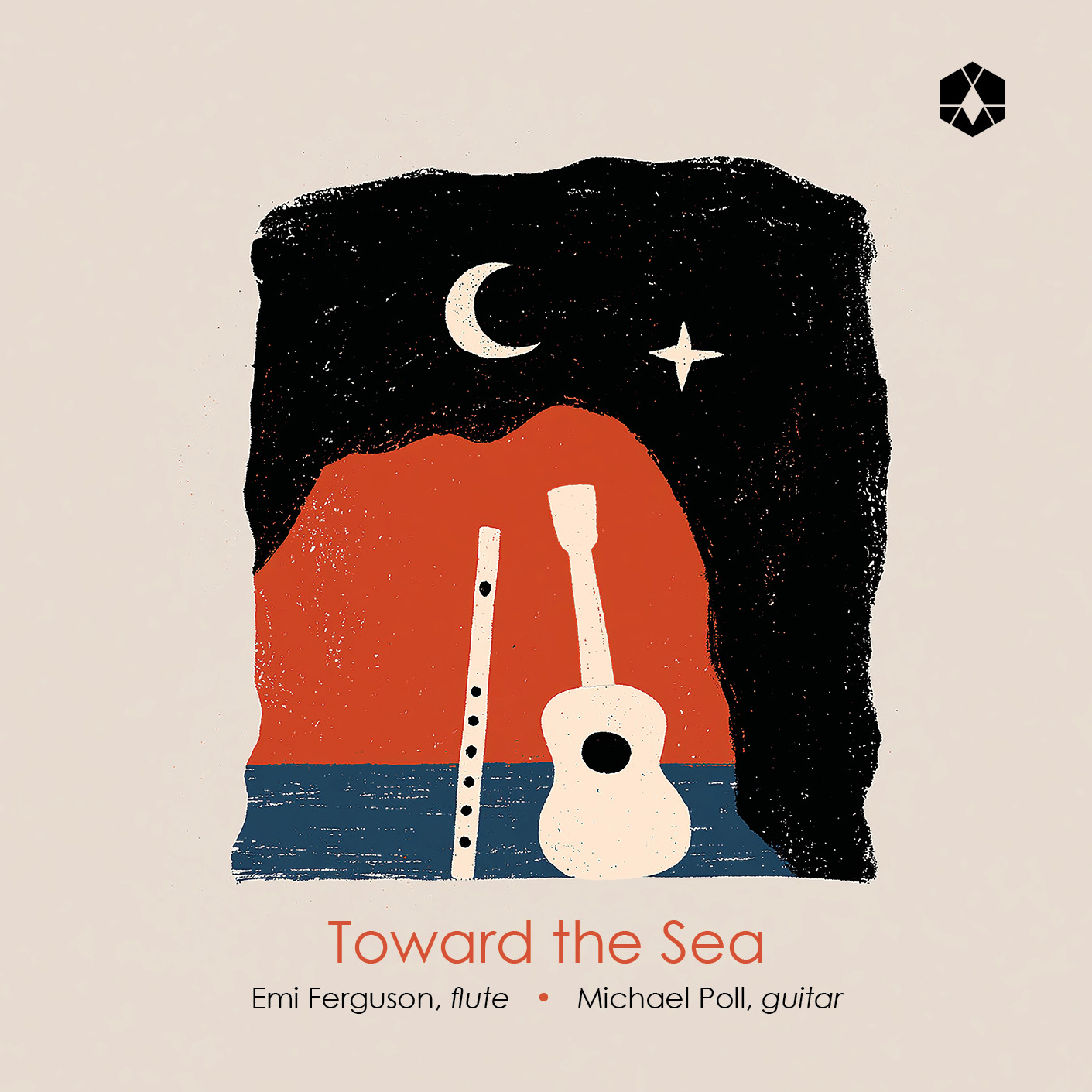
Toward the Sea
Emi Ferguson, flute
Michael Poll, guitar
Release Date: September 25th
ORC100494

Astor Piazzolla (1921–1992)
Histoire du Tango (1985)
for flute and guitar
1. I Bordel 1900
2. II Café 1930
3. III Nightclub 1960
4. IV Tango d’aujourd’hui
Elizabeth Ogonek (b. 1989)
arr. Poll & Ferguson
5. Altair (2012)
Tōru Takemitsu (1930–1996)
Toward the Sea (1981)
for alto flute and guitar
6. I The Night
7. II Moby Dick
8. III Cape Cod
Emi Ferguson, flute
Michael Poll, guitar
Emi and Michael met during the pandemic over the internet, when they had the opportunity to collaborate with a small group of brilliant artists including pianist Nico Namoradze and architect Juan Jofre Lora on a broadcast concert for digital space – a sort of virtual art gallery with a performance taking place therein – which created something artistically distinct for a time of social isolation. It was a complete artistic experience that used the detriment of physical distance to advantage, providing a unique proximity to the music only possible online, while preserving ephemeral aspects that make live performance so special.
Further collaboration was organic and spontaneous. Together, Emi and Michael transcribed Elizabeth Ogonek’s Altair for guitar and flute, and when live concerts resumed, were invited to perform recitals in Philadelphia, New York, and Massachusetts. This recording came together ahead of a recital at the Stone Church Cultural Center in Hardwick, MA, where it was possible to record in the peace and silence of a rural town with an artistic streak. We held our breath when the occasional truck rumbled by on the only thoroughfare in town.
In the 1880s, Buenos Aires was a city on the move: thriving, sophisticated, and cosmopolitan. The old Spanish-colonial city was being razed to rubble to make way for Haussmann-esque Parisian boulevards, and throngs of immigrants – especially from Italy and Spain, but also France, Germany, Eastern Europe, and the Ottoman world – were arriving through the port. Amidst this tectonic shift, tango was born. Not in the twinkling grandeur of the newly-minted-capital, but in the alleyways that progress had overlooked; in the illicit brothels surrounding the port.
In Histoire du Tango, Astor Piazzolla uses the development of tango’s origins to highlight its history: four dances for flute and guitar chronicle a century of the tango’s transformation on the instruments upon which it was born.
The story begins with ‘Bordel 1900’, which pulses with exuberance and intimacy. Its unrelenting rhythm is punctuated by episodes of seduction. A oenopoetic ‘knock at the door’ in the opening bars serves as much as a metaphor for our entrance into this new musical world as a direct reference to the bid for entry that was necessary to gain access to early underground tango.
By ‘Café 1930’, the tango has turned inward, becoming reflective and almost intimate. It is as emotional as it is erotic, and soulfully lyrical. ‘Nightclub 1960’ absorbs and integrates the influence of jazz and cosmopolitan modernism and is the most rhythmically driven movement in the suite, while ‘Tango d’aujourd-hui’ presents a contemporary sound world shaped deeply, according to the composer, by other giants of the 20th century interested in folkloric music, Stravinsky and Bartók.
In Histoire du Tango, vernacular music serves as a foil for artistic exploration in memory and cultural origin, which in turn fuels artistic innovation.
Tōru Takemitsu’s Toward the Sea presents an entirely different mode of composing music in dialogue with cultural heritage. The composer himself observed in 1988:
In this age, we face problems which are both political and economic in nature. To free ourselves from such problems I think the most important thing is the ability to understand each other deeply through cultural exchange […] Each country must take care to avoid concealing itself within its own shell.
A few days before his death, Tōru Takemitsu sent a postcard to pianist Peter Serkin wishing for the strong body of a whale to swim in an ocean ‘that has no west and no east.’ Takemitsu spent much of his life as a cultural bridge between Eastern and Western music and philosophy, seeking not merely to blend European (especially French) and Japanese musical techniques and aesthetics, but to ‘confront the contradictions, even intensify them.’
Written in 1981 for Greenpeace’s ‘Save the Whales’ campaign, Toward the Sea is haunted by disappearance; sounds emerge softly, drift apart, and dissolve back into silence. Tōru Takemitsu’s ocean, like that of Debussy’s tone poem La mer, is never static, alternately shimmering, swelling and ebbing, occupying a sound world that ebbs and flows like water.
The three movements – ‘The Night’, ‘Moby Dick’, and ‘Cape Cod’ – suggest three different aspects of life with and within the ocean, and in a nod to another historical practice, the composer embeds the word “SEA” directly into the score through the pitches E-flat (“Es” in German notation), E, and A, a private cipher submerged beneath the surface. Around it, fragments of melody appear briefly before vanishing again into resonance and breath.
In Takemitsu’s hands, both instruments are treated less as melodic protagonists than as sources of colour, texture, and atmosphere. The guitar sustains harmonic shadows and delicate attacks without decay; the flute becomes wind, vastness, and suspended motion, creating music that exists outside of ordinary time.
Between these larger works stands Elizabeth Ogonek’s Altair. Named after one of the brightest stars among the constellations of the night sky, the work turns the programme upward toward something numinous and celestial. Ogonek creates a sense of suspended stillness that resonates deeply with Takemitsu’s ability to conjure atmosphere with only a handful of sonorities.
Altair situates this recording within the continuing evolution of the repertory for flute and guitar, providing beautiful evidence that this pairing of instruments remains fertile ground for the explorations of contemporary composers. Few instrumental pairings are capable of such intimacy while also affording such vast imaginative space. Across this recording, they become instruments of colour and transformation – carrying echoes of people, the earth, and the cosmos, offering a vehicle to hold on to vanished worlds long after the final sounds have faded.
Michael Poll
Guitar
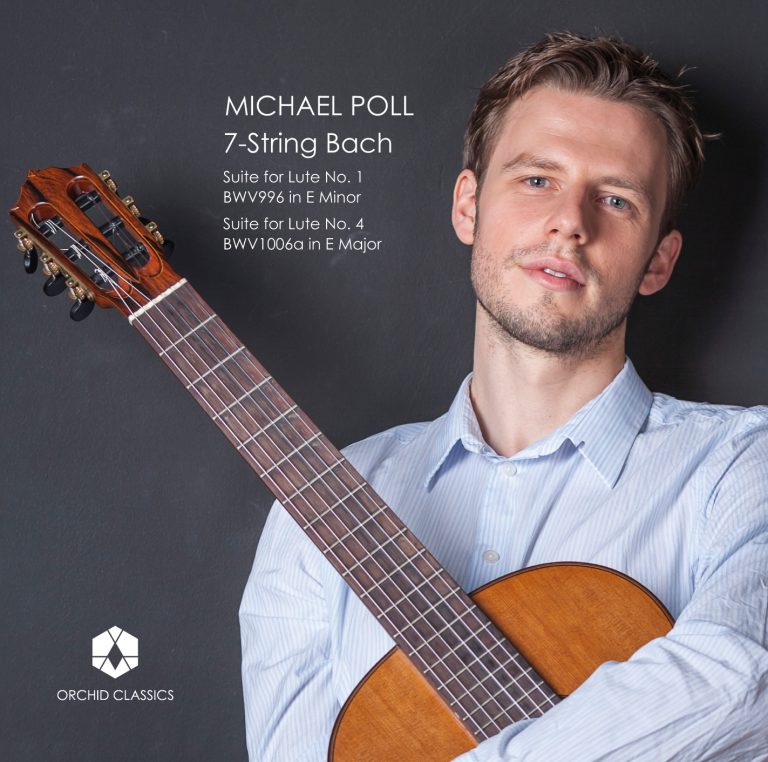
Michael Poll is a guitarist and conductor whose artistry brings together instrumental intimacy, structural clarity, and a refined ear for colour. As a guitarist, he has performed across North and South America and Europe, appearing at venues including Barbican Hall, Wigmore Hall, and the National Theatre of Panama. His debut recording, 7-String Bach, was described as “masterful” by Gramophone, and WholeNote praised his “warm, rich, and full tone.”
Poll’s work as a performer is shaped by a rare breadth of musical experience. He currently serves as Head of Orchestras at the Baltic Opera in Gdańsk, following appointments with the Poznań State Opera, Central City Opera in Colorado, and Bloomsbury Opera in London. His conducting has included productions of Madama Butterfly and Carnival of the Animals at the Baltic Opera, Le nozze di Figaro and Così fan tutte for Bloomsbury Opera, and The Pirates of Penzance for Central City Opera. Critics have praised his “command of detail”, “exceptional clarity and spaciousness of sound”, and “finely balanced proportions.”
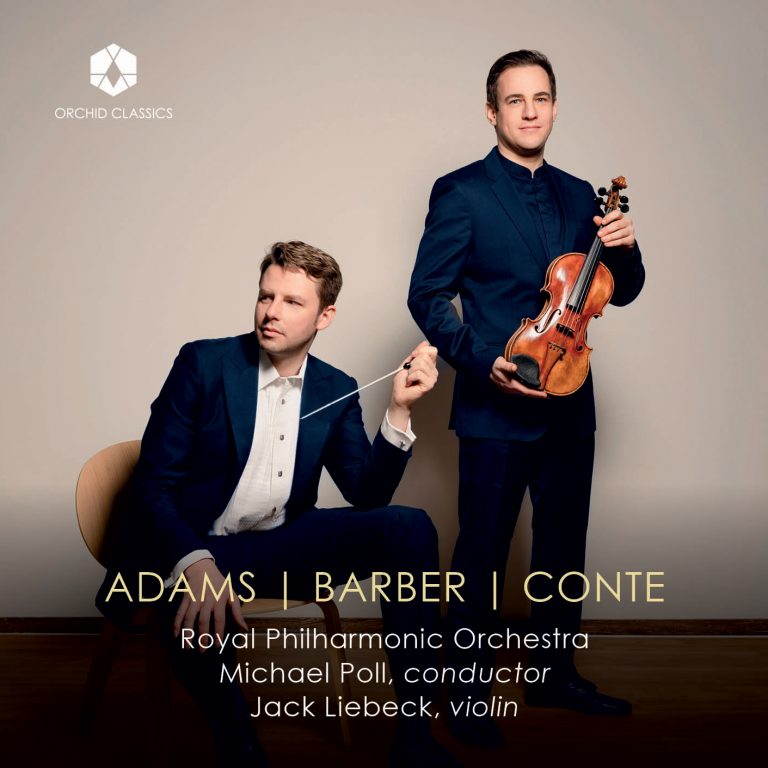
His recent recordings reflect an equal commitment to the classical canon and to living musical traditions. His 2025 album with the Royal Philharmonic Orchestra – featuring Barber’s Violin Concerto with Jack Liebeck alongside works by David Conte and Byron Adams – was featured on the Apple Music Top 100. His 2026 recording with composer Gao Hong and the RPO received a Gold Medal at the World Music Awards.
In this recording, Poll’s dual identity as guitarist and conductor is especially revealing. The flute–guitar repertoire demands not only virtuosity, but also proportion, breath, balance, and an acute sensitivity to resonance. Poll’s playing brings those qualities into focus: lyrical yet precise, intimate yet architecturally aware, and always attentive to the expressive possibilities of linking sounds together.
____________
Emi Ferguson
Flute
A recipient of the Avery Fisher Career Grant, Emi Ferguson is the founder of interdisciplinary ensemble Exquisite Corpse and can be heard live in concerts and festivals with groups including the Handel and Haydn Society, AMOC*, Ruckus, the New York New Music Ensemble, the Manhattan Chamber Players, and as the music director of Camerata Pacifica Baroque.
Her recordings By George!, Amour Cruel, and Fly the Coop: Bach Sonatas and Preludes, celebrate her fascination with reinvigorating music and instruments of the past for the present and have been called “blindingly impressive … a fizzing, daring display of personality and imagination” by The New York Times.
Emi has spoken and performed at TEDx events and has been featured on the Discovery Channel, Amazon Prime, WQXR, and Vox talking about how music relates to our world today. With WQXR, she hosts the Young Artists Showcase and Once Upon A Composer, and created the series This Composer Is SICK!. Her book Iconic Composers was released in 2023. Born in Japan and raised in London and Boston, she now resides in New York.
similar Artists & Albums