Artist Led, Creatively Driven
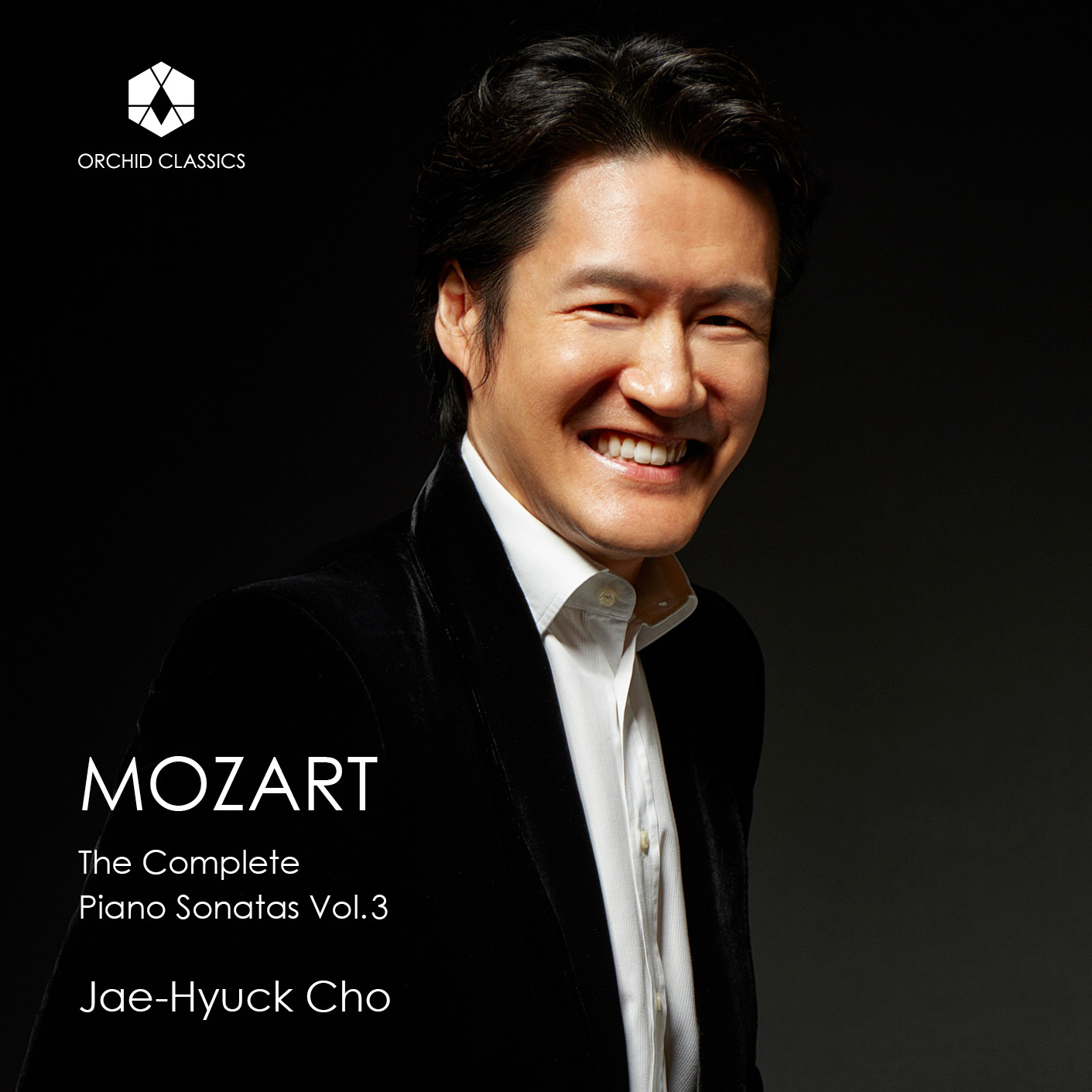
MOZART: THE COMPLETE PIANO SONATAS VOL. 3
Jae-Hyuck Cho, piano
Release Date: September 4th
ORC100480

Wolfgang Amadeus Mozart (1756-1791)
Piano Sonata No. 10 in C major, K. 330
1. I Allegro moderato
2. II Andante cantabile
3. III Allegretto
Piano Sonata No. 8 in A minor, K. 310
4. I Allegro maestoso
5. II Andante cantabile con espressione
6. III Presto
Piano Sonata No. 5 in G major, K. 283
7. I Allegro
8. II Andante
9. III Presto
Jae-Hyuck Cho, piano
Welcome to the third volume of my Mozart piano sonata recordings.
As I have lived with these sonatas over time, I have come to feel ever more strongly that Mozart’s piano music is never only elegant, and never only beautiful in the abstract. It speaks with a human voice: sometimes open and gracious, sometimes troubled, sometimes light again—but changed by what has come before.
That is what drew me to the shape of this program. In Sonata No. 10 in C major, K. 330, I hear a heart opening itself to the listener in trust—presented with a charm that seems inseparable from the innocence of C major. In Sonata No. 8 in A minor, K. 310, the voice turns inward and speaks with an urgency that still feels startling to me every time I play it. Then, in Sonata No. 5 in G major, K. 283, light returns—but not with the same innocence. It feels to me like breath regained, like sunlight after shadow.
This recording cycle began with a simple question I kept asking myself: how would a singer shape this phrase? In this volume especially, that question stayed close to me. I wanted these sonatas to feel less like polished objects and more like living scenes—breathing, shifting, and revealing their character from within.
I hope you will hear in this music something personal as well: not only Mozart’s voice, but also my own attempt to meet it honestly, and to let the piano sing as freely as I can.
This third volume traces a path from radiance to shadow and back into light. In these three sonatas, Mozart’s voice at the keyboard appears in sharply different forms: open and lyrical in C major, concentrated and dramatic in A minor, and finally fresh, quick, and sunlit in G major. What links them is not merely style but speech – the sense that the piano is always being asked to breathe, to ask questions, and to answer.
We begin with Sonata No. 10 in C major, K. 330, one of Mozart’s most open-hearted and luminous works. Everything here seems to unfold with natural ease, yet that ease is inseparable from refinement. The first movement sings with grace and inward poise, as if melody and form had become one. I hear it almost as an aria for a coloratura soprano: a light-hearted character with an agile voice, full of charm and apparent spontaneity. Yet its simplicity is never empty. It depends on inflection, timing, and the life of each phrase.
The Andante cantabile is among Mozart’s most intimate keyboard utterances, sustained not by display but by tenderness and quiet eloquence. I still remember encountering the chiaroscuro of this movement — its play of major and minor, light and shadow — in a music theory class during my college years with the late Michael White at The Juilliard School. That lesson has stayed with me. Then the finale restores motion with buoyancy and wit, without ever losing the singing quality that gives the whole sonata its balance. If this volume begins in light, it is light touched by breath and feeling.
At the center of the program stands Sonata No. 8 in A minor, K. 310, where Mozart’s language darkens and tightens into one of his most uncompromisingly dramatic statements for the keyboard. Nothing in this sonata feels ornamental. The first movement speaks with compressed force, its urgency driven by inner anxiety. The slow movement does not offer escape so much as another kind of truth: a vulnerable, searching song, restrained yet deeply felt. In the finale, tension returns in a more concentrated form, pressing forward with fierce energy and little consolation.
Here, the piano becomes theatrical in the deepest sense: not decorative, but human, exposed, and unguarded. Mozart often provides some kind of relief after presenting moments of tumult, but not here. Marked Presto, the final movement only deepens the fear and uncertainty that have been present from the beginning. If K. 330 opens the door to someone’s heart, K. 310 leads us into the room where Mozart speaks of desperation.
After such darkness, Sonata No. 5 in G major, K. 283 does not feel like a denial of seriousness, but like light returning to the air. If the previous sonata withholds emotional resolution, this one offers something more than resolution: a renewed sense of humor, almost operatic in character — perhaps something close to Leporello in Don Giovanni. Its opening movement has freshness and ease, with quick turns that delightfully surprise the performer and the listener alike; at moments, it almost suggests slapstick comedy.
This movement has also reminded me of “Coquette” from Schumann’s Carnaval: a character who tries almost too hard to conceal her true nature, but cannot help blurting out sudden exclamations in the middle of seemingly elegant speech. The Andante sings with unaffected warmth, never overstating its emotion, and the Presto closes the disc with brilliance that feels airborne rather than emphatic. If this sonata were an opera, this final movement would be a perfect closing scene, with all the characters onstage, singing together while the principal figures still try to get in their final words before the curtain falls. I am grateful that, with this sonata, sunlight passes through the shadow and returns to us brighter.
Across this volume, I have tried to create a unified drama of the kind Mozart himself so often imagined: capable of innocence and tension, candor and theatre, elegance and pain. These sonatas do not ask to be admired from a distance. They ask us to face human emotions directly — to hear them, to recognize them, and to respond.
Jae-Hyuck Cho
Pianist Jae-Hyuck Cho is an internationally active soloist, acclaimed for performances that fuse classical clarity with the expressive freedom of the voice. At the center of his recent work is the recording of Mozart’s complete Piano Sonatas for Orchid Classics, a five-volume series shaped by his belief that Mozart’s keyboard writing lives with the immediacy of opera—dramatic, flexible, and deeply human. This disc is Volume 3 of the cycle.
He appears regularly in recital and as a concerto soloist, and his work on stage is complemented by an equally engaged life in chamber music and collaboration, where his listening instincts and lyrical line bring a vocal sensibility to ensembles as naturally as to the piano alone. As a recording artist, Cho moves with rare ease between two worlds—the symphonic breadth of the organ and the intimate lyricism of the piano. His discography reflects this range, including an organ album recorded at Église de la Madeleine, Paris (Evidence) alongside major piano releases spanning Bach to Shostakovich.
Cho serves as Artistic Director of the Hasla International Festival of the Arts in Gangneung, Korea, where he curates programs that connect music with literature, visual art, and community—championing friendships on and off stage. Whether in recital, with orchestra, or in partnership with other artists, he seeks a direct line of communication with listeners: a singing phrase, a living tempo, and the courage to let music breathe.
similar Artists & Albums