Artist Led, Creatively Driven
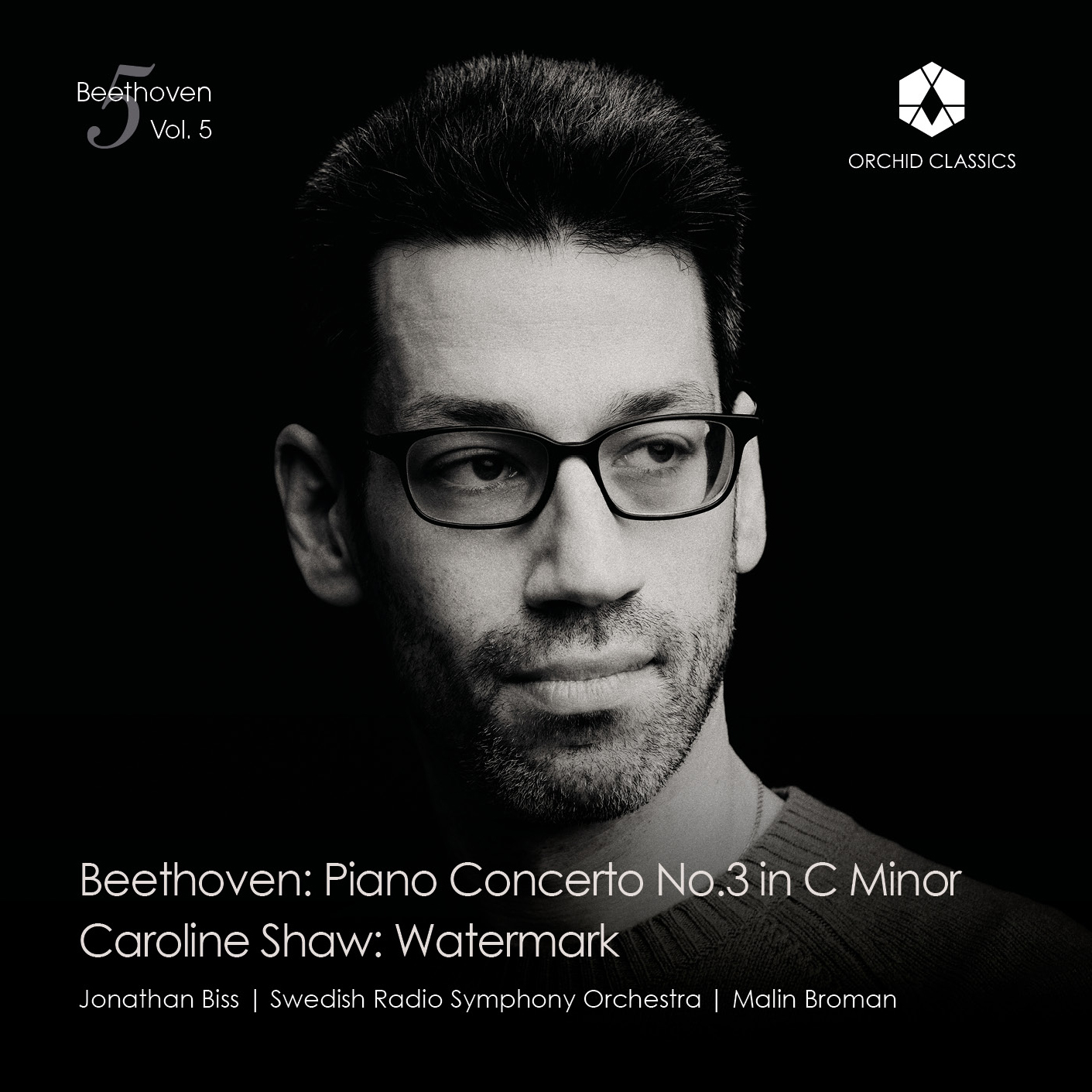
Beethoven/5 VOL. 5
Jonathan Biss, piano
Swedish Radio Symphony Orchestra
Malin Broman, leader
Release Date: April 24th 2026
ORC100433

Beethoven/5 VOL. 5
Jonathan Biss on Beethoven’s Concerto No.3
The opening of the Piano Concerto in c minor, K. 491 is among Mozart’s strangest and most unsettling inspirations. Its tone is hushed, its energy coiled and threatening. Its narrative follows a clear path for precisely two notes: With the third, it is thrown off course and never really recovers. Any sentient listener would expect that third note to be a G, the top of the c minor triad that Mozart seems to be building, note by note. The A-flat that arrives instead is deeply disorienting. In a great performance, it makes the blood run cold.
It is just the beginning. The rest of the phrase is doggedly, unremittingly chromatic, its motion furtive and disconcerting. It does not walk; it slithers. Artur Schnabel apparently referred to this concerto as the first work dodecaphonic work, 150 years before Schoenberg, because by the end of its first phrase, all twelve notes have been heard.
Beethoven knew and loved this concerto. When he wrote his own piano concerto in c minor – his third, Opus 37 – Mozart’s work was clearly taking up space in his brain. The first two notes of the concerti are identical in both pitch and rhythm. Then the paths diverge. Mozart’s is fear-inducing; Beethoven’s is foursquare. He completes the triad that Mozart willfully avoids; his first phrase uses five notes to Mozart’s twelve. Beethoven takes Mozart’s motive, strips it down, and removes each of its most distinctive features.
Then he proceeds to build something totally original and utterly gripping and out of it.
That is Beethoven. He has the capacity for rare beauty, which we will hear later in this concerto. But he does not need it to stir the soul. In his hands, ideas that initially make little impression become the basis for monumental or transcendent works of art. In the first movement of the c minor Concerto, he has monumentality on his mind. Its drama, established almost immediately and maintained nonstop for the movement’s sixteen minutes, hits the listener in the solar plexus. It is not an enveloping drama, but an oppressive one, created almost entirely from the terse rhythmic figure that brings the opening phrase to a close. It is impossible to describe this figure without feeling silly; it is barely anything at all. It consists of a short upbeat, and a somewhat longer downbeat. Two notes. They bring no rhythmic subversion: The emphasis is on the downbeat, where we expect it. They create no motivic or harmonic tension: The interval they outline is, on first and nearly every other hearing, consonant and unremarkable.
These two unremarkable notes become an irresistible force. Their power comes through sheer repetition, context, and the inexplicable magnetism of Beethoven’s personality. The tautness of this figure gives it a fateful quality that becomes more prominent with each iteration. When the second theme blossoms into E flat major, the two notes are there, reenforcing the music’s rigor and mitigating its generosity and warmth. When that theme builds to a battled-scarred triumph, the two notes are there, played again and again first by the orchestra, then by the piano. When the recapitulation and a return to work’s grim c minor home are imminent, they are heralded by the two notes, delivered by the timpani in a menacing whisper. Everything that matters in this movement is underpinned or foretold by those two notes.
The first movement’s most remarkable moment comes after its cadenza; of course, it is dominated by that same rhythmic figure. In most classical-era concertos, this is not a critical juncture of the work. The real drama comes in the cadenza itself, when the composer – or, traditionally, the player – takes the movement’s themes and puts them through their paces. Finally given the chance to play alone, without the restrictive influence of the orchestra, the solo piano displays a newfound freedom. The cadenza might not be improvised, but it ought to sound improvised. It is a flight of fancy, and a bit of a tease, promising the listener harmonic resolution and withholding it until the very end. When it finally arrives and the orchestra re-enters, the fundamental issue of the work has been resolved. What remains is a formality – a cursory summation of the movement’s main ideas.
Mozart’s c minor Concerto is mildly subversive in this regard. The first movement’s coda is so unremittingly dark it demands the listener’s full attention. Breaking with tradition, the piano joins the orchestra, playing a serious of spectral arpeggios before vanishing into thin air. But its subversiveness is more a matter of style than substance. Extraordinary as this passage might be, it has no major structural events.
Beethoven goes further: The end of his cadenza and the coda that follows it are a magnificent violation of classical form. After building to a gigantic climax, the cadenza is poised to resolve. A trill on the dominant should – would, if this concerto behaved like any that precedes it – bring a final cadence, and then a coda that wraps the movement up in a bow.
The opposite occurs. This is a cadenza without a cadence. One trill leads to another, and another, and another. Each takes us further from our c minor home and the sense of security that comes with it. The cadenza does not come to an end: It breaks down. And so, for the first time in musical history, the coda is no formality. It must succeed where the cadenza failed and bring the piece to a conclusion.
Does it ever. The coda begins sotto voce, the pianist groping for the c minor that suddenly feels so distant. Simultaneously, the timpanist intones the two-note motive with quiet insistence. This insistence wins the day: Within moments, the motive again dominates the proceedings, the piano and strings playing it in alternation, an expression not of concord but of conflict. Here again, Beethoven reveals how fundamentally unlike Mozart he is. Mozart’s soloist is in dialogue with the orchestra. In Beethoven, particularly minor key Beethoven, they are at war. A war here fought on a battlefield composed of one eighth note and one quarter note.
There is much that could be said about this concerto’s second and third movements. There is the surreality of the E Major chord that opens the slow movement – a chord so far from the c minor world we were just immersed in, it becomes a portal to another dimension. There are the moments when Beethoven seems to bend time to his will. There is the brutality with which the last movement wrenches us back to c minor and the conflict that comes with it. And there is the work’s C Major conclusion, poised between comedy and triumph, the music winking one moment and exultant the next.
There is always more that can be said. But it feels unnecessary. Once you know that Beethoven can hold you in his grasp with just two notes, you know what is essential about him. Who else can? Not even Mozart, with his limitless sophistication and inspiration and beauty. Beethoven is a one-off. His greatness cannot and perhaps should not be explained. Better to be astonished anew on each hearing. Being astonished by Beethoven is a gift to one’s life.
___________________________
Caroline Shaw on Watermark
Watermark is woven from strands and patches and patterns of Beethoven’s Third Piano Concerto. At times the connection is direct, as when the end of the first movement morphs into the final bars of Beethoven’s own race to the cadence. At other points there is a more oblique and subtle kind of illumination of Beethoven’s approach to serenity and tragedy, in the mirroring of Op. 37’s harmonic shifts and textures.
Throughout the writing process, I was always inspired by Jonathan Biss’s artistry, listening constantly to his recordings of the Beethoven Sonatas and other works, and to his wise insight into this music. The title, Watermark, refers in one sense to the research done (by musicologist Alan Tyson) on Beethoven’s manuscript paper to determine the dates of composition for Op. 37, and more broadly to the notion of the origin of a document being expressed and embedded in subtle ways, like fragments of older language peeking through a palimpsest.
Jonathan Biss
Piano
Pianist Jonathan Biss is recognized globally for his “impeccable taste and a formidable technique” (The New Yorker). Praised by The Boston Globe as “an eloquent and insightful music writer,” Biss published his fourth book, Unquiet: My Life with Beethoven, in 2020. The book was the first Audible Original by a classical musician and one of Audible’s top audiobooks of the year.
Biss has appeared as a soloist with some of the world’s foremost orchestras, including the Los Angeles and New York Philharmonics, the Boston Symphony, the Royal Concertgebouw, the London Symphony and more. He has served as the Co-Artistic Director of the Marlboro Music School and Festival alongside pianist Mitsuko Uchida since 2018. He served on the faculty of the Curtis Institute of Music for ten years, and has been a guest professor at schools such as the Guildhall SOMAD and the New England Conservatory of Music. Biss is also the author of Unquiet: My Life with Beethoven, in which he examines music and his own life’s journey through the lens of Beethoven’s last piano sonatas.
Coinciding with the 250th anniversary of Beethoven’s birth in 2020, Biss recorded the composer’s complete piano sonatas, and offered insights to all 32-landmark works via his free, online Coursera lecture series Exploring Beethoven’s Piano Sonatas. In March 2020, Biss gave a virtual recital presented by 92NY, wherein he performed Beethoven’s last three piano sonatas for an online audience of more than 280,000 people. In 2024, Biss participated in Princeton University Concert’s Healing Through Music Series, appearing alongside author Adam Haslett for a panel discussion on anxiety, depression, and creativity. Biss is the recipient of numerous honors, including the Leonard Bernstein Award, the Andrew Wolf Memorial Chamber Music Award, an Avery Fisher Career Grant, the Borletti-Buitoni Trust Award, and a Gilmore Young Artist Award. His albums for EMI won the Diapason d’Or de l’Année and Edison awards. He was an artist-in-residence on American Public Media’s Performance Today and was the first American chosen to participate in the BBC’s New Generation Artist program.
Biss is a third-generation professional musician; his grandmother is Raya Garbousova, one of the first famous female cellists (for whom Samuel Barber composed his Cello Concerto), and his parents are violinist Miriam Fried and violist/violinist Paul Biss. Growing up surrounded by music, Biss began his piano studies at age six, with his first musical collaborations alongside his mother and father. He studied with Evelyne Brancart at Indiana University and Leon Fleisher at the Curtis Institute of Music.
_______________________________
Swedish Radio Symphony Orchestra
More than 100 exceptional musicians make up the Swedish Radio Symphony Orchestra, a multiple-award-winning ensemble renowned for its high artistic standard and stylistic breadth. The first radio orchestra was founded in 1925, coinciding with Sweden’s first national radio broadcasts.
Daniel Harding has been Music Director of the SRSO since 2007, with 2019 seeing him appointed as the orchestra’s first ever Artistic Director. His extensive tenure will last throughout the 2024/25 season. “It is increasingly rare for the relationship between a conductor and an orchestra not only to last for more than a decade, but to keep growing,” Harding says about working with the orchestra, “it is also rare for an orchestra of the highest musical standard to also very obviously want to keep on growing.”
The orchestra tours regularly, receiving invitations from all over Europe and the world. Recent highlights include two programmes at the Musikverein in Vienna, with programmes including Robert Schumann’s Manfred performed with the Wiener Singverein and actor Cornelius Obonya, and Schumann’s Violin Concerto with Christian Tetzlaff. Additionally, Harding and the SRSO performed an all-Sibelius programme at the Sibelius Festival in Lahti, Finland, featuring María Dueñas in Sibelius’ Violin Concerto.
Upcoming projects include playing major works by Mahler, Strauss, Alfvén and Mozart together with Christian Gerhaher and Maria João Pires, both regular musical partners of Harding and the orchestra. Venues include the Elbphilharmonie, Concertgebouw, KKL Luzern, Philharmonie de Paris and Müpa Budapest.
The SRSO remains a cornerstone of Swedish public service broadcasting, its concerts heard weekly on the classical radio P2 and regularly on Swedish national public television SVT. During the pandemic, its much appreciated on-demand streamed concerts on Berwaldhallen Play brought further worldwide attention to the orchestra.
The Swedish Radio Symphony Orchestra has an extensive and acclaimed recording catalogue. Recent releases include Jesper Nordin’s triptych Röster for orchestra, works by Britten featuring Andrew Staples and the orchestra’s own solo hornist Chris Parkes, and Eduard Tubin’s Double Bass Concerto with the orchestra’s solo bassist Rick Stotijn. Music Director Daniel Harding’s other recent, noteworthy recordings with the SRSO include Schönberg’s Verklärte Nacht and Violin Concerto with Isabelle Faust, Brahms’ Ein deutsches Requiem featuring Christiane Karg and Matthias Goerne, and Mahler’s Symphony No. 5.
Two of the SRSO’s former chief conductors, Herbert Blomstedt and Esa-Pekka Salonen, have since been named Conductors Laureate and make regular appearances with the orchestra.
_______________________________
Malin Broman
Leader
The award-winning and versatile performer Malin Broman is equally in demand as a soloist, director, leader and chamber musician. Appointed leader of the Swedish Radio Symphony Orchestra in 2008, she has since been invited to perform as guest leader with the London Symphony Orchestra, Mahler Chamber Orchestra, Philharmonia Orchestra and Chamber Orchestra of Europe. Broman is also devoted to chamber music; she is a founder member of the Kungsbacka Piano Trio and was also a member of the Nash Ensemble for many years.
After regularly directing the Swedish Radio Symphony Orchestra she is now in demand as musical director/soloist. In that role she has appeared with ensembles including the Tapiola Sinfonietta, Iceland Symphony Orchestra, Norwegian Chamber Orchestra, Scottish Ensemble, Helsingborg Symphony Orchestra, Aalborg Symphony Orchestra and ACO Collective (Australia).
From 2015 until 2020 she was artistic director of the Musica Vitae chamber orchestra. Together they toured extensively, premièred more than 20 works, collaborated with actors and dancers, and performed at the Nobel Prize Ceremony. In 2019 she took up the post of artistic director of the Ostrobothnian Chamber Orchestra in Finland, and in 2025 she took over as musical director of the Nordic Chamber Orchestra.
In 2002 Malin Broman was presented with the Halland Academy’s Award for Outstanding Cultural Achievement, and in 2008 she was elected a member of the Royal Swedish Academy of Music. In 2019 she was awarded H.M. The King’s Medal for her services to music.
_______________________________
Caroline Shaw
Composer
Caroline Shaw is a musician who moves among roles, genres, and mediums, trying to imagine a world of sound that has never been heard before but has always existed. She works often in collaboration with others, as producer, composer, violinist, and vocalist. Caroline is the recipient of the 2013 Pulitzer Prize in Music, several Grammy awards, an honorary doctorate from Yale, and a Thomas J. Watson Fellowship.
Recent projects include the score to “Fleishman is in Trouble” (FX/Hulu), vocal work with Rosalía (MOTOMAMI), the score to Josephine Decker’s “The Sky Is Everywhere” (A24/Apple), music for the National Theatre’s production of “The Crucible” (dir. Lyndsey Turner), Justin Peck’s “Partita” with NY City Ballet, the premiere of “Microfictions Vol. 3” for NY Philharmonic and Roomful of Teeth, a live orchestral score for Wu Tsang’s silent film “Moby Dick” co-composed with Andrew Yee, two albums on Nonesuch (“Evergreen” and “The Blue Hour”), and tours with So Percussion featuring songs from “Let The Soil Play Its Simple Part” (Nonesuch). She has contributed production to albums by Rosalía, Woodkid, and Nas.
Her favorite color is yellow, and her favorite smell is rosemary.
similar Artists & Albums