Artist Led, Creatively Driven
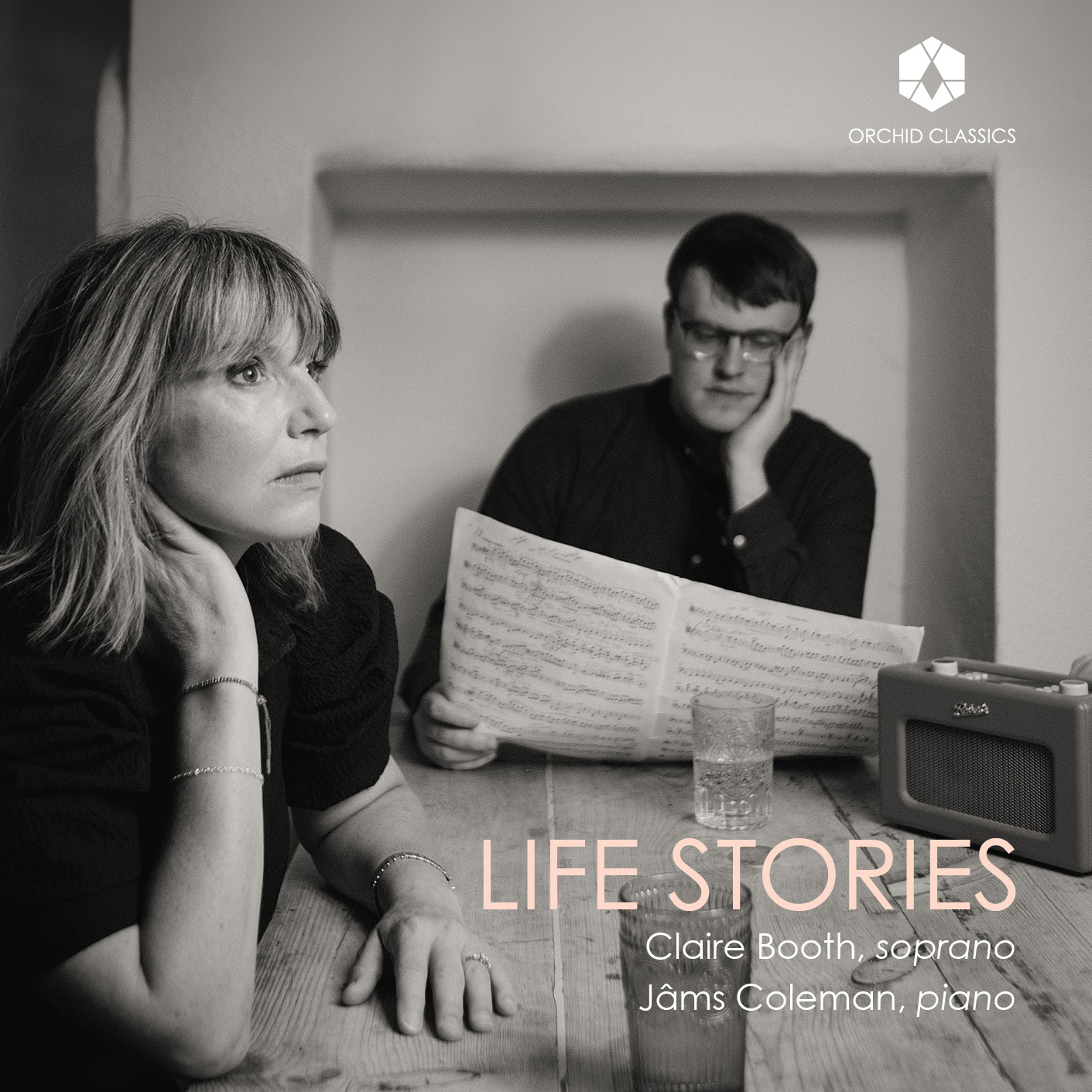
LIFE STORIES
Claire Booth, soprano
Jâms Coleman, piano
Release Date: February 27th 2026
ORC100421

LIFE STORIES
Zoë Martlew (b.1968)
Hotel Babylon
1. Madame
2. Baby
3. Chef
4. Beautician
5. Hierophant
6. Cashier
7. Lover
George Gershwin (1898-1937)
8. The Man I Love
9. I Got Rhythm
Hanns Eisler (1898-1962)
from Hollywooder Liederbuch
10. An den kleinen Radioapparat
11. Über den Selbstmord
12. L’automne californien (Kalifornischer Herbst)
13. Der Kirschdieb
Francis Poulenc (1899-1963)
Banalités, FP 107
14. Chanson d’Orkenise
15. Hôtel
16. Fagnes de Wallonie
17. Voyage à Paris
18. Sanglots
George Gershwin (1898-1937),
arr. Earl Wild (1915-2010)
19. Somebody Loves Me
20. Embraceable You
Thomas Adès (b.1971)
21. Life Story, Op. 8b
Claire Booth, soprano
Jâms Coleman, piano
A word from the musicians
That most famous interpreter of Kurt Weill’s songs, Lotte Lenya, never referred to the composer’s vocal music as ‘Cabaret’ but always as ‘Art Songs’, arguing that they resembled Schubert lieder more than anything else. That borderland between cabaret and classical continues to fascinate well into the 21st century, whether in terms of style or storyline, and there is something about the immediacy of story telling, so important for all song, lieder and mélodie, that is somehow liberated by the medium of cabaret.
To this end, I commissioned longtime friend and colleague Zoë Martlew to write a set of ‘classical cabaret’ songs (if such a thing exists), loosely based on Arnold Schoenberg’s own 1901 Brettl Lieder – for his 150th birthday year. The resultant cycle draws inspiration from a range of musical styes, and seeks through its wide-ranging texts to explore our modern-day relationship (obsession?) with temptation and vice. Substantial as it is, Jâms and I have chosen to contextualise Zoë’s remarkable work with a series of composers who, despite emerging from different times, continents and aesthetic traditions, together look to explore that similar interplay between the everyday and the profound, the banal and the existential, viewed through a lens of irony, fragmentation or social critique.
The emotional depths of Poulenc’s Banalités, at times masqued by ironic nonchalance, find echoes in Eisler’s politically bleak yet intimate portraits of life lived in exile, as with Adès’ interpretation of Tennessee Williams’ iteration of the ultimate kitchen sink drama: a one-night stand. Gershwin’s song writing, while seemingly far from Eisler’s politics or Poulenc’s salon culture carries a bittersweet clarity that inhabits similar emotional terrain : loneliness, longing and the daily drama of love and loss. Together, these works offer a constellation of composers who, in very different contexts all use song, and the story telling it offers, as a mirror: of society, of the self and of a world both mundane and precarious.
Claire Booth
Zoë Martlew’s Hotel Babylon is the happy result of a request for a set of cabaret-esque songs, loosely based on Arnold Schoenberg’s own set – Brettl Lieder – in his 150th birthday year. Composed to her own texts, Zoë describes the work as a “Faustian mini-drama tangled up with the Seven deadlies”, as each song draws the audience inexorably towards a reckoning with their soul. The Yorkshire Madame of the opening number invites us into a paradise of sin: intoxicating and irresistible. However no sooner have we established the lack of ground rules than we are confronted by various temptations; Baby, where a wheedling Lolita seeks to satisfy with silken kisses; a French Chef recreates the excesses of La Grande Bouffe, with guests unable (literally) to refuse; perfection might be possible by visiting the Beautician, but only before things take a darker turn; in Hierophant the audience strikes a deal with the occult, while the pianist accompanies with audible in- and exhalations; On the road to self-destruction there’s just time to visit the Cashier who’s inexhaustible supplies of ‘filthy lucre’ should satisfy the most insatiable greed. Passing through Viennese waltzes, Latin salsa, the world of Weill and Brecht, tango and expressionism, we are finally offered a chance of redemption in the baroque-inspired final song, Lover – its resolution in C major offering freedom, hope and new beginnings.
Intended for multiple musicals, Gershwin’s The Man I Love was repeatedly rejected before finding fame independently, largely due to recordings and performances by major singers and jazz musicians. A woman dreaming of a future lover she hasn’t yet met; the song’s lyrics and aching melody express longing, hope and a gentle melancholy, echoing the emotional immediacy and melodic grace of Poulenc’s own art songs: a sentimental clarity without excess. Written in 1930 for the musical Girl Crazy, the central message of I’ve Got Rhythm is about celebrating the essentials: music, love and spirit and their ability to outweigh material wealth. Its message of cheerful defiance in the face of hardship gave it lasting appeal in the Great Depression and beyond, and while Hanns Eisler’s own Hollywood songs emerge from a very different artistic and political world, they in their turn exude a moral or intellectual defiance against the status quo. Gershwin’s own performances of the work as a piano solo demonstrates that he did indeed have rhythm; the initial melody repeats with increasing bravura and unexpected reharmonizations, all demanding an extraordinary level of technical skill.
Hanns Eisler’s Hollywooder Liederbuch vividly reflects the composer’s political convictions and the personal turmoil he experienced during his exile in America in the later 1930’s and 40’s. A close collaborator with Bertold Brecht, Eisler’s exile in the United States was marked by profound alienation. Addressing the radio in An den kleinen Radioapparat – a symbol of technological advancement and mass communication – in one single page of music, Eisler captures the paradox of the device as both his intimate friend and protector, and tool of ideological control. In Über den Selbstmord, the stark title – On Suicide – encapsulates the existential despair of those alienated by the Nazi regime. Eisler’s dark, sparse harmonic language doesn’t simply register this unbearable tragedy; but with its final, sudden, fortissimo chord, underscores the awful psychological torment: jabbing an accusatory finger at those culpable. L’automne californien (Kalifornischer Herbst) offers a locational contrast, similar to Poulenc’s Parisian sojourn, capturing the bittersweet atmosphere of Eisler’s new environment. California here, however is not idyllic sunshine, but a season, a turning point, a reminder that even in exile – in paradise perhaps – there is decay, transience and homesickness, accompanied by the sluggish monotony of sunny skies. Der Kirschdieb might seem at first hearing to be a nostalgic, light-hearted tale of merry japes redolent of a Schubert lied. However, the narrative of the cherry thief staring down the protagonist while continuing to fill his pockets prompts the listener to question what has been stolen: fruit or freedom.
Francis Poulenc’s Banalités, composed in 1940 sets words from that pioneer of early 20th century modernism, Guillaume Apollinaire; a poet known for his innovative approach to language and imagery, revealing profundity beneath the everyday. Written during the upheaval of World War II, Poulenc’s musical settings match this sense of duality: complexity yet simplicity, irony betraying sincerity. In Chanson d’Orkenise, we enter a stylised almost medieval scene – a traveller, a tradesman, a town, a hint of ritual – but behind its cheerful exterior lies a subtle sense of exclusion and indifference to love lost or found. Hôtel, one of Poulenc’s most beloved miniatures, is a study in sensual inertia: the languor of smoking, laziness, hotel anonymity. The music breathes with quiet resignation, a gentle invitation to abandon the outside world; yet prefiguring both the sense of forced isolation found in Eisler’s Hollywooder Liederbuch and the emotional disengagement of Adès’ own hotel guests in Life Story. Fagnes de Wallonie shifts to a colder, windswept landscape evoking both geographical and emotional isolation. Despite the honeybees and jolly woodland, Poulenc’s vocal line grows increasingly declamatory, biting with ‘belles dents’ and echoing the internal wilderness of the speaker. Voyage à Paris offers a brief contrast – a buoyant tribute to the capital, filled with exuberance and affection. However, the song’s very brevity together with the vocal ‘shrug of the shoulders’ of the final phrase indicates a lack of permanent respite in the city of love. Beyond amour, Sanglots reflects far deeper emotions concerning spiritual longing, war, sacrifice and even artistic suffering. This final song, a farewell not only to the cycle, but perhaps also to love, innocence and life itself, seems, through Poulenc’s luminous harmonies, to open a door to something sacred and eternal, suggesting a kind of peace beyond the sorrow of its title.
A passionate admirer of Gershwin, Wild recognised the musical sophistication hidden within what were often considered merely popular songs. His re-imaginings highlight a deep appreciation of the tradition of Romantic piano transcriptions – following Liszt or Rachmaninov – and are rich in harmonic complexity, technical brilliance and emotional depth. In Somebody Loves Me, Wild captures the upbeat charm and rhythmic energy of the original, embellishing it with sparkling runs, syncopated passages and dynamic contrasts that demand considerable pianistic skill. Embraceable You, by contrast is rendered with lyrical sensitivity, featuring lush voicings, sweeping arpeggios and romantic expressiveness that bring out the song’s heartfelt intimacy.
Thomas Adès’ Life Story composed in 1997 and set to a text by Tennessee Williams, captures the writer’s obsession with the autobiographical, reflecting on the fragility of human connections and the enduring impact of past sexual experiences. Williams’ writing is intimate and fragmented, and Adès’ musical setting reflects this disjointed yet deeply emotional world. The piano accompaniment moves fluidly between lush harmonies and tense, unsettled passages, while the vocal line is carefully shaped to follow the natural rhythms of Williams’ language, emphasising the writer’s candid and conversational tone with moments of hedonistic outpouring. Indeed, all the Life Stories contained within this recording resonate on a broader level as meditations on the banality of the human condition: our vulnerability, joy, folly and resilience – serving to illuminate both the beauty and pain of the everyday: the delicate complexity that is life itself.
Claire Booth
Soprano
Recipient of the 2025 Royal Philharmonic Society Singers’ Award, Booth received a double 1st in Modern History from Oxford University before studying at GSMD and the National Opera Studio. While there, she came to international attention performing the world premiere of Birtwistle’s Io Passion at the Bregenz and Aldeburgh Festivals, followed by her debut at Nationale Opera Amsterdam as Pakriti in Harvey’s Wagner Dream. For the Royal Ballet and Opera she has sung the title role in Handel’s Berenice, Irene (Bajazet) and solo performances of both Kurtág’s Kafka Fragments and Haas’ Atthis. Other notable roles include Rossini heroines Rosina and Elcia (Mosè in Egitto) and critically acclaimed performances of La Voix Humaine for WNO, earning her Best Actress at the Welsh Theatre Awards.
Booth’s extensive collaboration with the late Oliver Knussen included her portrayal of Max in Where the Wild Things Are with the LA Philharmonic, performing under his baton with the Stockholm and Tokyo Philharmonics, BBCSO, London Sinfonietta and Boston Symphony Orchestra. Other selected concert performances include Erwartung with the Leipzig Gewandhaus Orchester, Vier Letzte Lieder with Boston Philharmonic, Tippett’s Child of Our Time with CBSO at Elbphilharmonie, Anne Truelove in Rakes Progresswith the CBSO, and Miranda in Adès’ Tempest with the Royal Concertgebauw Orchestra Amsterdam. She has given close to 100 world premiere performances, by composers including Benjamin, Carter, Woolrich, Birtwistle, Martlew, and Anderson, and is increasingly involved at commissioning level, such as Helen Grime’s recent Folk with BBCSSO.
She is a director of the BPA Composition and Performance Course, coaches modern operatic repertoire at RAM and RWCMD, and works with composers on the Opera Makers program at GSMD. Her recent award-winning Masters’ dissertation on the continuing relevance of opera in English translation has led to strategic discussions with ENO as to the company’s future direction. She takes up a Creative Fellowship post at Merton College, Oxford in 2026.
______________________________________
Jâms Coleman
Piano
From Anglesey, North Wales, Jâms Coleman is a pianist who enjoys performing as a soloist, chamber musician, and vocal accompanist. Awarded an ARAM from the Royal Academy in 2023, following studies at Cambridge University, he regularly performs at prestigious festivals and venues in the UK and internationally, with recent highlights including recitals at the Aldeburgh, Ortús Chamber Music, Cheltenham, Leeds, OISF and Petworth Festivals, BBC Proms, Cello Biënnale (Amsterdam), LSO St Luke’s, Prussia Cove, The Royal Concertgebouw (Amsterdam), and Wigmore Hall.
Jâms has consolidated particular duo partnerships with cellist Laura van der Heijden and soprano Claire Booth. Described as ‘intriguing and beguiling’ by The Guardian and as ‘gently alluring, enigmatic and romantic’ by Gramophone, Jâms’ and Laura’s most recent album – ‘Path to the Moon’ – reached two million streams worldwide in the first week. Exploring the realm between the concert and theatre stage, Claire and Jâms’ innovative programming and commissioning have led to a UK wide tour of ‘Willkommen, Welcome, Bienvenue’ including a rapturous homecoming reception at Wigmore Hall.
Other albums include Bridge and Britten with Maria Włoszczowska, Hélène Clément and Steffan Morris for Champs Hill Records, works by Bacewicz with the Karski Quartet for Evil Penguin, works by Pamela Harrison for Resonus Classics, Fanny Hensel lieder for First Hand Records (recorded in Mendelssohn Haus, Leipzig), and Loewe lieder with baritone Nicholas Mogg for Champs Hill Records. He takes over as Artistic Director of the Fishguard Festival of Music in Pembrokeshire in 2027.
similar Artists & Albums