Artist Led, Creatively Driven
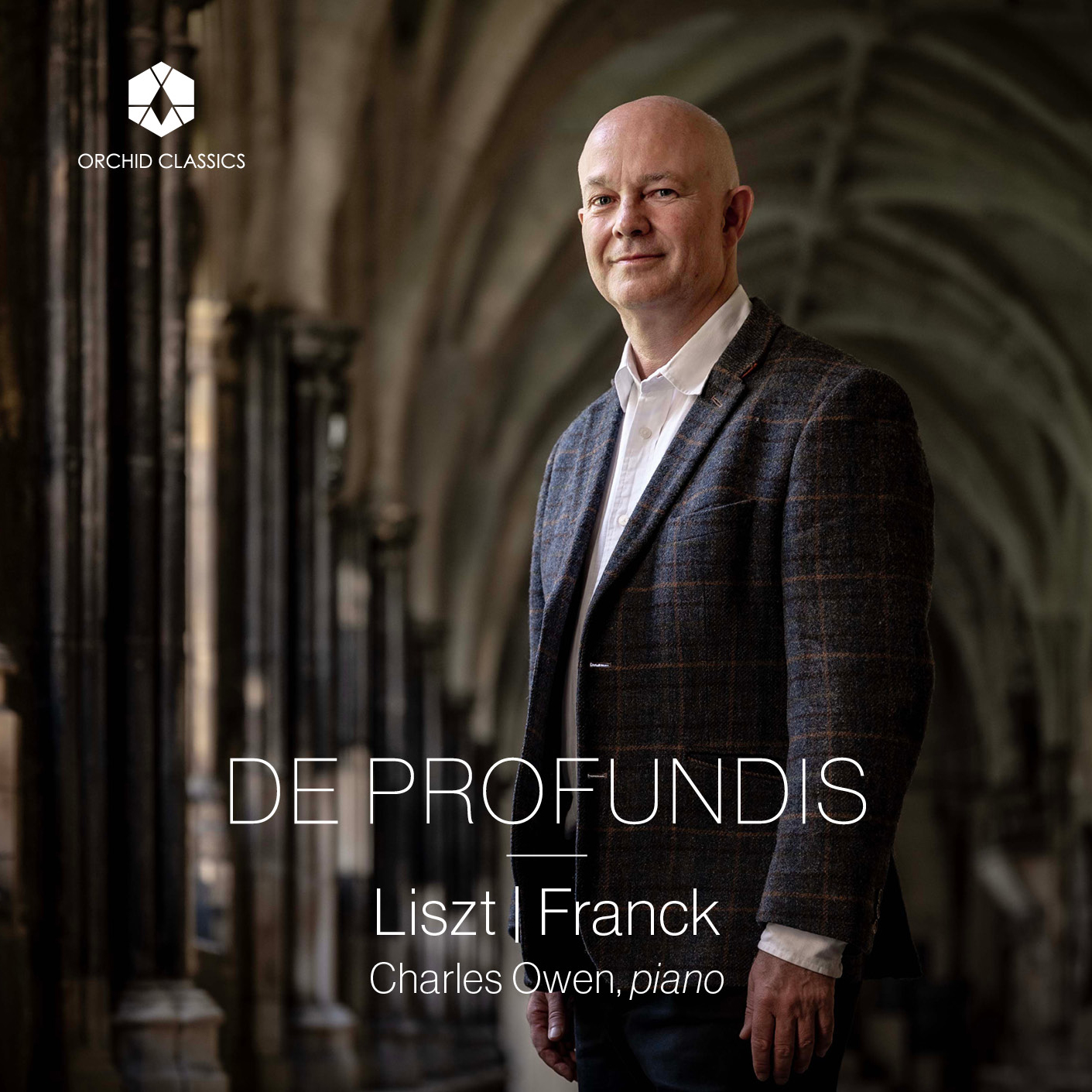
DE PROFUNDIS
Charles Owen, piano
Release Date: February 6th 2026
ORC100411

DE PROFUNDIS
Franz Liszt (1811-1886)
Deux Légendes, S.175
1. No.1: St. Francis of Assisi preaching to the birds
2. No.2: St. Francis of Paola walking on the waves
3. Variations on JS Bach’s Cantata
Weinen, Klagen, Sorgen, Zagen, S.179
4. Les jeux d’eaux à la Villa d’Este
from Années de pèlerinage III, S.163/4
César Franck (1822-1890)
Prélude, Choral et Fugue, FWV 21
5. Prélude
6. Choral
7. Fugue
Charles Owen, piano
De Profundis: Latin ‘from the depths’
At the heart of this programme stand two powerful musical edifices: Franz Liszt’s ‘Weinen, Klagen, Sorgen, Zagen’ and César Franck’s ‘Prélude, choral and fugue’. Both pieces exert a strong emotional pull, reflecting spiritual journeys which take us into realms of grief, doubt and despair. That each work ends in a blaze of redemptive, indeed transfigured hope, is testimony to the indomitable spirit of their creators.
The two towering figures of Liszt and Franck shared the greatest admiration for each other despite possessing widely differing personalities. Liszt, a legendary piano virtuoso and man of unbridled Romanticism contrasted with Franck, a more restrained soul usually found tucked away in a dusty organ loft or conservatoire corridor. Their important connecting strand was a shared Catholic faith, from which both men drew comfort, succour and musical inspiration.
To balance such profound utterances come sounds of nature. Birdsong and shimmering waters led Liszt to evoke aural visions imbued with radiant spiritual themes. His unique piano writing is miraculous, deploying every possible sonority from suspended weightlessness, ideal for depicting St Francis’s attentive birds, to roaring bass power effortlessly conjuring the beauty of the sea. Above these rolling waves resonates the hymn-like song of St Francis de Paul as he makes his dignified traversal of the waters. A true embodiment of the words ‘De Profundis’: a rising from the depths, a crying out of the soul, a yearning towards hope and eternity.
Charles Owen, September 2025
Deux Légendes (1863)
St. François d’Assise: La Prédication aux oiseaux
St. François de Paule marchant sur les flots
These two great religious works, complete with extensive descriptive texts, come from 1863, from the beginning of what we might see as Liszt’s late period. An orchestral version exists from this year (conceived at the same time as the piano version, but not published until 1983), reminding us that Liszt’s intention, some fifteen years earlier when he had taken up the post of Kapellmeister at the court of Weimar, had been to devote himself to the mastery of orchestration. In 1861 he ended his official role at Weimar and began to divide his life from now on between Rome, Weimar and Budapest in a continual round of travelling (he called this tri-partite life his vie trifurquée). Religious music increasingly occupied him — his great oratoria Christus was begun in the same year as the Legends — and it was at this period he completed and published piano transcriptions of all nine Beethoven symphonies. We will see too, in the note below for the Variations on Weinen, Klagen, Sorgen, Zagen, that he also immersed himself in the religious music of Bach.
Both Legends, with their unmistakable evocation of birdsong and the sound and movement of the sea, might be described as impressionist as well as narrative. There is an almost naive splendour in the way Liszt reacts to the two stories he wants to tell, in keeping with the essential simplicity, the ‘inimitable and naive grace’ (his words), of the religious message. At the front of ‘St Francis Preaching to the Birds,’ he reproduces a long story from the 14th-century Fioretti di San Francisco in which St. Francis captures the attention of a flock of birds and preaches a sermon to them, ‘amazed at their beauteous variety, at their attention and trustfulness…When he had finished at once all the birds flew into the air with wondrous songs.’ The opening moments of the first Legend unerringly evoke the twittering and chattering of ‘a well-nigh numberless number of birds. Simple the message — but the complexity and originality of the imagination that created these sounds is the polar opposite of simple. Equally ‘St. François de Paule Walking on the Waves’ (note this is a different St. Francis) is a naive tale of wonder, of goodness prevailing over meanness: the saint is refused a place in a boat crossing the straits between Italy and Sicily. ‘He paid no attention and strode with firm attention across the sea, spreading his cloak upon the waves, to the amazement of the people.’ Liszt frequently played this piece at private gatherings. In a letter to Wagner from the early 1860s he extolls an illustration on the wall of his study at Weimar by Edward von Steinle, in which St Francis ‘stands firm and immovable on his cloak spread out upon the raging waters.’ The first edition of the Two Legends contains a similar illustration to the story by the French artist Gustave Doré. Music, literature and visual art in these last decades of the century were moving ever closer together.
Variations on Weinen, Klagen, Sorgen, Zagen (1862)
In 1862 Liszt’s eldest daughter Blandine died a few weeks before her 27th birthday. Liszt assuaged his grief through an intense concentration on composition, telling a friend ’I am not responsible for my actions where external affairs are concerned.’ His oratorios ‘St. Elizabeth’ and ‘Christus’ come from this time, and he immersed himself deeply in the works of Bach. He also wrote one of his greatest piano works, variations on the bass line of the first movement of Bach’s cantata ‘Weeping, Wailing, Mourning, Trembling.’ It ends with a full quotation of the hymn ‘Was Gott tut das ist wohlgetan’ (What God does is well done) which Bach used as the basis for his cantata of the same name.
Liszt’s Weinen, Klagen, Sorgen, Zagen manifests what we might call, to coin a phrase, words becoming music — just four words on a page through which Liszt created and experienced, by way of Bach, the profound otherness of pure music and its ability to provide catharsis.
Les Jeux d’eaux à la Villa d’Este, No. 4 from Années de pèlerinage III (1877)
At the age of 54, in 1865, Liszt took minor holy orders — thereby becoming the Abbé Liszt. Liszt was spending an increasing amount of his time at the Villa d’Este, outside Rome, for him a spiritual retreat. There he composed much of his extraordinary late music and contemplated his own mortality, finding deep succour in the peace of his surroundings, in the magnificence of the fountains and the dark splendour of the avenues of cypress trees. He later included three pieces from his time at the Villa d’Este in the third book of Années de pèlerinage. On the manuscript of ‘Fountains at the Villa d’Este’ Liszt wrote a quotation from St. John: The water that I shall give him shall be in him a well of water, springing up into everlasting life — but this did not carry over into the published score. (Liszt became angry with his publishers for repeatedly dropping the texts he wanted published alongside his music, although this did not for once apply, as we have seen, to the Deux Legends.) Federico Busoni placed the historical significance of this piece when he observed that it became ‘the model for all musical fountains which have flowed since then,’ thus connecting Liszt to the impressionist composers of the next generation (in 1877, its year of composition, Ravel had only just been born and Debussy, at 15, was in danger of failing at the Paris Conservatoire). Busoni would have had in mind Liszt’s effortless gift for musical imitation, for tone painting, his characteristic keyboard style that created hitherto unimagined sounds from some 85 tones, 10 fingers and two (if not three) pedals. But the remark hardly does justice to the full symbolic power of the piece, and its accompanying quotation. It is not only the dazzling energy of the fountains that is evoked, but spiritual awe, a contemplation of the divine.
© 2025 Paul Roberts
When an admirer once informed César Franck that he was intending to put on a performance of one of his early sonatas, the composer gently dissuaded him, and suggested he choose instead the Prélude, Choral et Fugue, which, he said, “despite its austere title is really successful with the public”. Franck had, in fact, written a considerable amount of piano music during his early years, but it is not of lasting value, and some of it remains unpublished to this day.
In 1858, when he was in his late thirties, Franck was appointed as organist at the newly opened basilica of St. Clotilde in St. Germain-des-Près, and his important keyboard music of the period is mainly contained in his Six Pièces for organ, which were considered by Liszt to be worthy of a place beside the great organ works of Bach. But in the spring of 1884 Franck, by then in his sixties, told his pupil Vincent d’Indy that he wanted to enrich the piano repertoire with a new piece. According to d’Indy, his first idea was simply to compose a prelude and fugue in the style of Bach; but soon, said d’Indy, “he had the idea of linking these two pieces with a chorale whose melodic spirit would hang over the entire composition”. The Prélude, choral et fugue was composed in that year, and it was eventually followed by a companion-piece under the title of Prélude, aria et final.
The Prélude, choral et fugue begins in improvisatory style, with a swirl of notes in the midst of which a recurring germ-cell appears, its shape very close to that of the time-honoured ‘B-A-C-H’ motif. Alternating with this preludial material is a recitative-like passage in the manner of a lament. The central chorale begins with a transformation of the latter idea, but the heart of the chorale is a less chromatic and anguished motif that appears in widely-spaced arpeggiated chords, as though to evoke the sound of a harp. The new, more genuinely chorale-like, motif acts as a sort of redemption – a resolution of the conflicts that have unfolded thus far. It makes a return towards the end of the piece, following a cadenza, where it is absorbed into rapid swirling motion that recalls the prelude’s beginning. But before that happens, Franck unfolds his fugue, whose chromatic subject, with its sighing two-note phrases, echoes the prelude’s lament-like motif. Towards the fugue’s end the subject appears in inversion, and in the final pages Franck manages to combine the chorale theme, the fugue subject and the improvisatory figuration from the prelude in a climactic contrapuntal tapestry played con molto fuoco.
© 2025 Misha Donat
Charles Owen
Piano
Charles Owen enjoys an extensive international career performing a wide-ranging repertoire to outstanding critical acclaim. He appears at major UK venues such as Bridgewater Hall, The Sage, Wigmore Hall & Kings Place. Internationally, he has performed at the Lincoln Center and Carnegie Hall in New York, the Brahms Saal in Vienna’s Musikverein, the Amsterdam Concertgebouw and Melbourne Recital Centre. His chamber music partners include Alina Ibragimova, Johan Dalene, Steven Isserlis and Augustin Hadelich. Ensemble collaborations encompass the Carducci, Heath, Sacconi and Takács string quartets.
A regular guest at UK festivals such as Aldeburgh, Bath, Cheltenham, Three Choirs and Ryedale he has also performed in Australia at the Australian Festival of Chamber Music, Townsville and the Verbier Festival, Switzerland. Charles’s concerto appearances have included the Philharmonia, Hallé, Aurora and London Philharmonic orchestras. He has enjoyed collaborations with many leading conductors including Sir Mark Elder, Ryan Wigglesworth, Nicholas Collon and Martyn Brabbins.
Charles’s significant solo discography comprises piano music by JS Bach, Brahms, Fauré, Liszt, Janáček, Poulenc & Schumann. Chamber music albums include two-piano works by Rachmaninoff, Stravinsky & Poulenc with Katya Apekisheva, a disc of Janáček, Suk & Dvorak with violinist Augustin Hadelich and the world premiere recordings of the Piano Quintet & ‘Between Friends’ by Jonathan Dove.
Together with pianist Katya Apekisheva he is Co-Artistic Director of London Piano Festival, a celebration of the instrument held annually at Kings Place since 2016. The festival presents many distinguished pianists whilst also commissioning outstanding composers to write music for two pianos. Sally Beamish, Nico Muhly, Elena Langer & Sir Stephen Hough have all composed for the ongoing series.
Charles Owen is a Professor of Piano at the Guildhall School of Music & Drama. In 2016 he was appointed Steinway & Sons UK Ambassador, a role which offers masterclasses to schools and universities. He is an ambassador and mentor for the charity Help Musicians.
similar Artists & Albums