Artist Led, Creatively Driven
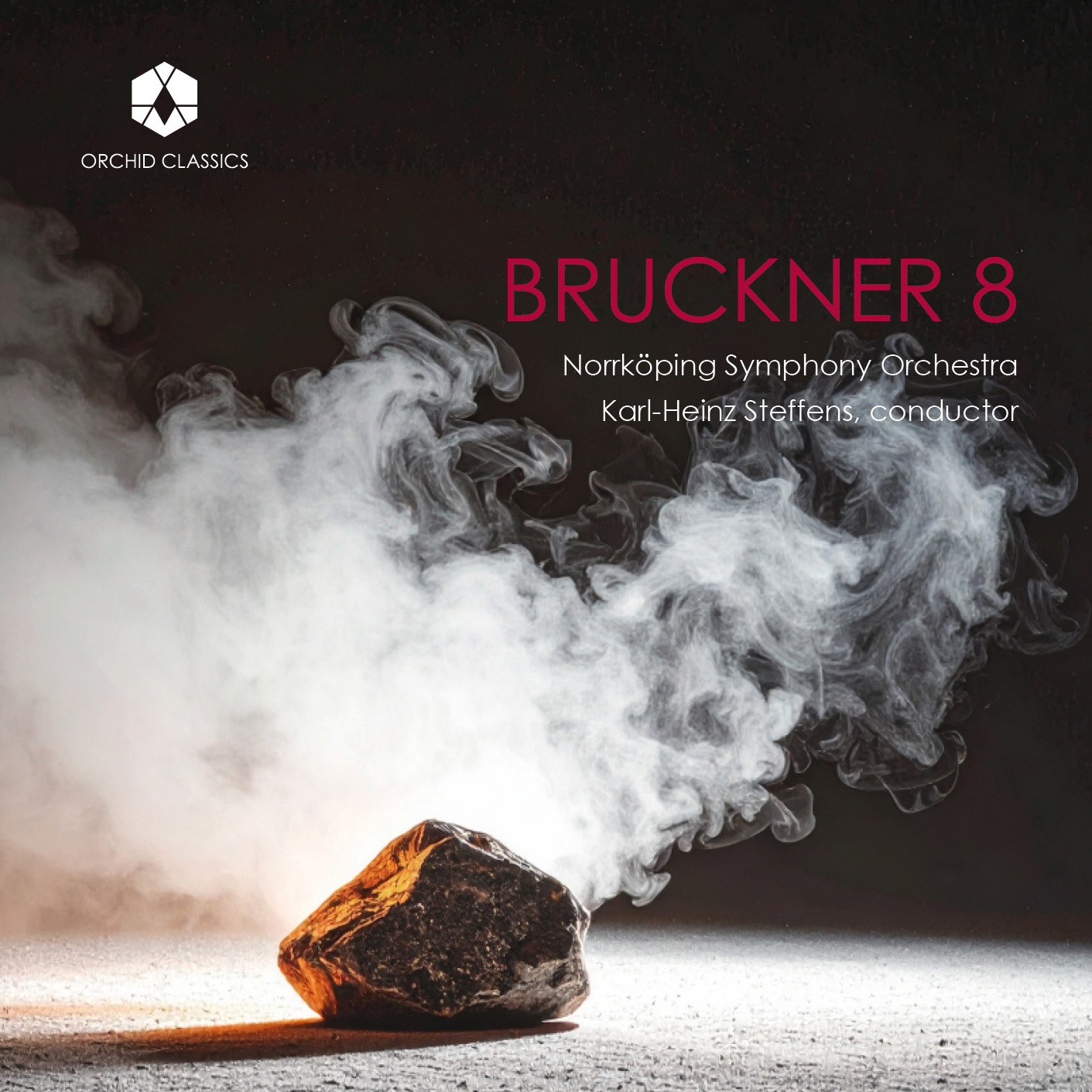
Bruckner 8
Norrköping Symphony Orchestra
Karl-Heinz Steffens, conductor
Release Date: Sept 4th
ORC100479

Anton Bruckner (1824-1896)
Symphony No.8 in C minor (Nowak 1890)
1. I Allegro moderato
2. II Scherzo: Allegro moderato – Trio: Langsam
3. III Adagio: Feierlich langsam, doch nicht schleppend
4. IV Finale: Feierlich nicht schnell
Norrköping Symphony Orchestra
Karl-Heinz Steffens, conductor
Shy, socially awkward, obsessive, workaholic: Anton Bruckner’s compositions may have struggled to find acceptance in musical Vienna when he moved there in 1868, but he was also evidently baffling to locals as a personality. Still, he was not entirely without friends. After the disastrous Viennese premiere of his Third Symphony in 1877 (demonstrating, as various reviewers put it, a ‘lack of taste and lack of inspiration’… ‘brain-shattering orchestration’… ‘even before Herr Bruckner has raised his baton, a part of the public was already leaving the hall’), a coterie of young musicians emerged as supporters and admirers of his musical approach. These included Gustav Mahler, still in his teens, and the brothers Franz and Josef Schalk, who were to remain close associates of Bruckner for the rest of his life (and who are deeply implicated in the tangled editorial histories of his later works).
The Third Symphony was a PR shambles. But the Fourth, premiered in 1881, was incredibly well received, and over the next decade Bruckner’s stock went up considerably. When the Seventh Symphony was given in Munich in 1885, it caused a sensation and was rapidly programmed across Europe and America. After decades of wrestling with poor reviews and baffled audiences, Bruckner’s star was finally in the ascendant.
He began composing his Eighth Symphony just a few days after finishing the Seventh. This had become something of a pattern over the years – to move straight from one enormous compositional endeavour to the next. Since he was a professor at the Vienna Conservatoire and an organist at the Court Chapel, Bruckner did most of his composing over the quieter summer months. Half of the Symphony was drafted in 1884, the other half in the summer of 1885. The orchestration was slower, but he finally declared it complete in August 1887.
Unsurprisingly, Bruckner hoped to entrust the premiere of the Eighth to the man who had led that breakthrough performance in Munich of the Seventh: Hermann Levi, an ardent Wagnerian who had conducted the premiere of Parsifal several years earlier. Bruckner sent a copy of the newly completed score to Levi to request his assistance, and Levi was, in principle, very keen to lead the performance. But when he came to study it, Levi found to his dismay that he couldn’t understand the Eighth at all. He eventually confessed to the composer, with as much care as he could, that ‘it is impossible for me to perform the Eighth in its current shape. I can’t get used to it! No matter how wonderful and grandiose the themes are, I consider their execution as difficult, and the orchestration is nigh impossible. Far be it for me to pass judgement: I can only offer you my impression and my opinion on how it would be received by my audience; and I have to be honest with you and tell you that I consider a performance of the 8th as part of my concert season is a risk that I must not take, for your own sake… Please release me from my promise to perform this piece, as I would only conduct it badly.’
This was, understandably, a serious blow to Bruckner. But he thanked Levi for his honesty and, with characteristic diligence and determination, began revising the piece to better suit contemporary audiences and performers. By 1890, a new version was ready and there began a rather farcical ‘pass the parcel’ game of would-be conductors: Levi politely declined and recommended Felix Weingartner; Weingartner agreed and then pulled out; a possible London performance was mooted and then vanished; Levi then did agree but the concert was cancelled. Finally, in December 1892, the work was premiered by the Vienna Philharmonic and its distinguished director Hans Richter.
The Eighth is a work of high drama and impassioned melodies, constructed on the grandest of scales. The opening theme is at first brooding and uncertain, pushing upwards in anticipation only to sink back downwards in disappointment. When it is restated by the full orchestra, the theme’s falling away is gentled and then reversed, leading to a warm rising melody in the violins. From these initial gestures, Bruckner builds a mighty Allegro – sometimes harsh and angular, at other moments rich and tender. Much later, the driving rhythm of that opening theme is given to trumpets and horns on a single note, loud and insistent. Bruckner described this as the Todesverkündigung – the ‘annunciation of death’, before ‘surrender’ in the movement’s hushed close.
The Scherzo circles endlessly around an energetic cascade of falling notes, taut and obsessive: a portrait, the composer explained, of Deutscher Michel, a popular stereotype of a naïve and easy-going German – who ‘wants to sleep’ in the central section but ‘cannot find his beloved’. By contrast, the expansive slow movement references Wagner’s Siegfried and Tristan und Isolde, in deference to one of Bruckner’s most important musical gods. Its tempo marking, ‘Feierlich langsam,’ suggests something solemn and ceremonial: after all, here was a devoutly religious composer who spent the first half of his career as the organist of Linz Cathedral.
Bruckner described the symphony’s finale as depicting a historic meeting of emperors: the German Kaiser Wilhelm I, Austrian Emperor Franz Josef I, and Tsar Alexander III, in 1884. This is all grand fanfares and galloping horses to begin with, but it softens into noble exchanges that recall the slow movement – and Deutscher Michel is also brought into the scene, summoned again after his turn in the Scherzo. Finally we return to the ‘annunciation of death’ theme of the opening Allegro; but this time we also hear the funeral that follows it. And yet that’s not the end. Slowly but inexorably death itself is overcome, and the Symphony ends in a blaze of transfigured glory.
People hurried from the auditorium at the end of every movement of the Viennese premiere in December 1892. The critic Eduard Hanslick, a famous anti-Brucknerian, left just before the finale to sarcastic applause from Bruckner’s admirers. And yet even Hanslick could not bring himself to be entirely negative. ‘In each of the four movements,’ he wrote, ‘especially the first and third, some interesting passages, flashes of genius, shine through – if only the rest of it was not there!’. There’s an element of fiction here, of course, since Hanslick never heard the last movement. But as Bruckner himself wryly observed afterwards, if he had remained, he would have been ‘even angrier by the end.’
Katy Hamilton
The Norrköping Symphony Orchestra
The Norrköping Symphony Orchestra has the reputation of being one of the most exciting orchestras in Scandinavia. The orchestra was founded in 1912 and has a long and rich history, and it holds an important place in the region’s cultural life. Among the orchestra’s principal conductors are distinguished names such as Herbert Blomstedt (1954–62), Okko Kamu (1972–79), Franz Welser-Möst (1986–91) and Alan Buribayev (2007–11).
The orchestra’s main repertoire ranges from Mozart to Mahler, while music from the 20th and 21st centuries is also a vital part of its programming. The orchestra tours regularly in Sweden and abroad. In 2024 it visited the Concertgebouw for the first time, and in 2025 the orchestra performed in the Berlin Philharmonie during Musikfest Berlin.
___________________
Karl-Heinz Steffens
Conductor
Karl-Heinz Steffens is Chief Conductor and Artistic Advisor of the Norrköping Symphony Orchestra since the season 2020-2021. He is recognised as a conductor of great distinction in both the symphonic and operatic worlds. Karl-Heinz Steffens has worked with ensembles such as the Bavarian Radio Symphony, Berlin Philharmonic, Helsinki Philharmonic, Israel Philharmonic, Munich Philharmonic, Orchestre National de Lyon, Royal Stockholm Philharmonic, Toronto Symphony Orchestra and the Tonhalle Orchestra in Zurich, as well as the Radio Symphony Orchestras of Berlin, Cologne, Frankfurt, Hamburg, Hannover, Leipzig and Stuttgart. Until 2022 he was Music Director at the Prague State Opera. Prior to his conducting career, Steffens was a highly respected solo clarinettist who also held several orchestral positions culminating in the successive posts of Principal Clarinet with the Bavarian Radio and the Berlin Philharmonic Orchestras.
similar Artists & Albums