
Daniel Temkin: “Music on! Music on!”
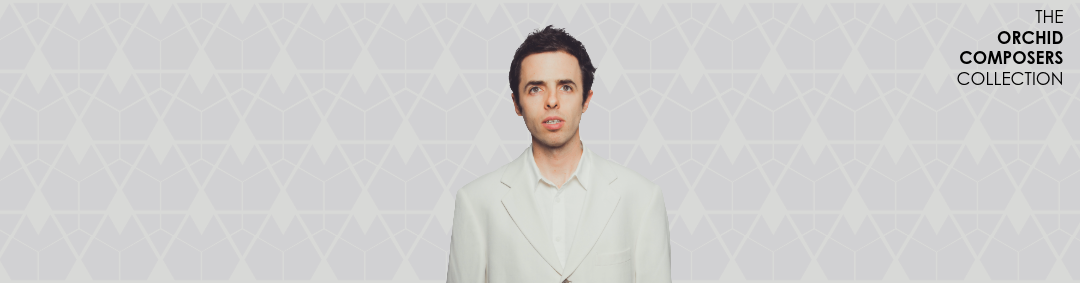
My parents told me that when I was about 2 years old, I would run into their bedroom at full speed early in the morning, point towards the cassette player and speakers, and bounce up and down saying “Music on! Music on!”.
Something about music has always grabbed me, and though I didn’t come from a musical family, or even have access to instrument lessons through school until I was about 11 years old, I was pretty passionate about it from the start. I started playing percussion in school band and youth orchestra, and also drum set in rock and metal bands from my pre-teen years and on. I ended up mentoring with an incredible marimba virtuoso and teacher, She-e Wu, as a teenager, and continuing my studies with her at university, alongside Chris Deviney (Principal Percussion of the Philadelphia Orchestra). They helped me grow so much as a deeper musician, learning to really listen to all of the colors of instruments around me, and they nurtured the deep love for classical music that was always inside of me, even though it wasn’t a big part of my family life at home.
My father was a philosopher – an ethics professor – and his work centered on big questions about how we can treat one another in society, how we can empathize, how we can care on genuine levels (not just superficial ones) about concepts of right and wrong. In my music today, there is clear influence from his paternal teaching and mentorship. I think so much in music about issues of connection, empathy, and our mutual listening experience. My work is neither wildly-niche hyper-intellectual music, nor is it flashy, populist, or oriented in the latest fads or gimmicks. I am trying to think deeply about the world around me — its beauty, its pain, its people seeking connection — and to write earnest, sincere music about our authentic experiences. I think that comes a lot from having a philosophical outlook and having an upbringing that taught me to care and be in tune with others around me.
One of my most important memories with classical music — something that stirred me and stays with me to this day — is playing the finale of Tchaikovsky’s Symphony No. 2 with a youth orchestra when I was about 14.
There are towering opening brass chords, and then they suddenly cut off in a fermata. In the small rehearsal room we were in, even after the brass chords cut off, the lockers and cabinets around the room were still physically shaking in the silence because of the force of the sound waves. I was simply blown away. The physical power of the resonance was remarkable.
And there were a few other instances like that — for example, playing Ravel’s Daphnis and Chloe and Stravinsky’s Petrushka as a student with the Aspen Festival Orchestra — where I heard a sort of palpable, visceral, physical ringing of sound around me. There is simply nothing like it! Standing there in those moments was as exciting as riding a roller coaster, of being at a rock concert!
I knew I had a certain predilection for music that was deeper than any of my other interests (which included sports, civics/political science, and more). There wasn’t a doubt in my mind that I was made for music, and music was made for me. But understanding my full musical identity took a long time.
As a percussionist, I had played in heavy metal bands, and also in classical orchestras. I had also studied aesthetics and philosophy. I wasn’t sure how these worlds all came together, even though I was passionate about them. Composing became the confluence: I could write music that brought people together in intimate chamber settings I liked to play in; I could explore cool techniques and facets of classical orchestration; I could mix in influences of timbre, architectural singularity, and harmony from my time in metal bands; and I could weave in philosophical ideas that always interested me. Composing became the way that my full identity – its performative instincts, raw creativity, and intellectual passion – could all come together in harmony.
I love being able to write a piece of music that can physically move someone in a concert experience. I have watched people hold their breath in a concert when a performer is stretching a phrase I’ve written just before arriving at a cadence. I’ve seen audiences moved to tears in a moment where performers on stage felt deeply connected in the emotional arc of something I’ve written. I’ve seen eyes light up when a towering chord is ringing in an orchestral piece I’ve composed. Knowing that I am connecting with someone inside their minds and hearts as they hear something I’ve written is one of the most powerful experiences I have had, and it is so unique. It’s something I will never take for granted in terms of how lucky I am to be a composer.
There are moments in our lives that are bigger than ourselves — whether it is standing on a mountain looking out at the ocean, or going through a personal experience that helps you feel a connection between your past and your present. I hope that the music on this album helps us explore and celebrate the richness of those sorts of moments, and I hope that listening can help put us in touch with those sorts of special experiences. It goes so far beyond the latest tech gadget or media headline, and it is important for us as humans to connect to those deeper parts of ourselves and the world around us!
I’ve been extremely fortunate in my life. I’ve had good health and love from those around me. I’ve had support and belief for the work I do. I’m incredibly lucky in this sense.
Professionally, being a composer can seem glamorous from the outside, because the public usually encounters us at a performance, or maybe seeing us taking a bow when we are dressed up for the concert. But, people don’t always realize the full blood, sweat, and tears that go into creating a piece of music from nothing. The early stages of the piece, with raw ideas and doubts, can be very odd and dubious. The hours and hours and hours of labor that go into writing and re-writing drafts, engraving the music into the computer, and more, are such a solitary activity. Composing can be very, very lonely. And this is something we don’t always acknowledge.
When composers are pouring their life into their craft, and then other societal forces or trends and fads start to sweep through and leave them without performance opportunities or avenues to share their art with the world, that can be really devastating. If there were ways to promote more opportunities for living composers, and to truly nurture a sense of community between composers working across different styles, I think it would make our profession, our sense of purpose and belonging in society, a lot stronger and more meaningful. And I think it would be a lot less lonely to be a composer.
TRADITION OR INNOVATION?
“Humans have found ways to connect their societies across epic time spans. We shouldn’t simply replicate the past, of course we should create anew and be of the moment in our time. But, if we are so bent on innovation that we lose all sense of history or connection to the past, we lose a vital connection to who we’ve been as societies.”
PREPARATION OR IMPROVISATION?
“Learn to create fluidly and smoothly. Find your own voice through repeated experimentation. Discover brilliant accidents you may never have stumbled on through predictable exercises or method books.”
SMALL MUSIC OR BIG MUSIC?
“Big music of the orchestra has something that I’ve never experienced anywhere else. But the intimacy and emotion of some small music — the color in a chamber work by George Crumb or Takemitsu, the dramatic poignancy of an art song — there is such poetry and humanity in all this that it is, simply put, vital.”
PASSION OR PRECISION?
“Passion. 100%. Every day. Twice on Sunday! The way performers communicate a phrase with emotion and passion is exactly what makes classical music so utterly human and so utterly vital.”
BACH OR BEETHOVEN?
“Bach’s music flows with profound mystery. It is elegant. It is fiery. It is beautiful. It is engaging. And yet for all our analyses of his harmonic or cadential formulae, there is a sort of profound mystery as to why it moves us so deeply when we hear it. Bach is simply incredible.”
___________________________________________________________________________________
We live in a world that is increasingly siloed by technology. We are losing connection to one another physically, and we are living lives that are fragmented by soundbites, tiktoks, and internet ads flashing at us. We are also becoming increasingly divided, with algorithms and news media scare tactics pushing us away from one another as a way to drive up ratings.
Music, and especially classical music — which has longer time arcs, ringing sound and silence, and melodic shapes — beckons us back into a place of mindfulness and awareness. Our listening experience can become cathartic. We can slow down, and think, and feel present through the music as it inhabits us through our ears, hearts, and mind. Music is in a unique place to help us feel engaged and connected to one another as we listen. And it can help lead us towards places of awareness, empathy, and love. This is vital now more than ever.
The deep blues of Yves Klein paintings or the ocean. I’m not literally synesthetic, but certain harmonies and chords have a particular sensual depth for me in my mind’s eye. (You can hear some of this in chords I’ve written in my piano work Dreamed Landscapes — Mvts II and III.) Certain hues that have a richness just so, like the depths of the ocean, or in a Klein canvas, are the closest visual version of that I can think of.
Florence, Italy is a very special place. I was there on my honeymoon with my wife. We walked through the brick-laden streets for hours, we breathed in the fresh green of the Boboli Gardens, and we stood on the hills looking down across the Tuscan region. There was a certain, particular beauty — if, admittedly, old school — that touched us both deeply. I don’t know if I have a “favorite” city, but being there is as special a place as I can remember.
I played competitive beach volleyball as a kid — loved it, very passionate. I love to watch English Premier League (the beautiful game!). I am also a big Green Bay Packers fan (American football), because my family is all from Wisconsin. We still watch many of the games together each season — tuning in from different places and texting each other reactions when we score.
I’m not sure I have one — I try not to be swept up in the notion of celebrity. I have always had an artist-crush on conductor Esa-Pekka Salonen, and on filmmaker Christopher Nolan. Both have captured such profound moments in their art. I deeply respect leaders who serve a greater cause — whether major public figures or local mentors. Figures like Jennifer Higdon, Tania León, and Augusta Read Thomas inspire through both their work and their support of others.
On a personal level, I would choose my paternal grandmother. I would love to tell her about my daughter and how her values continue through generations. On a broader level, I would be fascinated to meet minds like Albert Einstein, Leonardo da Vinci, or Teddy Roosevelt — individuals whose curiosity and vision shaped the world.
Passion. 100%. Every day. Twice on Sunday! The way performers communicate a phrase with emotion and passion is exactly what makes classical music so utterly human and so utterly vital.
Try not to pay so much attention to others, or to outside expectations. Learn to love yourself, and try to care for others — to see them, to recognize their joys or their pain, and to be able to support them in small ways when you can. You will realize that by finding ways to connect with others, whether big or small, it will leave you more fulfilled inside.
Finding connection with others, and finding ways to let love into our hearts. These sound like utter clichés, but they are fundamental in societies in every period of human history.