Artist Led, Creatively Driven
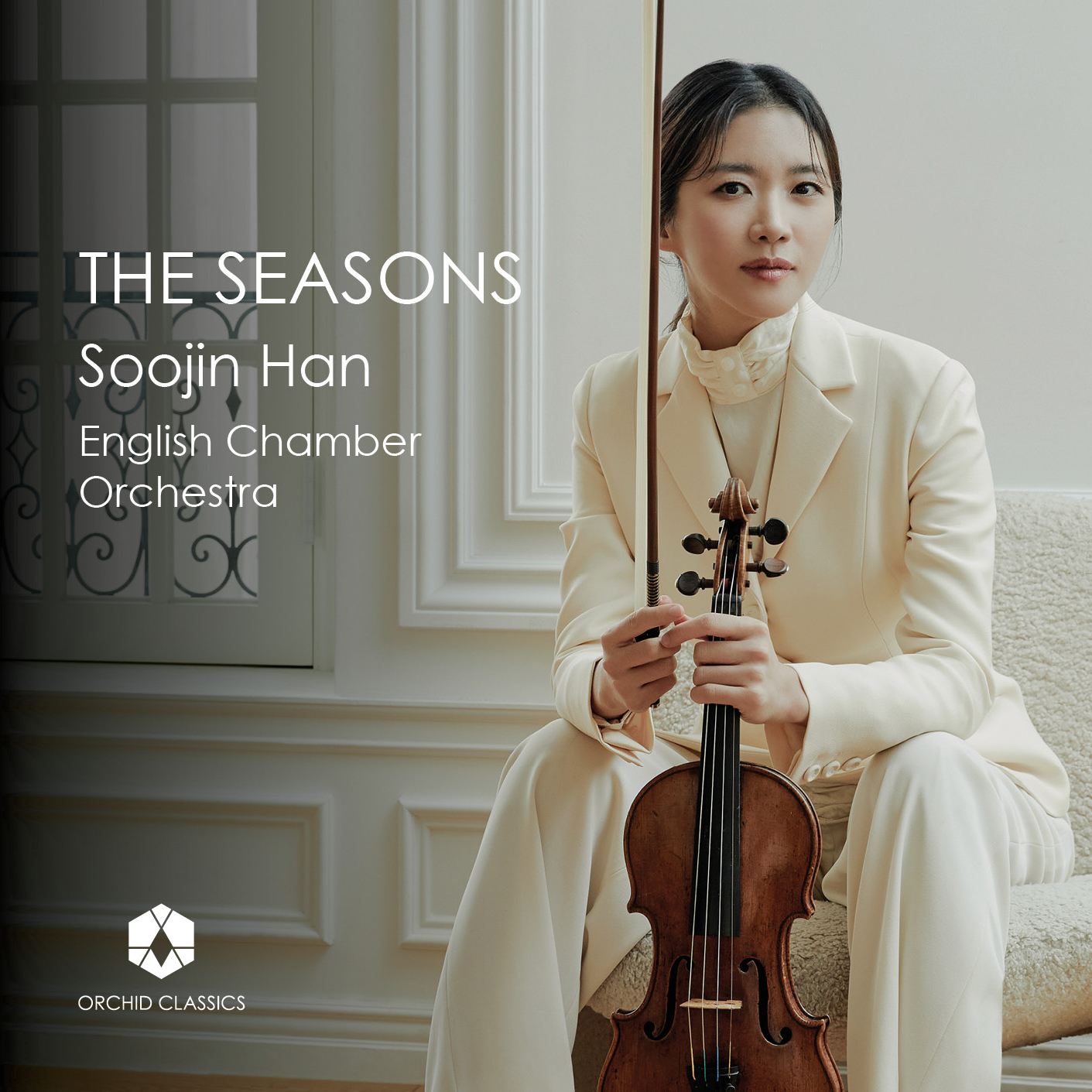
THE SEASONS
Soojin Han, violin
English Chamber Orchestra
Release Date: September 25th
ORC100435

Astor Piazzolla (1921-1992)
Las cuatro estaciones porteñas (The Four Seasons of Buenos Aires)
1. Verano porteño (Summer of Buenos Aires)
2. Otoño porteño (Autumn of Buenos Aires)
3. Invierno porteño (Winter of Buenos Aires)
4. Primavera porteña (Spring of Buenos Aires)
Arranged for violin and string orchestra by Leonid Desyatnikov
Antonio Vivaldi (1678-1741)
Le quattro stagioni (The Four Seasons), Op. 8
Concertos Nos. 1-4 from Il cimento dell’armonia e dell’invention
Concerto No. 1 in E major, RV 269 “La primavera”
5. I Allegro
6. II Largo
7. III Allegro (Danza pastorale)
Concerto No. 2 in G minor, RV 315 “L’estate”
8. I Allegro non molto
9. II Adagio
10. III Presto
Concerto No. 3 in F major, RV 293 “L’autunno”
11. I Allegro
12. II Adagio molto
13. III Allegro
Concerto No. 4 in F minor, RV 297 “L’inverno”
14 I Allegro non molto
15 II Largo
16 III Allegro
Soojin Han, solo violin/director
English Chamber Orchestra
Ofer Falk, concertmaster
Nature has held an important place in my heart for as long as I can remember. I was born in the port city of Busan, and the first word I spoke after “Mum” and “Dad” was “the sea.” When my family moved to the UK, we spent the first three and a half years on the Isle of Man, an island of unspoilt natural beauty. There, among green meadows, their inhabiting creatures, and the ever-present sea, I grew up immersed in nature’s colours, sounds, and shifting moods. During this time, Vivaldi’s Four Seasons became part of the soundscape of my childhood.
Hearing nature through music, and music through nature, shaped a fundamental part of my musical identity. For me, the seasons were never abstract ideas, but living experiences – felt in the changing wind, light, and air of the land and sea.
Many years later, when I encountered Piazzolla’s Four Seasons of Buenos Aires, I was immediately struck by how differently the same idea could be expressed. While Vivaldi’s seasons largely reflect the rhythms of the natural world, particularly the countryside, Piazzolla’s seem to emerge from the city and the sea. Like Busan, Buenos Aires is a port city, and in these works the moods of the ocean intertwine closely with human emotion. The music feels urban and restless, nostalgic and raw, suffused with a romantic lushness that speaks as much of inner weather as of climate. These seasons record not only the passing of time, but also shifts in emotional states and memory.
Throughout history, nature has been a spring of inspiration for countless composers – a place of retreat, contemplation and rejuvenation. In this same spirit, I hope this recording may offer a space of healing and restoration: a moment in which to be transported to different realms, and to reconnect with something both greater than ourselves and with our inner voice.
Placing these works side by side became a personal journey: a dialogue between nature and humanity, between childhood landscapes and adult perspective, between the outer and inner worlds. This album traces that journey, and I invite you to rediscover the seasons, not only as they unfold around us, but as they resonate within us.
Soojin Han
________________
As Soojin Han explains in her note, a journey through the seasons can reveal as much about the inner worlds of the traveller as it does about the outer realities of a given time or place. This programme brings together an early, enormously successful example of programme music, with a mid-twentieth-century depiction of a very different place, and from a very different perspective: one pictorial, the other seemingly as much about emotional seasons, memories and hopes, as it is a portrayal of 1960s Buenos Aires.
In 1725, the year of his forty-seventh birthday, Antonio Vivaldi published Il cimento dell’armonia e dell’inventione Op. 8. The grand title of this set of twelve concertos refers to a contest: between harmony, which represents a traditional and rational approach to composition; and invention, the fire of imagination and novelty. Opening the opus is Le quattro stagione – The Four Seasons, a sequence of works that were to have a profound influence on composers across western Europe. They were printed with sonnets at the head of each of the season, probably written by Vivaldi himself; and although these are somewhat poetically clunky, they reveal a string of vivid scenes that the composer wished to conjure in his score.
La primavera was the most popular of the set both during and immediately after Vivaldi’s lifetime. Indeed, the composer himself ‘borrowed’ his own opening theme here in both Il Giustino, an opera written for Carnival season in 1724, and a chorus from a Venetian stagework, La Dorilla in Tempe, two years later. Quite where La primavera fits chronologically into this sequence is less clear, since the concertos were clearly in circulation in manuscript before they were published. But it’s hardly surprising that Vivaldi would want to make the most of such a theme. It’s graceful and sunny, replete with chirping birds and gently burbling brooks – and later, we sense storm clouds lurking on the horizon. The Largo murmurs and sings, always with an unsettling edge, until we swing into a lively dance of nymphs and shepherds celebrating the burgeoning of a new year. This concerto inspired at least three French works for various vocal and instrumental combinations, and it was sufficiently popular that in 1730, King Louis XV put together a scratch orchestra of Parisian noblemen to perform it for him.
L’estate is rather different: overwrought and overheated. Vivaldi’s sonnet describes it as a ‘harsh season’, and the opening movement wilts and slumps as cuckoo, turtle dove and goldfinch sing in the solo violin. A brief slow movement, anticipatory and restless, is swept aside by the arrival of a ferocious hailstorm. This is followed by the delighted relief of L’autunno, as farm labourers celebrate the completion of the harvest. The soloist staggers in, cheerfully drunk, until (s)he eventually falls asleep to long, droning notes just before the first movement’s close. In the Adagio molto, the cool air lulls many more to slumbering oblivion; and then we hear the neatly cantering finale, a vivid depiction of a hunt, the soloist taking the role of the pursued animal as it flees and eventually dies, to the obvious satisfaction of the riding party.
L’inverno is the sound of a deep-frozen winter, teeth chattering in the biting wind as the whole ensemble shudders with cold. Vivaldi clearly felt that he had found the perfect musical analogue, and the opening phrases recur in several of his later vocal works where it accompanies a text beginning ‘I feel frozen in every vein’. The cosy Largo provides a moment of reprieve, a scene of blissful contentment by the fireside as the rain taps at the windows. And by the closing movement our musicians have found a new winter hobby. We hear the violin sliding unsteadily as the players taken their first steps onto the ice, push themselves into a hard run across the cracks and steadying their wobbling skates. Eventually, as the winds roar around them, we feel the flight and freedom of their movement. ‘This is winter,’ Vivaldi’s sonnet concludes, ‘but of a kind to bring joy.’
240 years later, a brilliant Argentinian bandoneon player journeyed across the United States of America and onwards to Brazil and Uruguay. Astor Piazzolla, the forty-four-year-old leader of the Quinteto Nuevo Tango, had been invited by his government to undertake this tour as a way of showcasing the best of Argentine culture. He was astonished to discover just how many leading musicians were avid followers of his recordings, and eager to hear his ensemble in live performance. Piazzolla had been playing the bandoneon in tango ensembles in Buenos Aires since the late 1930s; but in subsequent decades he also studied composition and counterpoint, with the ambition of writing larger-scale concert music. He learned first with fellow Argentinian composer Alberto Ginastera and later travelled to Paris to have lessons with the famous French pedagogue Nadia Boulanger. Boulanger encouraged Piazzolla to draw on his deep understanding of tango as a means of building his own unique compositional language, and this had a profound impact on his confidence and creativity.
In 1965, the year of his tour to America, Brazil and Uruguay, Piazzolla composed Verano porteño as part of the incidental music for Alberto Rodríguez Muñoz’s play Melenita de oro. ‘Porteño’ literally means ‘port city person’ and is used colloquially to describe the residents of Buenos Aires, a kaleidoscopically cosmopolitan city whose denizens consider themselves highly sophisticated – and just a little pessimistic. This movement is a depiction of summer in Buenos Aires, and the inspiration is audible: Vivaldi’s Venetian seasons, with direct quotations from L’estate. But this is summer of Argentinian tango. Close and crowded, languid and seductive, its sweeping string harmonics hint at the voices of gulls crying out across the harbour.
Piazzolla recorded Verano porteño in 1965; but it was only four years later, in 1969, that he composed three further pieces to make a seasonal cycle, and recorded the complete set with pianist Osvaldo Manzi, guitarist Cacho Tirao, double bassist Kicho Díaz and violinist Antonio Agri. Now we hear Otoño porteño (Autumn), biting and foggy, with a resonant, singing cello solo that seems to hint at the mellow and melancholic aspects of the season. Invierno porteño (Winter) is not a little mournful, violin and cello duetting with their hearts firmly on their sleeves, recalling happier times as the temperature falls and the cold begins to bite. Again, Vivaldi appears in direct quotation here, in the solo violin and the cascading scales of the full ensemble – and towards the very end of the piece, in the warm flicker of the fireside as we look to happier times ahead. Piazzolla’s set closes with the hopeful energy of Primavera porteña (Spring), which blows in with brisk winds and a bite in the air. Its tender central section hints at romance: a lover lost who may come home? A memory of past springtimes shared? But our opening music returns, bristling with energy, and we are left alone to anticipate what the new year might bring.
On this album, we hear Las cuatro estaciones porteñas arranged between 1996 and 1998 by the Ukraine-born composer Leonid Desyatnikov. A highly successful composer of film and concert music, Desyatnikov’s arrangement brings Piazzolla’s Vivaldian hat-tips to the fore in a colourful dialogue of composers across the centuries.
© Katy Hamilton
Soojin Han
Violin
“A wonderful and deeply sensitive young violinist of extraordinary refinement and expressive depth, impressing me not only with her exceptional technical ability but also with her great musical integrity and sincerity.” – Gidon Kremer
Having moved to the UK at the age of two, Korean-born violinist Soojin Han began studying the violin at eight and went on to receive a distinguished musical education at the Yehudi Menuhin School, the Purcell School with Felix Andrievsky, Oxford University, the Royal Academy of Music in London, and the Kronberg Academy, where she studied with Ana Chumachenco.
Soojin has appeared as a soloist with leading orchestras including the London Symphony Orchestra, Tokyo Philharmonic, Seoul Philharmonic, and Poznań Philharmonic, and has performed in some of the world’s most prestigious venues, among them the Concertgebouw Amsterdam, Suntory Hall Tokyo, the Seoul Arts Center, and almost all the major concert halls in London. Her performances have been broadcast internationally on European, Korean, and US radio.
She first gained international recognition as the youngest top prize winner in the history of the Wieniawski International Violin Competition (2001), receiving numerous special awards including the Critics’ and Journalists’ Award. Further national and international prizes, most recently the Korean National Academy of Arts’ Young Artist of the Year 2023 in the Classical Music category – one of the highest honours awarded to Korean artists under 40 – have confirmed her standing as one of the most distinctive violinists of her generation.
An ardent chamber musician, Soojin has collaborated with András Schiff, Gidon Kremer, Yuri Bashmet, and Frans Helmerson, and was a regular participant at IMS Prussia Cove. Her artistry is also documented in her debut recording on Warner Classics. Beyond the concert stage, she serves as the Classical Music representative on the Committee for Cultural Exchange of the Korean Ministry of Foreign Affairs, is deeply engaged in education and charitable initiatives, gives speeches at international forums, and writes columns for major newspapers and magazines. Soojin Han performs on a 1666 Antonio Stradivari, generously loaned by an anonymous benefactor.
______________________
English Chamber Orchestra
The English Chamber Orchestra (ECO) has been performing throughout the UK and internationally for over 60 years and is the most recorded chamber orchestra in the world. Founded in 1960, with Benjamin Britten as its first patron, the ECO has worked consistently with many of the most significant figures in classical music.
The orchestra continues to build upon its distinguished tradition of maintaining the highest international musical standards, nurturing new talent, and championing the very best of British music and musicianship.
Alongside its close association with Benjamin Britten, the ECO has toured extensively in the UK and abroad with artists including Daniel Barenboim, Dame Janet Baker, Sir Colin Davis, Plácido Domingo, Jacqueline du Pré, Dame Kiri Te Kanawa, Yehudi Menuhin, Luciano Pavarotti, Murray Perahia, Itzhak Perlman, André Previn, Karl Richter, Mstislav Rostropovich, Sir Georg Solti, Mitsuko Uchida, Maxim Vengerov, and Pinchas Zukerman.
Recent tours have included performances across Europe, the Americas, and Asia, alongside regular appearances at major London venues such as the Royal Festival Hall, Queen Elizabeth Hall, Kings Place, and Cadogan Hall.
His Majesty King Charles III has been Patron of the English Chamber Orchestra since 1977. The orchestra has performed at numerous high-profile Royal occasions, including the first concert ever broadcast from Buckingham Palace. The ECO has also recorded many acclaimed film soundtracks, notably Dario Marianelli’s Academy Award®-winning scores for Atonement and Pride & Prejudice.
The orchestra is proud of its outreach programme, Close Encounters, which works with communities and schools in the UK and internationally to expand access to music and performance for future generations.
similar Artists & Albums