Artist Led, Creatively Driven
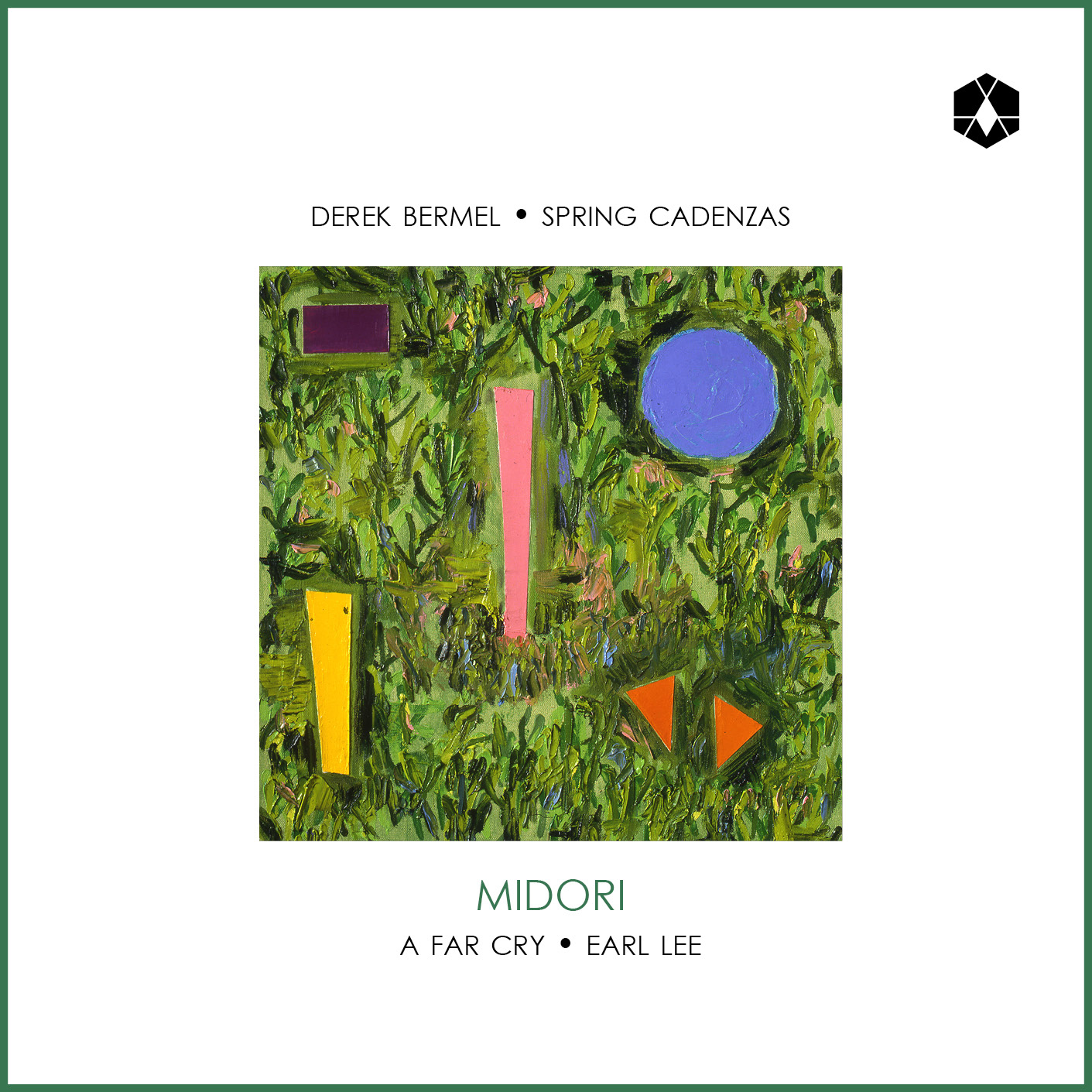
DEREK BERMEL – SPRING CADENZAS
Midori
A Far Cry
Earl Lee
Release Date: Aug 28th
ORC100481

Spring Cadenzas
Derek Bermel (b. 1967)
I. fields, mountains
II. wake, butterfly
III. unknown spring
Midori, violin
A Far Cry with Project STEP
Earl Lee, conductor
Reflections on Spring Cadenzas
I compose for instrumentalists, rather than instruments. This was a credo of my teacher William Bolcom, and one can also locate this specificity of focus in Duke Ellington’s scores; he indicates “Cootie” or “Russell” next to musical phrases that invoke the personalities and quirks of those members of his ensemble. Artistic collaborators have become my most essential teachers, and the story of composing Spring Cadenzas is linked to my friendship with Midori. The piece’s evolution took twists and turns that neither of us could have predicted at the outset, but one constant throughout the process was the invaluable feedback Midori provided on the nuances of string playing. Her extraordinary artistry, brilliant technique, and inquisitive yet exacting nature engendered insights from both practical and aesthetic perspectives, reflecting the work back to me in multiple dimensions through the lens of her violin mastery.
Midori wrote me in the fall of 2020 to ask for a concerto to perform as part of her Orchestra Residencies Program. I had written a set of violin etudes for her a decade earlier, and I knew that she was passionately devoted to education. But at this moment the whole world faced a particular challenge; COVID-19 was raging internationally, and all the facets normally comprising a student’s music education – tuning, ensemble playing, interaction with others – had disappeared in a flash. Attempting to overcome our massive and sudden isolation, orchestras turned to technological solutions. Projects often required musicians to record their part over a click track, to be collectively assembled later by engineers. Computer programs that had been largely experimental were being frenziedly road-tested by the arts establishment, presenters were pouring whole budgets into remote technology, and applications – explored mainly in university settings – were exploding into mainstream use and being touted as indispensable tools.
In this highly specialized environment, Midori was concerned that youth orchestras were not getting a chance to rehearse and perform together. She and I discussed whether we could – in this moment – place community back at the fulcrum of music-making, finding ways for young musicians to continue honing their listening skills remotely and without access to expensive hardware and software. From a real-time musical perspective, the most intimidating obstacle we faced was latency. Those annoying laws of physics dictated that participants in a remote ensemble needed to be situated within a circumscribed distance of each other; if not, a chaotic misalignment of timing was almost certain to ensue. And inserting a remote conductor and soloist into the mix made the headaches multiply exponentially.
With all these red flags waving, I elected to navigate directly into the wind. So I began sketching a concerto structure with latency as a feature, rather than a drawback, centering Midori as the linchpin. During my student days, I had witnessed a fascinating performance of Ligeti’s Piano Concerto – a work with the baroque sensibility of continuous motion in the solo part – in which the ensemble continually fell apart but the pianist soldiered on, anchoring the piece. That bizarre remembrance prompted me to envision a series of cadenzas linked by common musical material. Those cadenzas, I reckoned, could form the concerto’s skeleton, and if technology faltered or lagged, Midori would continue to play; so as long I kept the aligning points “soft”, the structure would remain fundementally intact. In other words, reversing the function of cadenzas – from extensions to focal points – paved the way for unity in the wake of latency.
Since a finite number of players could participate in sessions without overloading internet connections, the original version’s orchestration was limited to an opening movement for strings and a finale for winds only, with a middle movement that Midori performed solo. We sought an engineer/producer/sound designer to perform the complex task of mixing and rendering a live audio and video feed. To our great fortune, we found Trevor New, a wizard of real-time video performance, who steered us brilliantly through the technological tempest, allowing us to make music with talented young musicians in orchestras all over the country – Indiana, Florida, New Jersey, Massachusetts, New York, Colorado. Wonder suffused the process; we viewed the whole initiative as a kind of collective experiment, stepping into a space knowing that any failures along the way would be remedied by the success of the larger creative endeavor.
The musical material itself draws from three Basho haiku that serve as both poetic and visceral inspirations for the individual movements, which unfold without pause:
Fields, mountains
of Hubaku. In
nine days – spring.
Wake, butterfly –
it’s late, we’ve miles
to go together.
Unknown spring –
plum blossom
behind the mirror.
All the motifs felt naturally embodied in Midori’s own brilliant violin technique, but each also contained contradictory impulses that offered possibilities for inner drama – in the opening movement bubbling arpeggios tempered with an icy octatonic retort, in the second movement a sighing, stretching melody colored by a descending chromatic bass, and in the third movement gestures that diverged startlingly, at first snaky and searching, then hovering, jittery, fluttering.
Midori had always envisioned continuing to perform the work once some “normalcy” returned. To that end, as the pandemic began to recede, I expanded the orchestration to the full version heard on this recording, rendered with refinement and care by producer Jesse Lewis and his talented team at Immersive Music Project. I’m grateful for the musicality breathed into it by the virtuosic orchestra A Far Cry along with the inspiring young musicians from Boston’s STEP Program. And, of course, to Midori, the beating heart of Spring Cadenzas.
Derek Bermel
Midori
Midori is a visionary artist, activist and educator who explores and builds connections between music and the human experience. In the four decades since her debut with the New York Philharmonic at age 11, she has performed with many of the world’s most prestigious orchestras and collaborated with world-renowned musicians including Isaac Stern, Leonard Bernstein, Yo-Yo Ma, and many others.
Committed to expanding the violin repertoire, Midori has collaborated with composers including Brett Dean, Derek Bermel and Detlev Glanert, among others, and looks forward to upcoming collaborations with Thierry Escaich and Jörg Widmann.
An essential part of Midori’s life and career has been her dedication to furthering humanitarian and educational goals. She has founded several non-profit organizations to bring music to children and underserved communities, including the New York City-based Midori & Friends as well as the Japan-based MUSIC SHARING and its ICEP program, which bring music to young people in Japan and developing areas of Asia. Through her Orchestra Residencies Program (ORP), Midori supports young musicians in youth orchestras through hands-on artistic collaboration that emphasizes creativity and development over competition. Her work with ORP and in other educational contexts has led to commissions like Derek Bermel’s Spring Cadenzas (for ORP) and a series of interactive pieces by Hannah Ishizaki (for MUSIC SHARING).
In recognition of her work as an artist and humanitarian, she serves as a United Nations Messenger of Peace, and in 2021 she was named a Kennedy Center Honoree.
Born in Osaka in 1971, she began her violin studies with her mother, Setsu Goto, at an early age. Midori recently joined the faculty of the Juilliard School; she is the Dorothy Richard Starling Chair in Violin Studies at the Curtis Institute of Music in Philadelphia and Artistic Director of Ravinia Steans Music Institute’s Piano & Strings program.
______________
Derek Bermel
Composer and clarinetist Derek Bermel is a musical omnivore, equally at home at major concert halls and pop music clubs and festivals worldwide; the San Francisco Chronicle writes, “To listen to his music is to run across a wealth of influences, from Bartók and Stravinsky to big band, and from early-period rap to Bulgarian folk music to West African drumming. Also, it seems, theoretical physics.”
Bermel’s performance of his own clarinet concerto Voices on BMOP/Sound was nominated for a GRAMMY, and he has presented it with orchestras from BBC to Beijing. His discography also includes the also GRAMMY-nominated albums Intonations with the Jack Quartet and Migrations with the Albany Symphony and Juilliard Jazz Orchestra (Naxos), as well as Soul Garden with Chamber Music Society of Lincoln Center (New World/CRI) and Canzonas Americanas with Alarm Will Sound (Cantaloupe).
Bermel has received commissions from the Pittsburgh, National, Seattle, Saint Louis Symphonies, Los Angeles Philharmonic, Chamber Music Society of Lincoln Center, Koussevitzky and Fromm Foundations, and residencies at Tanglewood, Aspen, Nuova Consonanza (Rome), IC Festival (Hong Kong), Kempten Classix (Germany), Asko|Schönberg (Netherlands), and Glimmerglass Opera Festival. His many honors include the Alpert Award in the Arts in Composition, Rome Prize, Guggenheim and Fulbright Fellowships, and the American Music Center’s Trailblazer Award. In 2025 he was inducted into the American Academy of Arts and Letters.
______________
Earl Lee
Winner of the 2022 Sir Georg Solti Conducting Award, Korean-Canadian conductor Earl Lee has emerged as one of the most compelling and versatile artists of his generation. He has led major ensembles including the New York Philharmonic, Boston Symphony Orchestra, San Francisco Symphony, Pittsburgh Symphony Orchestra, Toronto Symphony Orchestra, Atlanta Symphony Orchestra, and the Seoul Philharmonic Orchestra. In March 2026, Lee stepped in on short notice to replace Eun Sun Kim with the Minnesota Orchestra, conducting Beethoven’s Symphony No. 9; a familiar experience, it seems, having already jumped in to replace Zubin Mehta at the head of the Boston Symphony Orchestra with Beethoven 9 back in August 2025.
As Music Director of the Ann Arbor Symphony Orchestra, Lee has revitalized the ensemble’s artistic vision with programming that bridges tradition and innovation. Under his direction, the Ann Arbor Symphony has presented genre-crossing collaborations with artists such as Jacob Collier and Chris Thile, broadening the ensemble’s reach and musical scope.
An advocate of contemporary repertoire, he has collaborated closely with composers including Unsuk Chin, Donghoon Shin, Katherine Balch, Carlos Simon, and Tod Machover, and has given premieres of works by Machover and Balch. A former cellist, Lee studied conducting with Andris Nelsons, Manfred Honeck, Hugh Wolff, Peter Oundjian, Kurt Masur, and Bernard Haitink.
______________
A Far Cry
Described as a chamber orchestra of “vigor, sensitivity, and shared concentration” by The New Yorker, A Far Cry is known for its innovative and compelling programs, stellar communication, and a democratic process that is the group’s north star. A Far Cry was founded in 2007 on the belief that every voice deserves to be heard; so instead of one artistic director, the collective of musicians (“Criers”) curate and submit program ideas inspired by individual curiosities and what is happening in the world at large. As WBUR says, “it’s hard to think of a more consistently adored group than the conductorless chamber orchestra A Far Cry.”
This inherent sense of curiosity led the Boston Globe to say that “even though A Far Cry has decisively established itself as a mainstay of the Boston musical community, something about it feels perpetually fresh with every performance.” A Far Cry has risen to the top of Billboard’s Traditional Classical Chart and garnered two Grammy nominations. In 2023, in a testament to the group’s strength as a collaborator, all three albums A Far Cry released were nominated for a Grammy Award. This includes The Blue Hour (New Amsterdam and Nonesuch Records), Stillpoint (New Amsterdam Records), and A Gentleman of Istanbul (Crier Records).
similar Artists & Albums