Artist Led, Creatively Driven
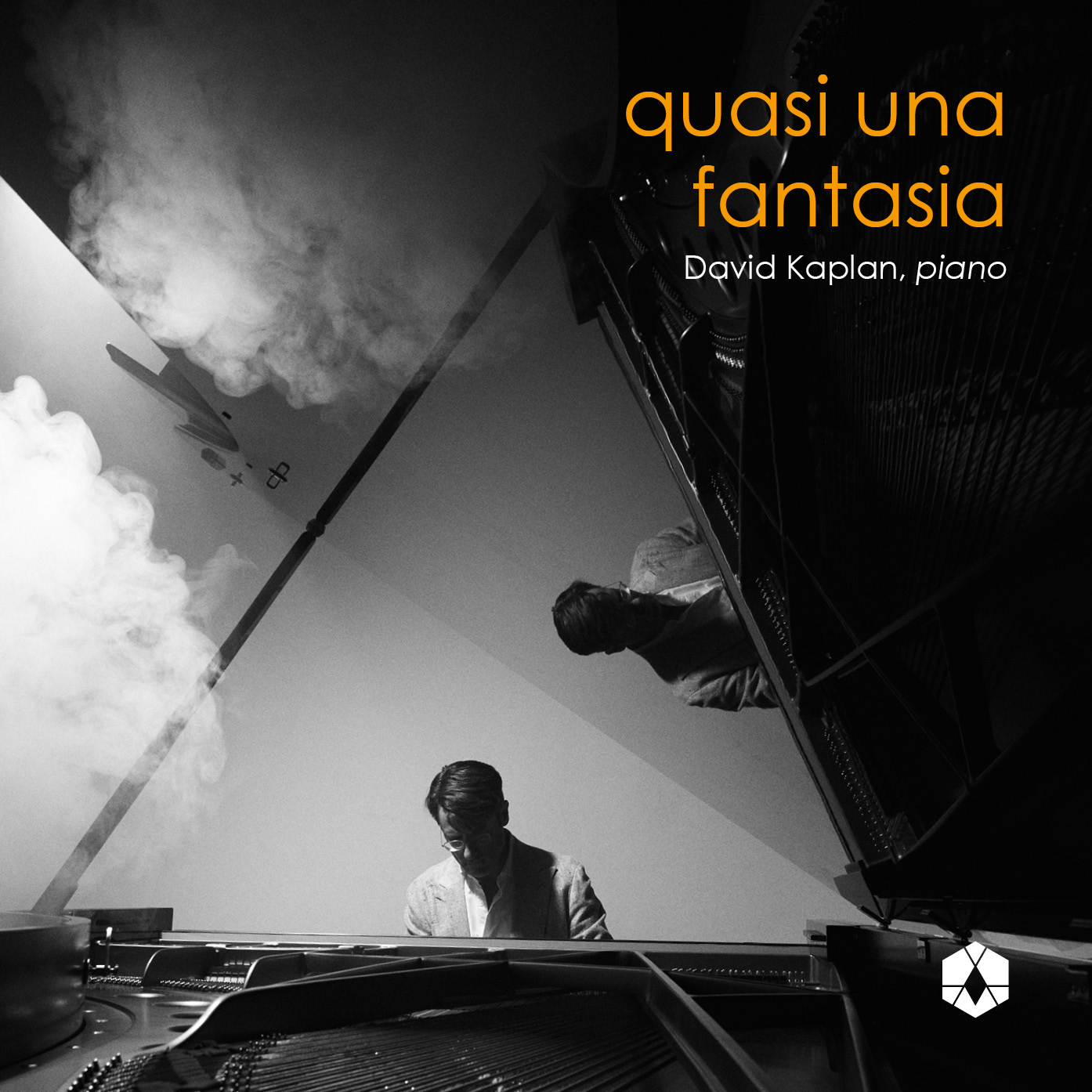
quasi una fantasia
David Kaplan, piano
Release Date: Nov 20th
ORC100506

quasi una fantasia
György Ligeti (1923–2006)
1. Musica ricercata No.1
Christopher Cerrone (b. 1984)
2. Passagework
David Kaplan (b. 1983)
3. (improvised prelude I)
Louis Couperin (c. 1626–1661)
4. Prélude non mesuré
Anthony Cheung (b. 1982)
Holding Patterns
5. I
5. II
7. III
Ludwig van Beethoven (1770–1827)
Sonata quasi una Fantasia, in C-sharp minor, Op. 27 no.2
8. Adagio sostenuto
9. Allegretto
10. Presto agitato
Johannes Brahms (1833–1897)
11. Intermezzo Op. 76 no.4
Andrea Casarrubios (b. 1988)
12. Sandglass
David Kaplan
13. (improvised prelude II)
Robert Schumann (1810–1856)
Fantasiestücke Op. 12
14. Warum?
David Kaplan
15. (improvised prelude III)
Ludwig van Beethoven
Sonata quasi una Fantasia, in E-flat major, Op. 27 no.1
16. Andante
17. Allegro molto e vivace
18. Adagio con espressione
19. Allegro vivace – Tempo I (Adagio) – Presto
David Kaplan, piano
Thoughts on “quasi una fantasia”
David Kaplan
The concept for this album, “quasi una fantasia,” emerged slowly, and partly by accident.
It began in 2020 with a pair of interrelated commissions from my dear friends and colleagues, Christopher Cerrone and Anthony Cheung, through which I hoped to explore the process of mutual influence between composers.
With this theme in mind, I had originally asked Chris and Anthony to consider exchanging seed ideas as the basis for new compositions. They were game, and so each based their two brilliant and distinctive solo pieces on musical elements from their recent piano concertos. Anthony seized on a particular set of pitches in Chris’ concerto, whereas Chris took inspiration from the exotic sound Anthony achieved by applying blu-tac to piano strings.
My programming vision was to anchor Chris’ and Anthony’s pieces on a concert with Beethoven’s Diabelli Variations, but like all the best laid plans, this grand design never materialized. With a crescendo-subito-piano that might have been the ultimate Beethovenian meta musical joke, the shuttering of live performance during the pandemic derailed most people’s plans for the composer’s 250th anniversary, including mine.
In addition to the unique circumstances of those difficult years, the nature of Chris’ and Anthony’s two works also contributed to my change of plans. Once finished, their music suggested to me an entirely different framing, focused less on the concept of mutual influence and cross-pollination than on the elusive boundary between improvisation and composition.
In Chris’ Passagework, which orbits around a single, driving ostinato, the relentless unity of idea mirrors the organic, generative simplicity of a great solo by the saxophonist Chris Potter or the pianist Keith Jarrett. In contrast, Anthony’s Holding Patterns captures the rhapsodic and florid aspect of improvisation in two contradictory ways: it demands literal improvisation through extended passages of indeterminate notation; at the same time, Anthony creates the illusion of improvisation by meticulously notating tautly controlled rhythms and metric modulations – if played just as composed, they sound like the freest improvisation.
The Diabelli Variations, despite the improvisational roots inherent to the variations form, constitute one of Beethoven’s most thoroughly sketched and methodically planned works, finished only after years of tinkering and shuffling. So rather than programming Passagework and Holding Patterns with Beethoven’s over-engineered Diabellis, I felt the urge instead to illuminate their improvisatory qualities, contextualizing them among a range of other works that similarly straddle the boundary between composed and extemporaneous playing. The third commissioned work, Andrea Casarrubios’ unabashedly expressive Sandglass, was born out of this new “quasi una fantasia” theme, and so it naturally embodies many elements of improvisation.
The “quasi fantasia” framing was also apropos for me personally. I had already been in a long process of gradually exporting more and more improvisation from my private practice into public performance – improvising cadenzas in classical piano concerti, extemporizing in the formats of chamber and solo works, and lightly recomposing passages in the reprises of sonata forms.
As a result of the exclusion of improvisation from the core training of classical music, it tends to be poorly understood, and therefore in equal parts pedestaled and feared. At the same time, however, improvisation is nearly ubiquitous in the performance practice of every other genre of music, and was prevalent in classical music as well prior to the era of early modernism. Today, the only classical musicians who typically improvise are those in the somewhat cloistered worlds of early and baroque music, as well as those who perform functional music such as weddings and church services (form must after all follow function, and perhaps the deacon needs a few extra measures to approach the altar). A handful of major artists are known for their public improvising in classical styles, such as Gabriela Montero and Robert Levin, but these are rare and exotic birds.
From a young age, extemporizing at the piano came much more naturally to me than sight-reading. Whereas other children with this affordance might have been drawn to jazz, I remained totally immersed in the world of Bach, Mozart, Beethoven, Schumann, and so too did my improvising. While learning a new Haydn Sonata or Chopin Ballade, I would create fun games for myself by inventing different cadences, sequences, and passagework over the existing harmonic progressions, or re-harmonizing ideas altogether. Improvising in a late classical, early romantic style (“Faux-zart”, i.e. fake Mozart) became a sort of party trick which I nevertheless hesitated to integrate into “real” concert performance.
After all, I was raised in the 20th century temple of New Objectivity and Werktreue – the modernist concepts dictating that the essence of a musical work lies in the “composer’s intent,” and that this intent can be realized only through practicing a kind of devotional fidelity to the printed, urtext score. Within the notion of Werktreue, the ideal performer is one who communicates dynamically to an audience, but who ultimately serves the music first. I once heard the conductor and pianist Daniel Barenboim say that a truly great performer is rare, because they must be both arrogant enough to believe their interpretation singularly valid, and humble enough to remain subservient to the composer.
While I still can’t escape that basic philosophical impulse to deeply consider and honor the “intent” of a composer, I have thought deeply about how I might redefine that intent differently from the tradition I received from my teachers, and from the vast unconscious aural memory of 20th century recordings and performances. Through this process, I have come to regard classical era scores as “modular” and pliant documents, not sacred tablets intended for eternal posterity. Like IKEA shelving, a good published piece in the late 18th and early 19th centuries had to be designed well enough to function in a wide range of circumstances: it had to retain its basic musical facts, meaning and impact whether played by professional virtuosi, aspiring wunderkinds, skilled amateurs, and even somewhat less skilled (read: bad) amateurs. It had to fulfill its essential function of both entertaining and challenging players and listeners alike, and had to withstand countless variables – whether someone played a treble part on the flute or the violin, whether movements were played in or out of a particular order (or not at all), whether or not people elected to take a repeat, whether or not a household had the latest, most tricked-out instruments.
I think of Mozart’s pride in his keyboard concerti K. 413, 414, and 415, which he performed himself, but obviously intended to be accessible to other keyboardists as well. He explicitly engineered the pieces like good modular shelving units, to function equally well in a range of spaces. Mozart attempted to “crowdfund” the concerti by selling them in a subscription model, advertising that they could be performed “not only with a large orchestra and winds, but also á quattro, namely with two violins, viola, and cello,” to appeal to both professional ensembles and amateurs playing at home. They could be played with or without keyboard continuo, for a harpsichord or for the latest Walter fortepiano, with multiple sets of cadenzas suited to different skill levels, or with entirely improvised cadenzi, should a virtuoso keyboardist be able to extemporize themselves. They were also designed to strike a balance between sophistication and light entertainment: in a letter to his father, he boasted that the concerti achieved “a happy medium between too heavy and too light… very brilliant, pleasing to the ear, and natural without being insipid. There are passages here and there from which connoisseurs alone can derive satisfaction, but these passages are written in such a way that the less learned cannot fail to be pleased, albeit without knowing why.” (December, 1782)
The goal of broad dissemination and application, therefore, necessitated a flexibility in compositional concept; and our contemporary interpretation of the printed score needs to account for that flexibility. In my view, this inherent pliability captures more about the “intent” of classical composers than the modernist notions of authenticity, correctness, and the fallacy of a singular “true” performance practice for any given work.
Beethoven was a vanguard figure whose musical ideas exceeded the contexts of his own time, but I believe we can nevertheless apply some of these same concepts of pliability to his scores, and especially so during the period before deafness curtailed his activity as a virtuoso performer. Consider for a moment the scrappy circumstances of the 8am premiere of the Sonata for Piano and Violin, Op. 47, now known as the “Kreutzer Sonata”. The manuscript, which Beethoven had finished copying out only earlier that morning, contains both fully composed virtuoso embellishments, “quasi una fantasia,” as well as unadorned held notes and long pauses. The former would allow an accomplished amateur to emulate the effect of a fiery improvisation, while the latter would afford a true virtuoso latitude to improvise and embellish themselves. The great virtuoso violinist George Bridgetower who first accompanied Beethoven in that early morning premiere must have struggled to see what the composer’s handwritten notes actually were, and so he apparently extemporized a great deal. While in the case of other performers (such as Carl Czerny), Beethoven was occasionally disapproving of such “enhancements,” he was in this case pleased enough that he rose from the piano and embraced Bridgetower. So I think we have to understand Beethoven’s sacred ink as being, on some level, still wet – even if fastidiously researched and engraved editions (in understated blue-hued covers) would have us believing otherwise. Beethoven’s scores too are modular, accommodating a range of approaches; they resist the modernist notion of an ideal, singular, authentic, correct reading.
For composer-performers of the 18th and 19th centuries, printed scores also served the function of providing for a wide audience a simulacrum of their personal performance styles – in other words, their improvisations. We should therefore understand the printed score of 1800 as more analogous to a Beatles album than to a book of Beatles songs. With a keyboard sonata, Beethoven is saying, “This is how I can play. Try it if you dare!”
Given this context, we have to understand the inherent tension between the disparate goals of a printed score. On the one hand, it had to provide the fullest possible realization to enable an amateur player of whatever skill both to experience and deliver emotional impact, and to convey the facts and spirit of a work. On the other, it had to be sufficiently open ended so as not to hamstring the great virtuosi who might perform the work in more elite circumstances; if playing a movement during the interval of an opera, or in a royal court or aristocratic drawing room, the score needed to leave them adequate room to demonstrate their own generative musical prowess, while maintaining the same essential facts and spirit.
We could hardly find a better pair of pieces in which to explore this textual ambiguity than in the two Sonatas “quasi una fantasia” (almost a fantasy), Op. 27 no. 1 and 2. Each one provides a perfect blend between fully realized virtuosity and expression, while occasionally offering latent opportunities for invention. Here and there, a transition or cadence will offer a kind of pregnant space – a cliffhanger moment where a virtuoso would have felt potential energy to be mined in the form of new, unplanned expression and display.
The concert program on this album developed out of my desire to explore those liminal spaces, both amid works – in these wonderful cliffhanger moments – as well as in between works, in the form of improvised transitions and preludes (which were once a ubiquitous feature of instrumental performances).
On this album, just as I do in live recitals, I have interspersed the three relatively substantial works by Cerrone, Cheung and Casarrubios (the Three Cs!) with an eclectic mosaic of preludes, miniatures, and in-the-moment-improvisations.
As for the occasional extemporaneous outbursts that a listener might notice in the Op. 27 sonatas, my goal is to bend rather than break Beethoven. Unlike the post-modern insertions of Frederic Rzewski (he famously improvises for 20 minutes or so in the middle of Beethoven’s Hammerklavier Sonata), my goal is to mine the potential energy latent in a handful of cliffhanger moments, and to imagine what one extra degree of expression, embellishment, excitement, or harmonic invention might have sounded like in 1800 at the hands of a contemporary improvising pianist.
The various pre-composed preludes that dot this album speak to specific elements in the larger works. The Ligeti, which is built on a single pitch, operates with an austerity of content that sets up Cerrone’s dogged ostinato in Passagework. The “unmeasured prelude” of Louis Couperin, whose novel notation gives only pitches, inviting performers to generate their own rhythms, gestures, and phrases, anticipates Cheung’s blend of aleatoric and specified rhythmic notation, both of which literally require improvisation from the performer. The short works of Brahms and Schumann, with their plaintive and questioning expressivity, bookend the ruminative romanticism in Casarrubios’ Sandglass. My improvised transitions between pieces on this album serve a different function, which is to create the illusion of continuity between disparate musical languages, and to synthesize or bridge ideas in adjacent works.
In some ways, the whole mosaic serves to frame the two visionary “quasi una fantasia” sonatas by Beethoven. In each of these pieces, the “quasi fantasia” element inflects a different musical parameter. In Op. 27 no. 2, commonly known as the “Moonlight Sonata,” Beethoven uses the firm ground of simple, stock musical forms as a stable foundation on which to “improvise” extreme and startling content. In the prosaic song that begins the piece, he proposes a radical new sound-world for the developing fortepiano – he indicates in several ways to play pianissimo, as delicately as possible, and always without dampers (with the pedal always pressed down). The resulting effect, in which harmonies melt into one another and the faint sonority threatens to dip below audibility, was not new. As early as the 1750s, C.P.E. Bach extolled playing “without dampers,” quietly and in an improvised context – but Beethoven was among the first to indicate this “song in a deep cave” effect in a printed score, and the first to do so for an entire movement.
After a palate cleanser in the form of a short and sweet minuet, the moto perpetuo finale again presents startling content, raising the bar for piano pyrotechnics. The virtuosic abandon that characterizes improvisation is baked into the composition, and Beethoven challenges the audience of his published work: “can you play as well as me?”
While the “Moonlight Sonata” couches startling content in simple forms, its sibling Sonata, Op. 27 no. 1 in E-flat major takes the opposite approach: it marries humility of content with boldness of form. Instead of the typical interplay and synthesis of themes that characterizes a classical sonata, this piece presents a procession of seemingly unrelated bagatelles, dances nested within one another and juxtaposed in surprising ways. The “fantasia” element manifests in how the music jumps from one simple idea to the next, traversing distant keys, contrasting opposite tempi, and often leaving fragmentary ideas unfinished, hanging in the air.
Just as Cerrone, Casarrubios and Cheung each capture a different element of “fantasia” in their works, Beethoven’s two sibling Sonatas in Op. 27 likewise appear to be fantasies in opposite ways. I hope this album, with its mix of old and new, thorough composition, mock improvisation, and true improvisation, manages to bottle just a little bit of the magic of fantasia.
_____________________
Notes on Holding Patterns, Passagework, and Sandglass.
Holding Patterns (2020)
Taking the opening four notes from the second movement of Chris’ piano concerto, the initial gesture expands, glides, and revolves, sometimes getting blown off course before returning to its point of origin. New patterns emerge, as do melodies embedded within their shifting accents. The second movement’s independent layers are in a state of perpetual drift, until they finally snap together with magnetized strings. The flowing patterns of the final section are rounded off and occasionally made unseen by the pedal, expanding and contracting with flurries of activity.
Anthony Cheung
acheungmusic.com
Passagework (2020)
The second movement of Anthony’s piano concerto features a repeating accompaniment as well as the sound of the piano muted with blu-tac (a kind of poster board putty). I took this as my starting point, to which I added a new effect: that blu-tac can work as not just mute but also a device to retune strings with sufficient pressure. Using blu-tac, three different keys–A, G#, and F#–all sound like F.
While working on the project with David and Anthony, the latter mentioned that his composition had a lot of “passagework,” according to Merriam-Webster, “a section of a musical composition characteristically unimportant thematically and consisting especially of ornamental figures.” Despite the derisive connotation, I loved the term and particularly loved the dual meaning of ‘passage,’ not just a musical figure but also a journey.
Christopher Cerrone
christophercerrone.com
Sandglass (2022)
Sandglass evokes the various states of the sand: the pent-up energy of the waiting particles, the inevitable cascade they experience, and the implacable yet deliberate transformation into stillness and acceptance as we watch time, literally, run out.
Andrea Casarrubios
www.andreacasarrubios.com
David Kaplan is a New York-born piano soloist and chamber musician currently based in Los Angeles. He has appeared with the Britten Sinfonia at London’s Barbican, Das Sinfonie Orchester Berlin at the Philharmonie, and with the Symphony Orchestras of Baltimore, Hawaii, and San Antonio, among many others.
As recitalist, Kaplan has consistently drawn critical acclaim for programs that creatively interweave classical, contemporary, and newly commissioned works. He has performed at the Ravinia Festival, Sarasota Opera House, Music on Main in Vancouver, Strathmore, Washington’s National Gallery, and New York’s Carnegie and Merkin Halls.
Balancing solo performances with meaningful collaborations, he is a veteran of numerous distinguished chamber music festivals and series, such as Seattle Chamber Music, La Jolla, Bard, the Chamber Music Society of Lincoln Center, Chamber Music Northwest, Bay Chamber, and Barge Music. As a core member of Decoda, the Affiliate Ensemble of Carnegie Hall, he performs and teaches around the world. The ensemble’s self-titled debut album was recorded at Tippet Rise Art Center and released in 2024.
Kaplan’s acclaimed solo debut album blending Schumann with music by a dozen contemporary American composers, New Dances of the League of David, was released on New Focus Records in 2024. He can also be heard on Naxos, Marquis, Bright Shiny Things, Albany Records, and on Nonesuch as part of his longstanding duo with pianist/composer Timo Andres (Shy and Mighty, 2010).
A student of the legendary Claude Frank, Kaplan has served on the faculty of the UCLA Herb Alpert School of Music since 2016. He is proud to be a Yamaha/Bösendorfer Artist, and away from the keyboard, he loves cartooning and cooking, and is mildly obsessed with classic cars.
similar Artists & Albums