Artist Led, Creatively Driven
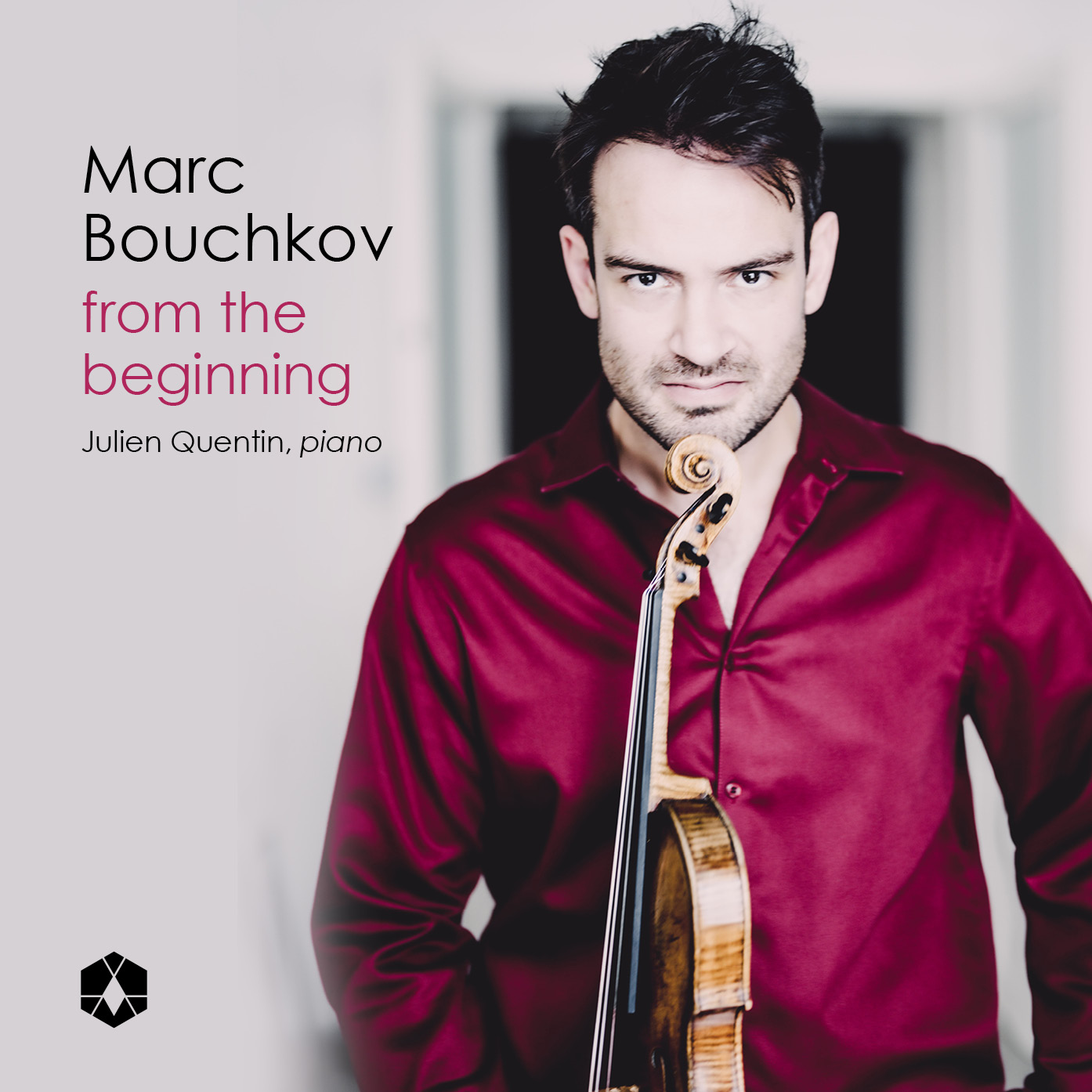
From the Beginning
Marc Bouchkov, violin
Julien Quentin, piano
Release Date: 6th November 2026
ORC100495

Isaac Albéniz (1860–1909)
1. Sevilla
transcribed by Jascha Heifetz
Alexander Glazunov (1865–1936)
2. Meditation
edited by Jascha Heifetz
William Kroll (1901–1980)
3. Banjo and Fiddle
Manuel M. Ponce (1882–1948)
4. Estrellita
transcribed by Jascha Heifetz
Claude Debussy (1862–1918)
5. Prélude à l’après-midi d’un faune
6. Cakewalk
7. Beau soir
transcribed by Jascha Heifetz
Leopold Godowsky (1870–1938)
8. Alt Wien
transcribed by Jascha Heifetz
Sergei Rachmaninov (1873–1943)
9. Daisies 1.59
transcribed by Jascha Heifetz
Sergei Prokofiev (1891–1953)
10. March from the opera The Love for Three Oranges
transcribed by Jascha Heifetz
Joseph Achron (1886–1943)
11. Hebrew Melody
transcribed by Jascha Heifetz
George Gershwin (1898–1937)
12. Prelude
13. Summertime
14. It Ain’t Necessarily So
transcribed by Jascha Heifetz
Jascha Heifetz, writing as “Jim Hoyl” (1901–1987)
15. When You Make Love to Me
Felix Mendelssohn (1809–1847)
16. Song Without Words
transcribed by Fritz Kreisler
Marc Bouchkov (b.1991)
17. Facets 6.28
Marc Bouchkov, violin
Julien Quentin, piano
This album is, in many ways, as personal as a recording project can be.
For as long as I have played the violin, I have been collecting influences, impressions, ideas, and questions. Every musician does. We absorb sounds, recordings, teachers, concerts, encounters, and memories, all of which slowly become part of our musical identity.
Yet throughout my own journey, there has always been one artist to whom I return, regardless of my mood, my state of preparation, or even my understanding of the music itself: Jascha Heifetz.
To me, Heifetz represents a form of artistic grandeur that remains unique. His playing possesses an unmistakable voice, instantly recognizable after only a few notes. And yet, his repertoire reveals a remarkable diversity of interests and influences. The same artist who championed the great violin concertos could also find inspiration in a Spanish dance, a Debussy miniature, a Gershwin song, a Jewish melody, or a virtuosic encore piece.
Listening to these transcriptions and arrangements, one encounters not only a violinist, but a personality. The elegance, wit, nostalgia, melancholy, brilliance, discipline, and curiosity that shaped Heifetz’s artistic world are all reflected in the music he chose to play.
This raises a question that has fascinated me for many years: what is the role of the interpreter?
Should one strive to disappear completely behind the score, allowing the composer’s voice to speak with as little interference as possible? Or should one embrace the freedom of the moment, allowing instinct, imagination, and personality to guide every phrase?
Perhaps the answer lies somewhere in between.
Every performer carries within them a multitude of influences, contradictions, and aspirations. The challenge is not to eliminate them, but to allow these different facets of one’s personality to coexist while remaining faithful to a single, authentic voice.
This album is my exploration of that idea.
Through these pieces—many of them closely associated with Heifetz—I hope to share not only my admiration for a great artist, but also my own search for identity as a musician. They represent different worlds, different moods, and different aspects of what the violin can express.
Together, they form a portrait composed of many facets.
Marc Bouchkov
______________________
Jascha Heifetz is one of the most celebrated violinists of all time, a child prodigy whose career spanned much of the 20th century. Born into a Jewish family in Russia, he and his relatives emigrated to America following the Russian Revolution. Heifetz was hailed as the greatest violin virtuoso since Paganini, and was revered by other violin masters such as Fritz Kreisler and Itzhak Perlman. One might imagine from this that he was an exhibitionist prone to showboating, performing with exaggerated passion as though channelling some divine force or muse. Yet Heifetz was so focused on the music that he tended to stand relatively still, and rarely smiled even during applause. Some audience members found this disconcerting, equating his approach with coldness, but most recognised an authentic sense of focus and a deep respect for the music; instead of drawing attention to himself and inviting praise, the music remained the focal point of Heifetz’s interpretations.
Alongside notable commissions and premieres, Heifetz made numerous transcriptions and arrangements of a wide array of pieces, bringing a colourful and cosmopolitan variety to his recitals. This collection demonstrates the sheer range of repertoire Heifetz embraced, while being unified by the distinctive nature of his transcriptions.
Spanish composer and pianist Albéniz was a natural improviser who wrote many characterful works. From his Suite española Op. 47 (1886), the vivacious ‘Sevilla’ is dedicated to the wife of musicologist Count Morphy, and is a sevillanas – a Castilian dance that originated in the 15th century. From Spain we move to the nostalgia of ‘Old Vienna’ (‘Alt Wien’) in a piece by Godowsky from his vast suite the Triakontameron (1919-20), consisting of pieces written at the rate of one a day.
William Kroll was an American violinist and composer; Banjo and Fiddle, with its use of pizzicato to sound like a strummed banjo, was his most famous creation and was regularly featured in recitals by both Heifetz and Kreisler. With its irresistible melody, Mexican composer Manuel Ponce’s most famous work is his song ‘Estrellita’ (‘Little star’, 1912) – the second of two Canciones Mexicanas.
We head to France in a trio of works by Debussy, whose Prélude à l’après-midi d’un faune (1894), originally for orchestra with a prominent solo flute part, takes us out of the world of miniatures and immerses us in a dreamlike realm of languid, impressionistic eroticism, inspired by Mallarmé’s poem of the same name. Debussy’s Children’s Corner suite was written for his daughter, Claude-Emma. The work’s dedication came ‘with her father’s affectionate apologies for what follows’, and includes the ‘Golliwogg’s Cakewalk’; a cakewalk is a dance of a jauntiness that belies its origins in the plantations worked by African American slaves. Beau soir is a song composed by Debussy when he was about 15 or 16. It was originally to a poem by Paul Bourget; his fellow composition students at the Paris Conservatoire described Debussy arriving for classes ‘at the last minute, coming across the courtyard of the old Conservatoire with the short, hurried steps that always characterised him… Most of his settings of Bourget date from those long distant days’. The song features Debussy’s hazy piano harmonies supporting a creamy melody.
Glazunov was a towering figure in Russian music, but was damning about Debussy, referring to him as one of a number of ‘contemporary degenerates’. Glazunov’s Meditation (1891) transports us away from such differences of opinion, its limpid piano part supporting a singing melody. Glazunov conducted the premiere of Rachmaninov’s First Symphony; it didn’t go well, but thankfully the younger composer eventually recovered and went on to write pieces such as the evocative ‘Daisies’, the third of his Six Songs, Op. 38 of 1916 – the last group of songs Rachmaninov ever wrote. The composer transcribed these songs for piano in the early 1920s, with a revised version following in 1940; both Heifetz and Kreisler produced versions with violin.
The Love for Three Oranges is an opera written by Prokofiev in 1921, its satirical tone encapsulated by the biting, unremitting ‘March’. In contrast, Joseph Achron’s Hebrew Melody of 1911 has a soulful quality that sings through the violin’s deeper register with moving poignancy. The piece is dedicated ‘To the memory of my father’.
Heifetz made a number of acclaimed recordings of music by George Gershwin, including a 1965 record of his transcription of the Three Preludes. These catchy pieces started life in 1917, when Gershwin began toying with the idea of writing some piano miniatures or ‘Novelettes’. He composed two Novelettes in 1919 which were arranged for violin and piano by Samuel Dushkin in 1925. Gershwin then added three more pieces to create a set of five, before publishing those three additional pieces separately as the Three Preludes in 1927.
A year earlier, Gershwin read Porgy by DuBose Heyward and immediately wrote to the author proposing they collaborate on an opera based on the novel. Heyward wrote the libretto and, with Ira Gershwin, the song lyrics, including the words to ‘Summertime’. With its hypnotic alternation of two notes underpinning a lazy melody, ‘Summertime’ evokes summer heat. ‘It Ain’t Necessarily So’, from the same opera, is a subversive number set to a slippery, chromatic tune.
Our programme is rounded off with music that wasn’t arranged by Heifetz, but which shares the spirit of his transcriptions. Heifetz was a Jewish Russian-American who drew upon these different aspects of his heritage and life. Marc Bouchkov is a Jewish violinist-composer who was born and raised in France and was educated in both Ukraine and Russia; he chose the piece title Facets ‘to illustrate the different aspects of my culture and personality’. Felix Mendelssohn wrote numerous piano miniatures with the evocative title Songs Without Words; Kreisler arranged this irresistibly lyrical example.
When You Make Love to Me is not a Heifetz transcription – it’s his own original composition, written under the pseudonym Jim Hoyl. The song became a wartime hit when it was recorded by Bing Crosby, and completely undermines the myth that Heifetz was a cool customer; the piece brims with tenderness.
© Joanna Wyld, 2026
Marc Bouchkov
Born in France and holding Belgian nationality, Marc Bouchkov is recognised for an artistic path defined by curiosity, individuality, and a refusal to follow convention. Growing up in a Jewish-rooted musical family whose origins stretch across Eastern Europe, he developed an artistic outlook shaped by cultural diversity and a fascination with questions of identity, memory, and belonging.
Guided by exploration rather than conformity, he has built a career that embraces both the great pillars of the violin repertoire and lesser-known masterpieces, while maintaining a strong commitment to contemporary voices. Drawn to music that challenges boundaries and resists easy categorisation, he continually seeks projects that unite artistic excellence with personal meaning.
A prizewinner of major international competitions, Bouchkov has appeared with orchestras including the Royal Concertgebouw Orchestra, the Munich Philharmonic, the Israel Philharmonic Orchestra, the Los Angeles Philharmonic, Filarmonica della Scala, the hr-Sinfonieorchester, and the Mariinsky Orchestra, collaborating with conductors such as Mariss Jansons, Valery Gergiev, Philippe Jordan, Christoph Eschenbach, Lahav Shani, Lorenzo Viotti, and Gianandrea Noseda.
A passionate chamber musician, he is a regular guest at the Verbier Festival, where he has performed alongside many of today’s leading artists. His artistic life moves naturally between the concerto stage, chamber music, teaching, and recording projects.
Today, alongside his international performing career, Bouchkov serves as Professor of Violin at the Folkwang University of the Arts in Essen, Germany.
Bouchkov performs on a Maggini violin, dated 1630.
___________________
Julien Quentin
French pianist Julien Quentin is acclaimed for his versatility, musical sensitivity, and refined artistry. Equally at home as a soloist and chamber musician, he has performed with ensembles including the Wrocław, Qatar, and Córdoba Philharmonic Orchestras, and has appeared at major festivals such as Verbier, Lucerne, Gstaad, Ravinia, La Jolla, and Mostly Mozart.
He has performed in many of the world’s most prestigious venues, including the Concertgebouw Amsterdam, Wigmore Hall, Berlin Philharmonie, Vienna Konzerthaus, Gewandhaus Leipzig, Mariinsky Theatre, the Louvre, and Carnegie Hall. As a sought-after chamber musician, he has collaborated with artists including Emanuel Ax, Joshua Bell, Lisa Batiashvili, Gautier Capuçon, Martin Fröst, Nicolas Altstaedt, and Sonya Yoncheva. His recordings have been released on labels including Deutsche Grammophon, Decca, Sony RCA, EMI, Channel Classics, and Hungaroton.
Born in Paris, Quentin studied in Geneva with Alexis Golovine, at Indiana University with Emile Naoumoff, and at The Juilliard School with György Sándor. Now based in Berlin, he is the founder and artistic director of an acclaimed concert series, Musica Litoralis at Piano Salon Christophori. Alongside his classical career, he explores improvisation and electronic music through collaborations with leading musicians and producers, including the projects Midiminuit and Les Cœurs Brisés.
similar Artists & Albums