Artist Led, Creatively Driven
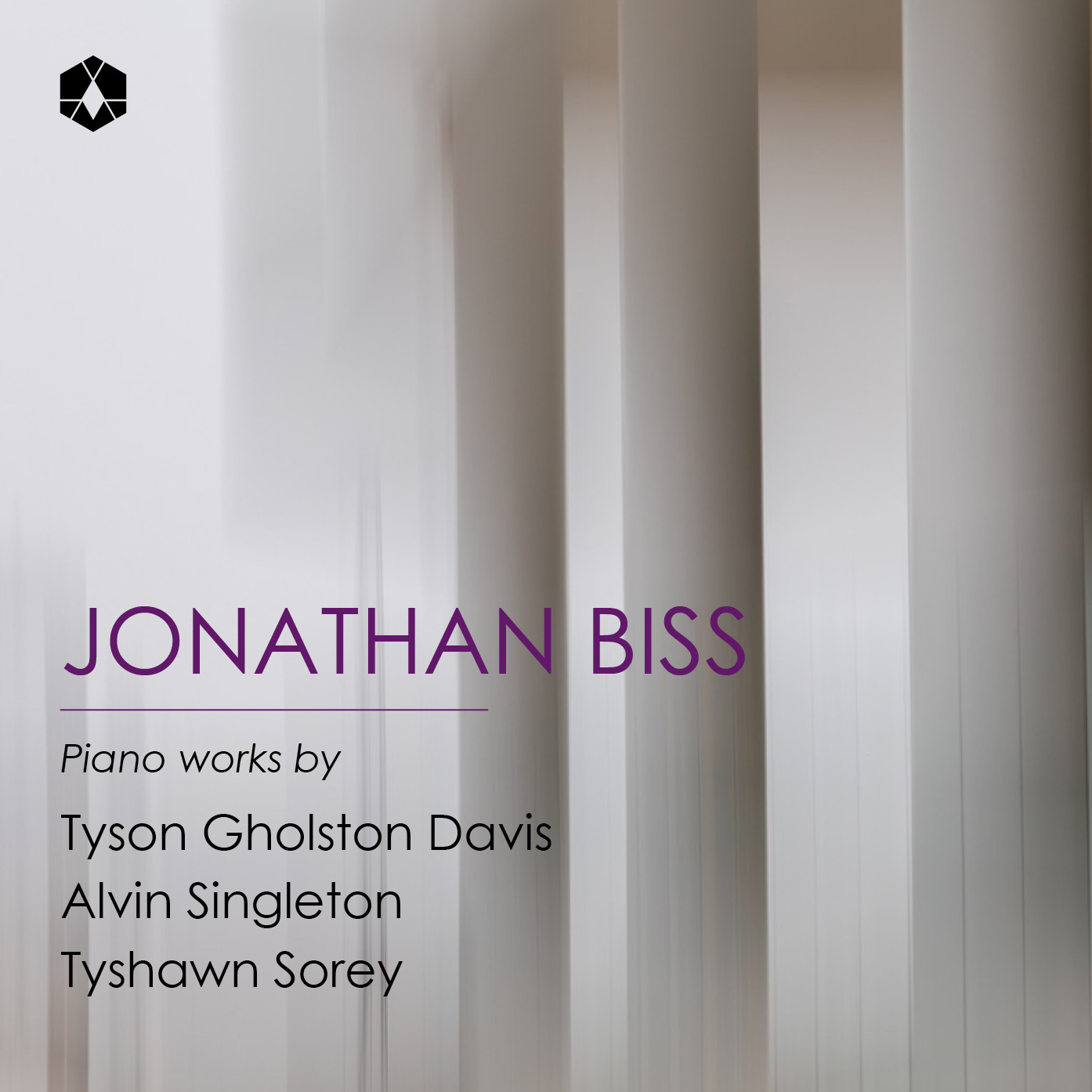
Jonathan Biss Plays New Piano Works
Release Date: 30/10/2026
ORC100493

Tyson Gholston Davis (b. 2000)
…Expansions of Light (2023)
1. I Arietta 1: Floating, meditative
2. II Caprice: Rapid, fluent, impetuous
3. III Arietta 2: Floating, meditative
Alvin Singleton (b. 1940)
4. Bed-Stuy Sonata (2023)
Tyshawn Sorey (b. 1980)
5. For Anthony Braxton (2024)
Jonathan Biss, Piano
Two things dominate my memories of the surreal year that was 2020: meeting my husband and Schubert’s final piano sonatas. Both were happy accidents – I was supposed to be on a near-perpetual tour playing the 32 Beethoven sonatas. When those plans fell apart, I decided to devote my daily practice to music that I adored but had put to one side while Beethoven dominated my life. The time I spent with Schubert during the pandemic was an extraordinary gift that changed me forever.
In 2022, when I was thinking about how to program the three sonatas, I decided that I wanted to pair each of them with a newly commissioned work; it is those works that comprise this recording. They are not meant to relate or respond to Schubert’s music in any way. But Schubert’s music is a portal into a different realm, and I wanted to play it alongside new music that would similarly expose me to sounds and perspectives I had never imagined, much less heard. Tyson Gholston Davis, Alvin Singleton, and Tyshawn Sorey have written works that are, in three completely different ways, full of mystery and wonder. Living with them has made me grow as a musician and, I suspect, a person. I am thrilled to share them with you.
____________________
…Expansions of Light, for piano (2023) is a triptych piece in response to Winter Light (1979), a painting by American abstract expressionist Helen Frankenthaler. The composition, like the artwork, is deeply contemplative in nature, providing a meditative and ethereal atmosphere through which the music flows. While studying the canvas, it became apparent to me that the essence of Winter Light is one of great concern to the expansion and development of a singular visual motive. Hues of bright golden bronze in the upper left of the canvas sweep in a downward fashion gradually to the right; this amorphous, draping background is influenced by muted dark shades of brown, green, and orange. In addition to this, a deep, yet vibrant blue (of the Yves Klein fashion) impacts the bronze, bleeding into it, and mutating itself into various turquoise greens. The metamorphosis of these hues, along with the manner in which they interact with one another, led me to explore the subtle manipulation of musical gestures and material within my composition.
The name “Expansions of Light” comes from the previously stated ideas and my continuous, literal “expansion” of the musical ideas I did in my sketches for the work. The gently flowing lyricism, along with the subtly frozen aspects of Frankenthaler’s canvas are the origin of the movement titles of Arietta I and Arietta II. These movement titles, belonging to the operatic tradition meaning “short aria”, were introduced into instrumental writing by Beethoven in his later piano sonatas (most notably Opus 111). The Caprice provides textural contrast for the composition’s preoccupation with pensive and vocal qualities.
Helen Frankenthaler’s canvases have led me to create several compositions reflecting the nature of her aesthetic concepts. There are currently five “Studies on Frankenthaler” and there are plans for several more in the future. …Expansions of Light (2023), was commissioned by the Terezin Music Foundation for pianist Jonathan Biss and is dedicated to Ara Guzelimian with admiration and gratitude.
Tyson Gholston Davis (11.16.23)
____________________
Alvin Singleton has a great deal to say, and he says it all in his music. The only time I ever saw him appear uneasy was when, a few months after he completed his Bed-Stuy Sonata, I asked him to write a program note for the piece. I could see an internal battle playing out: He didn’t want to say no, but he really didn’t want to do it. The piece, like all his music, had been borne of a process that was rigorous but instinctual. No attempt to describe or explain it could be as truthful as the piece itself.
Once I understood this, I withdrew my request. Better for me to say something slightly off-the-mark about Bed-Stuy Sonata than to ask Singleton, who had composed it and bared his soul in the process, to do so.
In an interview with Ethan Iverson, Singleton recalled a piece of advice given to him by his teacher Hall Overton: “You should learn broadly and exhaustively, but compose intuitively. You have to really trust your subconscious.” This remark had a major influence on Singleton – or, perhaps, it put into words an approach that he had already adopted. Singleton has lived a big life, and his influences are many and disparate. He studied with jazzmen and serialists; he has resided for extended periods in Brooklyn, Italy, Austria, and Atlanta. You don’t need to go to his Wikipedia page to know this; you can hear it in his music. But what you hear most of all is a singular voice. What he does cannot be taught or reduced to a set of cultural influences. Each gesture comes from deep within him and has an emotional logic all its own.
Both components of Bed-Stuy Sonata’s title are misleading. Atypically for a sonata, the work unfolds as a stream of consciousness – like all of Singleton’s works, it is in one uninterrupted movement and is devoid of formalities of any kind. As for the “Bed-Stuy,” that is shorthand for Bedford-Stuyvesant, the neighborhood in Brooklyn where Singleton was raised. But as he told Iverson, “My titles identify my pieces, but don’t explain them.” The piece might evoke a time and place in Singleton’s life, but only for him: The listener is asked to approach the piece without preconceptions, using only their ears and imagination.
The player is given the same license and responsibility. I should not have been surprised when Singleton begged off writing a program note: When I first played the piece for him, he declined to offer me any suggestions. What he wanted from me as an interpreter was freedom: the kind of freedom that comes from internalizing the music so deeply that any decision you make in the moment will seem authentic, to it and to you. I sensed that he worried that too much information would stifle this freedom. This is further reflected in Singleton’s extremely sparse notation: The score is an invitation, not a prescription.
Each time I play Bed-Stuy Sonata, it acquires new layers of meaning. It is built from cells of material that don’t sound as if they belong together: some propulsive, others enormously spacious. The piece toggles back and forth between these different modes, often without warning. Many phrases therefore seem like non- sequiturs, at least on first listening. The more I play the piece, the more I hear deep connections between these divergent musical gestures. They all come from the same imagination and the same psyche. Much like Mozart and Schumann, Singleton has the rare gift of revealing the mercurial side of human nature. Many ideas in Bed-Stuy Sonata are strange and surprising; each one is right. These ideas add up to something mysterious, engrossing, and profound.
Jonathan Biss
____________________
Great art alters your consciousness. It makes time move differently; changes your brain chemistry; heightens your awareness.
By this measure, and any other, Tyshawn Sorey is a great artist. When I listen to him – whether as a jazz drummer of unshowy, uncompromising brilliance or as the composer of complex, ethereal soundscapes – I enter a trance and emerge from it slightly but significantly changed. Discovering him as a player has been even more meaningful. Each time I play For Anthony Braxton, it feels different; each performance stays with me.
Sorey’s music collapses boundaries. When you sit with its quiet, concentrated intensity, the question of its genre feels irrelevant. Even the distinction between composition and improvisation disappears: Sorey notates his music with extreme care so that it will sound as inevitable and spontaneous as breathing. The sonorities created by the notes themselves are wondrous, but the silences between them are more so.
Sorey was no keener to write a program note for For Anthony Braxton than Singleton was for Bed-Stuy Sonata. His laconic response to my request that he do so: “The title speaks for itself, as will the music.” For the curious, Google and Spotify will provide a good introduction to the work’s remarkable dedicatee. For everyone else, just listen. Tyshawn Sorey has a mind and an imagination like none other. It is a gift to be invited into them.
Jonathan Biss
Tyson Gholston Davis (b. 2000, North Carolina) is an American composer who is frequently commissioned by organizations such as the John F. Kennedy Center for the Performing Arts, the Cabrillo Festival of Contemporary Music, and The Saint Paul Chamber Orchestra. His music is characterized by its expansive and resonant textures, imbued with kinetic gestures and a profound connection to the visual arts. His series “Studies on Helen Frankenthaler,” inspired by the artist’s paintings, has been performed by the Juilliard String Quartet and pianist Jonathan Biss.
Davis’s 17-minute solo piano work, …Expansions of Light, written for pianist Jonathan Biss, was praised by Biss in The Boston Globe, who commended its intentionality and profound meaning. Similarly, his work Amorphous Figures, inspired by a Frankenthaler painting, was co-commissioned by the Kennedy Center for the Juilliard String Quartet, touring extensively throughout the U.S. and Europe.
Recent major works include As Juniper Storms, an orchestral piece for conductor Cristian Măcelaru and the Cabrillo Festival and …inner flame… deep and blue…, a song cycle for soprano Ariadne Greif and a consortium of university wind ensembles. Upcoming projects highlight his versatility, featuring new works for the Santa Fe Chamber Music Festival, the JACK Quartet, Da Capo Chamber Players, and Eighth Blackbird.
In the summer of 2019, Davis was a composer apprentice with the National Youth Orchestra of the United States of America (NYO-USA), where his work Delicate Tension premiered at the Konzerthaus Berlin conducted by Antonio Pappano. This experience marked a significant milestone in Tyson’s early career, leading to further commissions from ensembles and organizations. His recognitions include the 2024 Copland House Residency Award and 68th BMI Student Composer Award. He holds degrees from the University of North Carolina School of the Arts (high school diploma), a Bachelor’s and Master’s from The Juilliard School.
____________________
Alvin Singleton was born in Brooklyn, New York and completed his studies at New York University and Yale. As a Fulbright Scholar, he studied with Goffredo Petrassi at Accademia Nazionale di Santa Cecilia in Rome, Italy. After living and working in Europe for 14 years, Singleton returned to the United States to become Composer-in-Residence with the Atlanta Symphony Orchestra (1985-88). He subsequently served as UNISYS Composer-in-Residence with the Detroit Symphony Orchestra (1996-97) and was the 2002–2003 Composer-in-Residence with the Ritz Chamber Players of Jacksonville, Florida. In addition, he has served as Visiting Professor of Composition at the Yale University School of Music. Alvin Singleton has collaborated extensively with major orchestras worldwide and has written significant works for chamber and vocal ensembles, as well as works for the theater. His set of Argoru pieces for solo instruments span a compositional period from 1968-2025 and have been championed by soloists across the world.
Singleton is the recipient of a 2003 Guggenheim Fellowship and was commissioned by The Serge Koussevitsky Music Foundation and American Composers Orchestra for the orchestral work When Given a Choice, which premiered at Carnegie Hall in April 2004. His other awards include the Kranichsteiner Musikpreis by the City of Darmstadt, Germany, twice the Musikprotokoll Kompositionpreis by the Austrian Radio, the Mayor’s Fellowship in the Arts Award by the City of Atlanta, and a grant from the National Endowment for the Arts. In 2014, Singleton was elected to the American Academy of Arts and Letters. Recordings of his music appear on the Albany Records, Elektra/Nonesuch, First Edition, Tzadik, Innova, and New World Records labels.
Recent works include Prayer, performed by the Cincinnati Symphony Orchestra and May Festival Chamber Choir under the baton of James Conlon at the Cincinnati May Festival in 2016. In 2018, the Youth Symphonic Orchestra of Russia, led by Alexis Soriano, performed the world premiere of Across Differences in Sochi, Russia as part of the 11th Anniversary Winter International Arts Festival. In 2019, the Momenta Quartet premiered Singleton’s Hallelujah Anyhow (String Quartet No. 4) at the Americas Society in New York City and in 2022, they released an acclaimed world premiere recording of all four of Singleton’s string quartets. In 2021, Chad Goodman led the New World Symphony in the world premiere of Time Past, Time Future featuring Awadagin Pratt as piano soloist. The following year, Bent Frequency Duo commissioned and performed the world premiere of Every Next Day for soprano saxophone and vibraphone, and in 2023, Chatter presented the world premiere performances of Singleton’s Topless for tuba and piano. Following a performance of Singleton’s complete Argoru series by Ensemble 20/21 in 2021, the Curtis Institute of Music commissioned Argoru IX for solo violin. The Juilliard School commissioned and presented the premiere of Argoru X for solo trumpet in 2025.
Alvin Singleton’s music is published exclusively by Schott Music, New York.
____________________
Composer and multi-instrumentalist Tyshawn Sorey has performed globally with his own ensembles, as well as alongside industry titans including John Zorn, Bill Frisell, Joe Lovano, Vijay Iyer, Jason Moran, King Britt, Claire Chase, Roscoe Mitchell, and Steve Lehman, among many others.
The bar is set high for Sorey’s continued evolution and success. He was named the 2024 Pulitzer Prize in Music winner for his composition Adagio (for Wadada Leo Smith), after being recognized as a 2023 Pulitzer Finalist for Monochromatic Light (Afterlife). Previously, Sorey roared onto the international landscape as a 2017 MacArthur Fellow and a 2018 United States Artists Fellow. Adding to his reputation as a multi-faceted talent, Downbeat Magazine recognized Sorey with its 2023 Critics Poll Award as a Rising Star Producer, while annually placing him near the top of its Composer and Drum Set performance lists. Other recent accolades include the Pew Fellowship, the Fromm Fellowship, the American Academy of Arts and Letters’ Goddard Lieberson Fellowship, and the Koussevitzky Prize.
Sorey has composed works for the International Contemporary Ensemble, Talea Ensemble, soprano Julia Bullock, PRISM Quartet, JACK Quartet, TAK Ensemble, Brooklyn Rider, A Far Cry, cellists Seth Parker Woods and Matt Haimovitz, the San Francisco Contemporary Music Players, bass-baritone Davóne Tines, Alarm Will Sound, pianist Awadagin Pratt and vocal group Roomful of Teeth, pianist Sarah Rothenberg, violinist Johnny Gandelsman, and tenor Lawrence Brownlee, as well as for countless others. His music has been performed in notable venues such as the Library of Congress, the Walt Disney Concert Hall, the John F. Kennedy Center for the Performing Arts, the Hollywood Bowl, the 92nd Street Y, Park Avenue Armory, the Donaueschinger Musiktage, Lucerne Festival, and Lincoln Center. His compositions are published by Edition Peters.
Sorey joined the composition faculty of the University of Pennsylvania in the Fall of 2020, where he maintains a vigorous touring schedule in addition to his academic duties. He was selected as a Peabody Resident at Johns Hopkins University for Fall 2023, and has taught and lectured on composition and improvisation at an impressive assortment of institutions, including: Columbia University, Harvard University, Darmstadter Ferienkurse, Wesleyan University, The New England Conservatory, University of Michigan, The Banff Centre, Berklee College of Music, Mills College, University of Chicago, and The Danish Rhythmic Conservatory.
In spring 2023, Sorey debuted a musical collaboration with percussion ensemble Yarn/Wire titled “Be Holding,” a multimedia adaptation of the book-length poem by Ross Gay about the beauty and cultural significance of Julius Erving’s momentous sky hook dunk during the 1980 NBA Finals. The production included performances by professional wordsmiths Yolanda Wisher and David A. Gaines, along with students from Girard College, and was featured in the New York Times. Sorey’s trio (featuring pianist Aaron Diehl and bassist Harish Raghavan) is currently touring with Sandbox Percussion Ensemble, performing a newly commissioned piece in honor of the Max Roach Centennial titled Cogitations. In the future, Sorey plans to continue pushing boundaries, extending cultural norms, and reformulating public perceptions of modern Black/Afrodiasporic creative practice through the breadth and depth of his works.
____________________
Jonathan Biss
Piano
Pianist Jonathan Biss is recognized globally for his “impeccable taste and a formidable technique” (The New Yorker). Praised by The Boston Globe as “an eloquent and insightful music writer,” Biss published his fourth book, Unquiet: My Life with Beethoven, in 2020. The book was the first Audible Original by a classical musician and one of Audible’s top audiobooks of the year.
Biss has appeared as a soloist with some of the world’s foremost orchestras, including the Los Angeles and New York Philharmonics, the Boston Symphony, the Royal Concertgebouw, the London Symphony and more. He has served as the Co-Artistic Director of the Marlboro Music School and Festival alongside pianist Mitsuko Uchida since 2018. He served on the faculty of the Curtis Institute of Music for ten years, and has been a guest professor at schools such as the Guildhall SOMAD and the New England Conservatory of Music. Biss is also the author of Unquiet: My Life with Beethoven, in which he examines music and his own life’s journey through the lens of Beethoven’s last piano sonatas.
Coinciding with the 250th anniversary of Beethoven’s birth in 2020, Biss recorded the composer’s complete piano sonatas, and offered insights to all 32 landmark works via his free, online Coursera lecture series Exploring Beethoven’s Piano Sonatas. In March 2020, Biss gave a virtual recital presented by 92NY, wherein he performed Beethoven’s last three piano sonatas for an online audience of more than 280,000 people. In 2024, Biss participated in Princeton University Concert’s Healing Through Music Series, appearing alongside author Adam Haslett for a panel discussion on anxiety, depression, and creativity. Biss is the recipient of numerous honors, including the Leonard Bernstein Award, the Andrew Wolf Memorial Chamber Music Award, an Avery Fisher Career Grant, the Borletti-Buitoni Trust Award, and a Gilmore Young Artist Award. His albums for EMI won the Diapason d’Or de l’Année and Edison awards. He was an artist-in-residence on American Public Media’s Performance Today and was the first American chosen to participate in the BBC’s New Generation Artist program.
Biss is a third-generation professional musician; his grandmother is Raya Garbousova, one of the first famous female cellists (for whom Samuel Barber composed his Cello Concerto), and his parents are violinist Miriam Fried and violist/violinist Paul Biss. Growing up surrounded by music, Biss began his piano studies at age six, with his first musical collaborations alongside his mother and father. He studied with Evelyne Brancart at Indiana University and Leon Fleisher at the Curtis Institute of Music.
similar Artists & Albums