Artist Led, Creatively Driven
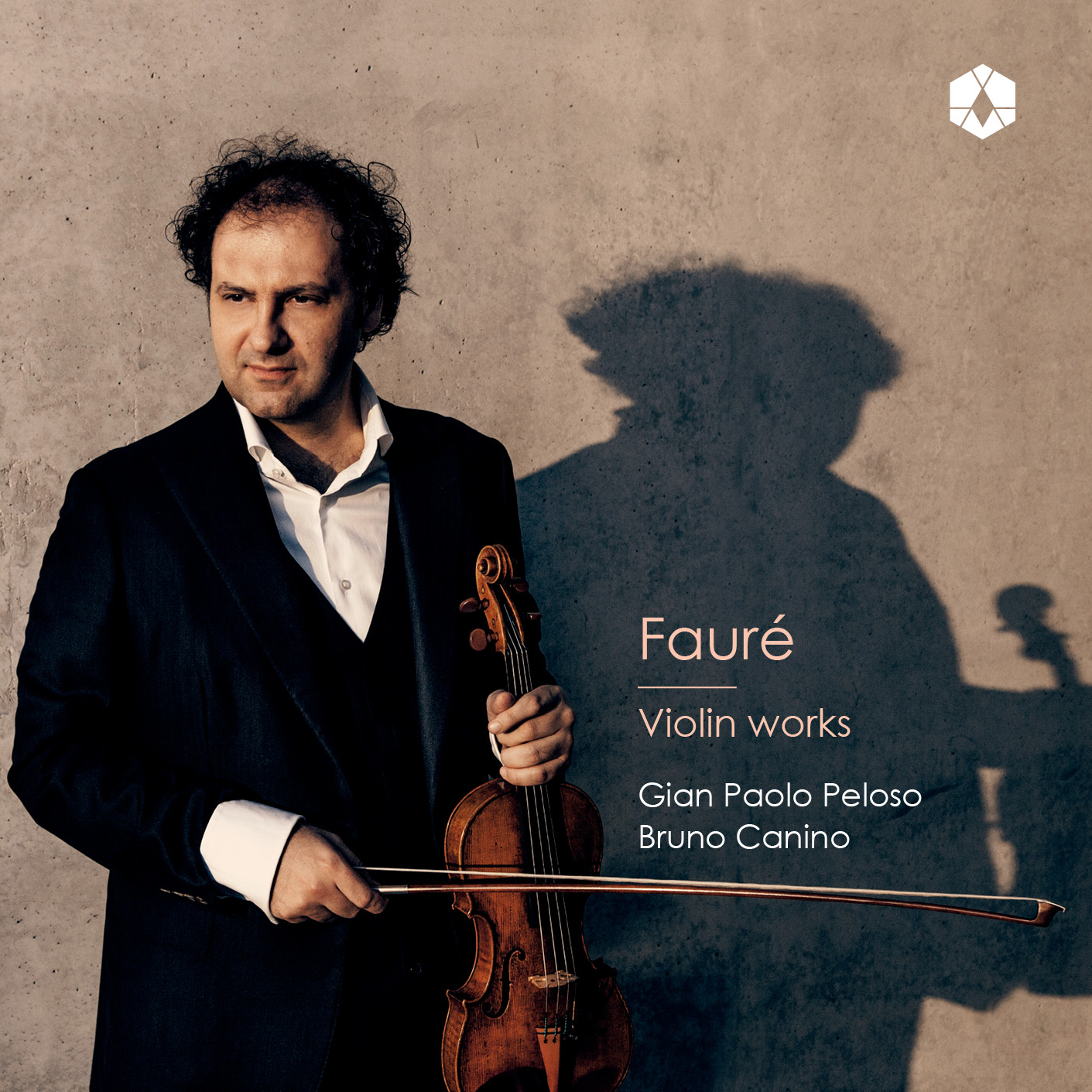
Fauré
Violin Works
Gian Paolo Peloso, violin
Bruno Canino, piano
Release Date: Nov 27th
ORC100488

Gabriel Fauré (1845-1924)
Romance for violin and piano in B flat major, Op. 28
1. Andantino molto moderato
Sonata No. 1 for violin and piano in A major, Op. 13
2. Allegro molto
3. Andante
4. Allegro vivo
5. Allegro quasi presto
Andante for violin and piano in B flat major, Op. 75
6. Andante molto moderato
Sonata No. 2 for violin and piano in E minor, Op. 108
7. Allegro non troppo
8. Andante
9. Finale. Allegro non troppo
Berceuse for violin and piano in D major, Op. 16
10. Allegretto moderato
Gian Paolo Peloso, violin
Bruno Canino, piano
Fauré Violin Sonatas
The circumstances of his early life combined to make Gabriel Urbain Fauré a reticent, undemonstrative man. Born at Pamiers, Ariège, in the south of France on 12 May 1845, the youngest of six children of a schoolmaster, he was farmed out to a foster mother for the first four years of his life. As a result he never really bonded with his parents and was the quiet one among the siblings. It is therefore hardly surprising that in his maturity he excelled in the intimate forms of chamber music and mélodies. He became the prominent Parisian organist who wrote virtually nothing for the organ; and he destroyed much of his early orchestral music, including a symphony, part of which found its way into his Second Violin Sonata. His surviving large-scale works, such as the Requiem and the opera Pénélope, reflect his gentle, agreeable but slightly withdrawn personality.
In 1849 the Fauré family moved to the Ecole normale in Montgauzy, where young Gabriel-Urbain learnt to play the harmonium in the chapel next door – he recalled that ‘an old blind lady’ taught him the rudiments, and later he had piano lessons with a certain Bernard Delgay. In the summer of 1853 his father consulted a music-loving civil servant who was visiting the area, and he recommended that the boy should study at the recently founded Ecole Niedermeyer in Paris. The school’s director, Swiss composer Louis Niedermeyer, was so impressed by Gabriel’s talent that he offered him a free place. Thus, at the age of nine, Fauré was launched into the ideal institution for a budding musician of reflective bent. Although Niedermeyer died in 1861, the brilliant pianist-composer Camille Saint-Saëns had joined the staff in 1860 and his encouraging influence was crucial in the boy’s development. Graduating with distinction in 1865 and taking a first prize in composition, Fauré began a career as organist and choirmaster, first in Brittany and then in increasingly important Parisian churches. In 1870 he fought in the Franco-Prussian War and was awarded a croix de guerre. As a composer Fauré was not at all precocious. He had enough early successes to bolster his confidence but he was over 30 when, in 1876, he finished his first masterpiece, the A major Violin Sonata, Op. 13. It was the first of two chamber works breathing a fresh, spring-like air and announcing a new voice in French music, the other being the C minor Piano Quartet of 1879. Much of the sonata was written in 1875 at the home in Saint-Adresse, near Le Havre, of Fauré’s friends and patrons Camille and Marie Clerc, and worked out on Madame Clerc’s piano: the composer would make progress on it during the day and try it out in the evenings with the distinguished Belgian violinist Hubert Léonard. However, the dedication went to another violinist, Paul Viardot, son of another of Fauré’s patrons, the great contralto Pauline Viardot, and brother of the young woman whom, at that stage, Fauré hoped to marry. To complicate matters even further, the composer gave the première on 27 January 1877 at the Société nationale de musique with Marie Tayau and played it at the Trocadéro, in one of the concerts connected with the 1878 Exhibition, with yet another violinist, Jean-Pierre Maurin.
The A major Sonata is in four movements, Fauré emulating several of Beethoven’s sonatas – and, more to the point, Schumann’s D minor – and setting the trend for Saint-Saëns and Franck. The first, second and fourth movements are in sonata form. The piano starts the Allegro molto with quite an agitated theme, which the violin takes up in a more singing manner: the effect is very fresh and we meet for the first time what might be called ‘the Fauré pulse’, the inexorable rhythmic drive which, while quite gentle in comparison with other composers’ rhythms, would increasingly propel Fauré’s chamber music. (In his 1946 book on the composer, Norman Suckling pinpoints ‘a certain irresistible rhythmic impetus in which he reminds us of the eighteenth-century composers by his power of maintaining the flow of a movement, at whatever speed, without falling into monotony’.) The second main theme is very expressive and, after the exposition has been repeated, the development varies the first theme, also bringing in the second. The 9/8 Andante, starting in D minor but modulating through several keys, has the character of a barcarolle. The delightful 2/8 scherzo, Allegro vivo, is in A major: both instruments indulge in filigree and the F sharp minor Trio provides the ideal contrast. Towards the end of each statement of the scherzo the violin plays pizzicato. This movement had to be encored at the première. In the Allegro quasi presto finale, the Fauré pulse is again at work: the two themes and their development are all subordinated to this restless yet satisfying motion, although the lovely first theme is never far from our thoughts as we listen.
Ironically, even though the sonata was a hit from the start, Fauré could not find a publisher for it. Choudens, who had issued some of his songs, balked at handling a bigger work. Finally Camille Clerc got Breitkopf und Härtel in Leipzig to take it, on condition the composer received no fee and no royalties. Fauré had to be content with the considerable éclat that the work brought him. He played it in public with major Franco-Belgian violinists such as Eugène Ysaÿe, and later with Jacques Thibaud and George Enescu. At the turn of the century he toured Europe, performing the A major Sonata and the C minor Piano Quartet with local string players: for instance, on 10 January 1905 he appeared in Cologne, partnered by the distinguished Dutch violinist Bram Eldering and two members of the Gürzenich Quartet that Eldering led. After Fauré’s death, the Sonata attracted further fame through the recordings made by virtually every well-known Franco-Belgian violinist, starting with the 1927 HMV 78rpm set by Thibaud and Alfred Cortot.
If the First Sonata stimulates thoughts of spring, the Second Sonata in E minor, Op. 108, of 40 years later reflects late summer. Written at a particularly fraught time in French history, the summer of 1916, when the Great War was not going well for the Allies and the composer’s son Philippe was on active service, it inevitably displays anxiety. Fauré did much of the work on it during a stay with his friends Fernand and Louise Maillot in a rented villa at Evian on the shores of Lake Geneva in late August and September, and finished it at the end of the year. The piano introduces the dramatic, syncopated first theme in 9/8; after an important second theme, lying high for the violin, the third main theme has a wistful, worried quality and we are clearly in the midst of music of Fauré’s maturity, with an inexorable pulse.
The instruments share the material, all three themes are developed and although the violin soars, it never escapes from the grip of this forward impetus, even when the metre changes to 12/8 for the recapitulation and coda. The superb Andante is based on a theme from Fauré’s discarded Symphony in D minor, Op. 40: the piano at first provides a foundation for the violin’s quiet rhapsodising but gradually gets more involved, so that for most of the movement there is an equal relationship between the parts. Fauré introduces a flowing, more purposeful contrasting theme before the main theme returns and the movement ends quietly. The sonata-rondo finale, in E major, has a family resemblance to the finale of the First Sonata but is in a more mature, more harmonically intriguing style: there are three themes but, in a nod to Franck’s cyclic principle, the first movement’s opening theme is brought back on the piano towards the end, followed by that movement’s third theme, and the two are combined with the principal refrain of the finale. The E minor Sonata was dedicated ‘to her Majesty Elisabeth, Queen of the Belgians’, a pupil of Ysaÿe and keen follower of Fauré, who would have liked to explore it privately with the composer at her wartime home in De Panne, but he excused himself and sent Marguerite Hasselmans instead. Sadly Ysaÿe never played the work – just the first instance of a curious neglect among prominent violinists of this slightly enigmatic but ultimately lovable sonata. The first performance was given at the Société nationale on 10 November 1917 by Cortot and the distinguished violinist Lucien Capet, whose celebrated quartet was in abeyance owing to the war. Other players such as Hélène Jourdan-Morhange, who worked on the sonata with Fauré at the Maillot home in Evian in 1917, took it up but it has always lagged behind the A major in popularity.
When Thibaud and Cortot programmed it in 1924, Fauré wrote that they had woken it from a ‘long, sad sleep’. Perhaps this fine performance by Gian Paolo Peloso and Bruno Canino will stimulate others to investigate it. This disc includes all Fauré’s music for violin and piano. The Romance in B flat, an attempt to capitalise on the success of the A major Sonata, was written in the difficult summer of 1877, when Fauré had been packed off to Cauterets in the Pyrenees to take a cure for his constant hoarseness and incidentally to undergo a cooling-off in his rather one-sided engagement to Marianne Viardot – he was very keen to marry her, she was uncertain, and towards the end of the year he called the whole thing off. The piece is in the song form of most romances. The piano begins an accompaniment before the violin sings a theme of dewy freshness, very much in the spring-like style of the sonata, and proceeds to decorate it. Then the violin thinks of a more serious theme in G minor, which is explored before a violin cadenza leads to the return of the main theme and the quiet conclusion. The Romance was published in 1883 and dedicated to the tragically short-lived American violinist Arma Harkness (aka Arma Senkrah), who premièred it at the Société nationale on 9 February that year with an unknown pianist. Fauré made an orchestral version which was somehow lost: the existing orchestral score is by Philippe Gaubert. The Andante in B flat, Op. 75, may well be more or less identical to the Andante of the Violin Concerto, on which Fauré worked in the late 1870s, never finishing the finale. The Andante from the concerto was first played by Ovide Musin, with the composer André Messager at the piano, for the Société nationale on 28 November 1878; and the orchestral version was performed by Musin at the Société nationale on 12 April 1880, with the concerto’s first movement – Edouard Colonne conducted. Fauré prepared the Andante for publication in July 1897, dedicating it to the Dutch violinist Johannes Wolff. The piano sets the scene for a long-breathed melody; this romantic idea gives way to a more animated theme which carries the piece along to a quiet resolution.
The Berceuse in D, Op. 16, of 1878-79 is analogous in Fauré’s output to Elgar’s Salut d’amour, in that it became a huge hit but the composer made virtually no money from it. The piano sets up a rocking 6/8 accompaniment over which the muted violin sings the sweetest of songs; after the usual contrasting section, the main theme returns. The whole piece is very attractive. Fauré gave the first performance with Musin at the Société nationale on 14 February 1880 and the Berceuse was published by Hamelle that year, with a dedication to Madame Hélène Depret. Fauré made an orchestral version which was performed at the Société nationale on 24 April by Musin and Colonne but was not issued by Hamelle until 1898. The first of many recordings was made by Eugène Ysaÿe and Camille DeCreus in New York in 1912.
Tully Potter
Gian Paolo Peloso
Gian Paolo Peloso is regarded as one of Italy’s most accomplished violinists. He studied with some of the twentieth century’s most distinguished teachers, including Ruggiero Ricci, Viktor Tretyakov, Ivry Gitlis, Igor Ozim, Viktor Pikayzen and Pierre Amoyal.
The late Ivry Gitlis described Peloso as “a violinist and friend whom I respect and love in both capacities: a true musician of the highest quality, both as a soloist and chamber musician, and a top-class violin teacher whose work honours our profession and its future.”
Peloso made his debut at the age of ten under the direction of the composer Luciano Berio. He has performed internationally throughout Europe, Asia and the United States as a soloist and chamber musician. He has appeared at the Kuhmo Chamber Music Festival in Finland, the Martha Argerich Festival in Switzerland, Fondazione La Società dei Concerti in Milan, the Moscow International House of Music, the Singapore Sun Festival, the Archipel Festival in Geneva, Hong Kong Musicus Fest, the Cannes Festival and Weill Recital Hall in New York.
He has toured extensively with the Camerata de Lausanne and performed chamber music with Sofia Gubaidulina, Mark Lubotsky, Vladimir Mendelssohn and Bruno Canino. He was Professor of Violin at the Conservatory of Music in Neuchâtel, Switzerland, and recorded sonatas by Saint-Saëns and Poulenc for Swiss National Radio.
Peloso recorded the violin sonatas of Respighi and Busoni in New York for Sony Classical with pianist Bruno Canino. He was Senior Lecturer in Violin at the Hong Kong Academy for Performing Arts. More recently, he has recorded as both soloist and conductor with the London Symphony Orchestra, and as conductor with the London Philharmonic Orchestra. He plays a 1710 Matteo Goffriller violin.
____________________
Bruno Canino
Born in Naples, Bruno Canino studied piano and composition at the Conservatorio Verdi in Milan where he taught piano for 24 years. Then, for 10 years, he gave a course in piano and chamber music at the Berne Conservatoire.
He has performed both as a soloist and a chamber musician in all the principal concert venues of Europe, the United States, Australia, Japan and China. For over 50 years he has been regularly performing with Antonio Ballista, his piano duo partner. He has collaborated with many prominent string players, such as Itzhak Perlman, Lynn Harrell, Salvatore Accardo, Viktoria Mullova and Uto Ughi and has played with leading orchestras including the Orchestra Filarmonica della Scala, Milan, the Orchestra dell’Accademia Nazionale di Santa Cecilia, Rome, the Berlin Philharmonic, the New York Philharmonic, The Philadelphia Orchestra and the Orchestre National de France, and with distinguished conductors such as Claudio Abbado, Riccardo Chailly, Wolfgang Sawallisch and Pierre Boulez.
Deeply interested in contemporary music, he has worked with many composers including Luciano Berio, Karlheinz Stockhausen, György Ligeti, Pierre Boulez, Bruno Maderna, Luigi Nono, Sylvano Bussotti and Mauricio Kagel, often giving world première performances of their works. From 1999 to 2002, he was Director of the Music Section of the Venice Biennale.
Bruno Canino’s recordings include Bach’s Goldberg Variations; Mendelssohn’s compositions for cello and piano (with Lynn Harrell); works by Prokofiev, Ravel and Stravinsky (with Viktoria Mullova for a disc that was awarded the Edison Prize); piano compositions by Debussy (including the Preludes), Chabrier (the complete piano works), and Casella.
Bruno Canino gives regular masterclasses in piano and chamber music in Italy, Germany, Spain and Japan and is frequently invited to serve on the juries of important international piano competitions. He is the author of the book Vademecum for a Chamber Pianist (Passigli Editions, 1997).
similar Artists & Albums