Artist Led, Creatively Driven
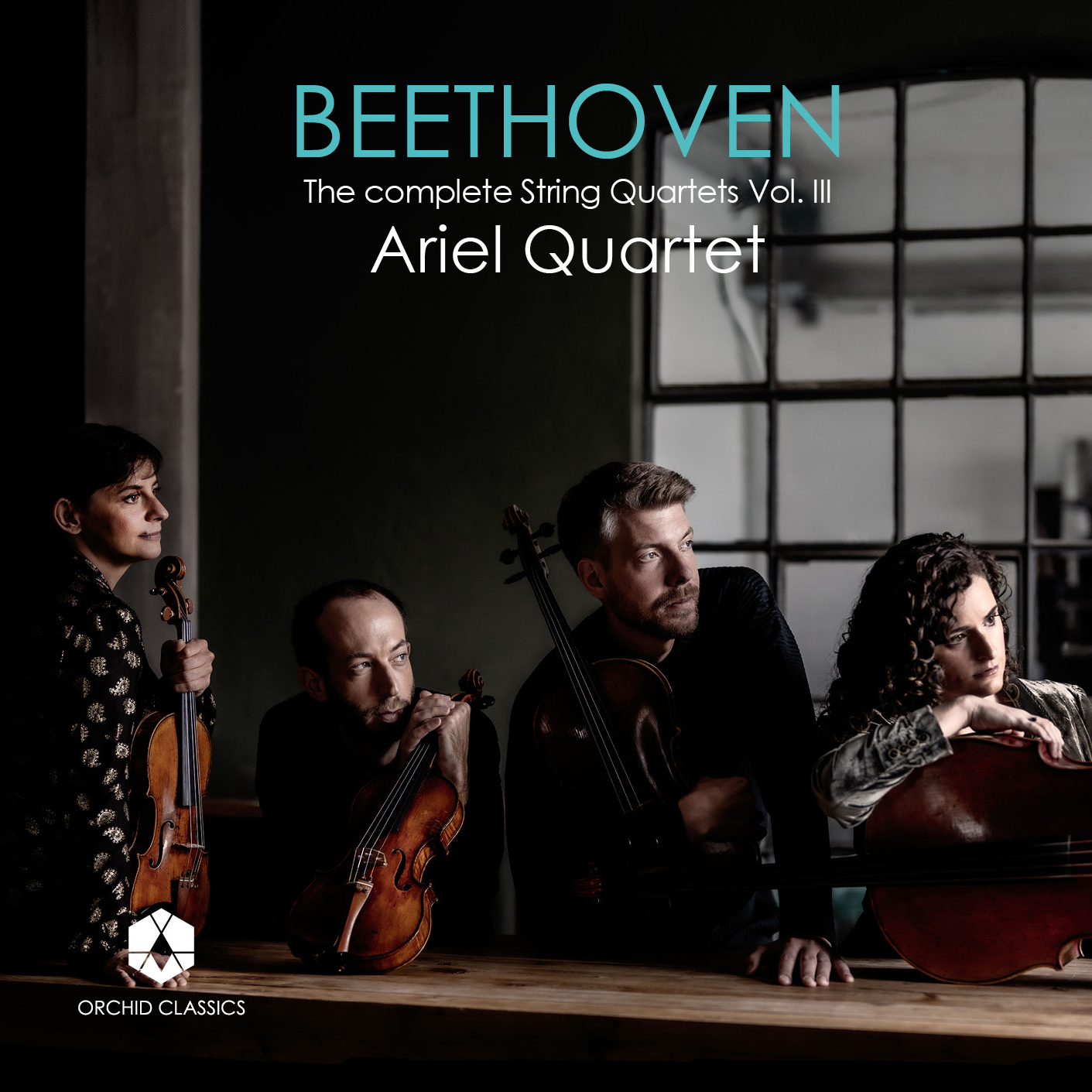
BEETHOVEN STRING QUARTETS – Volume 2
Ariel Quartet
Release Date: October 2nd
ORC100483

Disc 1
Ludwig van Beethoven (1770-1827)
String Quartet in E-flat major, Op.127
1. Maestoso – Allegro
2. Adagio ma non troppo e molto cantabile
3. Scherzo. Vivace
4. Allegro
String Quartet in C-sharp minor, Op.131
5. Adagio ma non troppo e molto espressivo
6. Allegro molto vivace
7. Allegro moderato
8. Andante ma non troppo e molto cantabile
9. Presto
10. Adagio quasi un poco andante
11. Allegro
Disc 2
String Quartet in A minor, Op.132
1. Assai sostenuto – Allegro
2. Allegro ma non tanto
3. Heiliger Dankgesang eines Genesenen an die Gottheit, in der
lidischen Tonart. Molto adagio – Neue Kraft fühlend. Andante
4. Alla marcia, assai vivace
5. Allegro appassionato
String Quartet in F major, Op.135
6. Allegretto
7. Vivace
8. Assai lento, cantate e tranquillo
9. Der schwer gefaßte Entschluß:
Grave, ma non troppo tratto – Allegro
Disc 3
String Quartet in B-flat major, Op.130
1 Adagio ma non troppo – Allegro
2 Presto
3 Poco scherzoso. Andante con moto ma non troppo
4 Alla Danza tedesca. Allegro assai
5 Cavatina. Adagio molto espressivo
6 Overtura. Allegro – Meno mosso e moderato – Allegro. Fuga*
Alexandra Kazovsky, violin
Gershon Gerchikov, violin
Jan Grüning, viola
Amit Even–Tov, cello
* This movement was later published separately as Op.133 under the title Grande Fugue, tantôt libre, tantôt recherchée.
“What is difficult, is also beautiful, good, great, and so forth.
Hence everyone will realize that this is the most lavish praise that can be bestowed, since what is difficult makes one sweat.”
Ludwig van Beethoven to Sigmund Anton Steiner,
Vienna, after 9 January 1817
__________
Our View
Beethoven’s string quartets have been covered from every angle, so rather than offering a theoretical analysis (fascinating as it is!) we will share a little about what makes us come back to this music for over 25 years now, how we approach it as interpreters and why we decided to record it. If you are interested in understanding the intricacies of the music in greater detail, we recommend starting with Joseph Kerman’s ‘The Beethoven Quartets’ and going from there.
In the previous booklet accompanying the Middle Quartets we talked about Beethoven spreading his wings and leading the music world into an entirely new direction. Doubling down on that path in his Late Quartets, expansion, freedom and transcendental expressivity become the DNA of the music – in several regards with the exception of the op.135 unicorn, his last complete work: some scholars believe it to mark the beginning of a possible fourth period, but alas…
Tickling Beethoven’s renewed interest in the string quartet genre, we have Prince Nicolai Galitzin to thank – arguably his claim to fame by now – for commissioning the three quartets op.127, op.130 and op.132, all composed in 1824/25. Op.131 shares a deep musical connection with the latter two, thematically focussing on the characteristic intervallic relationship between the last four notes of the harmonic minor scale, much like the opening motives of op.132 and the ‘Große Fuge’ op.133. Talking about the ‘Große Fuge’… this might be a good moment to shed a brief light on the alternative Finale for op.130 – the very last movement of music Beethoven ever composed – and why it is missing from this collection: as with all of it every interpreter will need to find their own truth here, and having played it extensively as an encore we do very much love and respect the movement; for ourselves, however, we have so far exclusively performed op.130 in its original version and simply can’t imagine presenting it differently. Our version of the alternative Finale will appear at a different time and we look forward to treating it as its own project.
On to op.135, which in most respects is unlike any of the other fifteen quartets. It somehow simultaneously and strangely closes the circle with the op.18 set by returning to a much more compact form and length, featuring short motivic writing and the F-major key of op.18 no.1. The last movement is headed Der schwer gefaßte Entschluß (The difficult decision), and Beethoven wrote in the manuscript Muß es sein? (Must it be?) to which he responds, with the faster main theme of the movement, Es muß sein! (It must be!) – both a philosophically deep and perplexingly light-hearted message to end this incredible canon of works.
Our journey with the late quartets began with op.132 in 2004, and despite encountering sentiments that young musicians shouldn’t readily dive into these worlds this work quickly became one of our favorites to perform.
Truthfully, this music does not ripen in us without performing it incessantly, and the notion that our deep love and respect for art should be expressed by staying away from it really makes more sense for a museum. How a given section, theme or movement relates, a tempo feels and a character comes to life will only truly be put to the test in a concert, where the moment is everything. We feel especially with this Volume that recording it is a touch like capturing a rare creature in Himalaya-like territory and displaying it in the zoo – ethically as debatable as choosing to declare that one specific version of any given phrase or character should persist. The sole reason to jump over one’s own artistic shadow and proceed nevertheless is to make a record in the spirit of how we feel these masterworks should come to life. The ‘Große Fuge’ must carry an air of insanity, the Adagios from op.132 faintly evoke something along the lines of Michelangelo’s Creation of Adam, and the famous Cavatina with its warmth and vulnerability should absolutely move you to tears as it did Beethoven himself. These aspects cannot be discussed, rehearsed or understood – they are the reflection of four hearts coming together in the most unusual yet natural way: creating in and for the moment, in front of, with and for others and themselves. It is our hope that you feel this deeply while listening and that in some way we enable the music to speak to and touch your inner self.
Our Story
A happy accident kickstarted our group in 1998, when we were 13 years old, attending a school for music and dance. Amidst stretching ballerinas and improvising jazz pianists, we were simply assigned to play together. Our teacher spoon-fed us repertoire just beyond our ability, knowing we were about to discover the addictive magic of playing string quartets. We spent our teenage years rehearsing in the school attic, immersing ourselves in the richness of the string quartet repertoire while learning to navigate both the music and our evolving relationships. Balancing a budding concert career with high school life was both challenging and rewarding, often providing excellent excuses to skip class. This lifestyle juxtaposition was on full display when we showed up to the prize-announcement ceremony of the 2003 Franz Schubert and Modern Music Competition in Graz, wearing pajamas, ready to cheer on the prize winners – only to discover we were to be awarded the first prize ourselves…
Today, 27 years in and with three founding members still on board, our mission is to breathe life into the bread and butter of the string quartet repertoire while shining a spotlight on the compelling music of our time. This commitment led us to perform the complete Beethoven cycle before any of us turned 30, while also expanding the repertoire through commissions by established composers such as Mohammed Fairouz, Matan Porat or John Harbison. The joy of sharing the music we love with audiences in the most direct way remains the essence of our experience as musicians – it is the “glue” that has kept us together for more than half our lives. We were fortunate to have had inspiring mentors, including the members of the Cleveland Quartet, Walter Levin of the LaSalle Quartet, and the Amadeus Quartet. Over the past 12 years, succeeding the LaSalle Quartet as Quartet-in-Residence at the Cincinnati College-Conservatory of Music (CCM) has become a deeply fulfilling part of our lives. Sharing the experience we’ve gained onstage, we maintain individual studios, mentor young ensembles, and are particularly excited about the recent revival of the renowned graduate string quartet residency program.
Our unusual journey has been fundamental in shaping who we are. Beyond the demands of our shared professional path, we have walked together as friends who have truly become family. From late-night debates about tempo and sight-reading marathons to raising our children alongside one another while balancing an international concert career, we have shared every stage of life. This closeness has created a deep and unique bond that continues to shape our identity, both on stage and beyond.
similar Artists & Albums