Artist Led, Creatively Driven
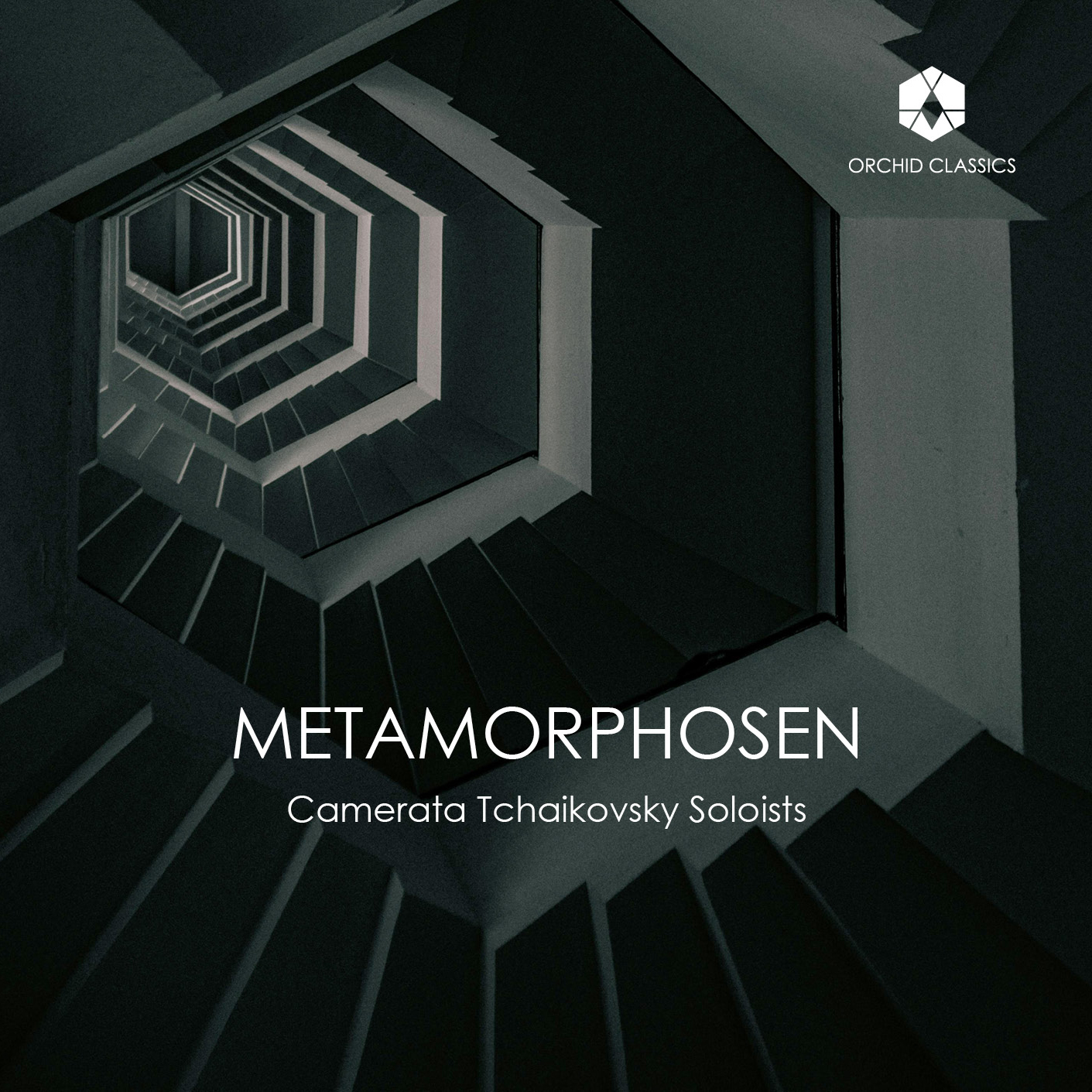
Metamorphosen
Camerata Tchaikovsky Soloists
Release Date: July 31st
ORC100470

W. A. Mozart (1756-1791)
Sinfonia Concertante, K.364
Transcription for string septet by Yuri Zhislin
1 Allegro.
2 Andante.
3 Presto.
R. Strauss (1864-1949)
4 Metamorphosen, TrV 290
Realisation for string septet by Rudolf Leopold
Camerata Tchaikovsky Soloists:
Natalia Lomeiko, Joshua Fisher, violins
Yuri Zhislin, Yukiko Ogura, violas
Kirsten Jenson, Adi Tal, cellos
Stacey Watton, double bass
Sinfonia Concertante in E-flat major, K.364, transcription for string septet.
This transcription was born from a simple but compelling wish: to perform Mozart’s Sinfonia Concertante with close colleagues in venues unable to accommodate a sinfonietta-sized orchestra. What began as a practical consideration soon developed into a deeper artistic journey.
In 1808, seventeen years after Mozart’s death, a manuscript of a string sextet version of K.364 appeared in Vienna. The arranger remains unknown, though the transcription may have been commissioned—perhaps even by the publisher Sigmund Anton Steiner, himself an amateur musician. In 2006, Bärenreiter issued a modern edition of this 1808 version, edited by Christofer Hogwood. Having long been curious about this adaptation, I eagerly obtained the parts and began to study the score.
However, closer examination revealed significant departures from Mozart’s original text. Essential voicings were missing, and the musical balance often felt compromised. Although Hogwood notes that the six parts were reproduced “not altogether perfectly” by the then-new technique of lithography, I found myself increasingly drawn toward reimagining the work more faithfully.
What began as minor corrections gradually evolved into a completely new arrangement. By adding a double bass and expanding the texture into a septet, I sought to preserve the structural clarity and expressive depth of Mozart’s conception while enhancing its chamber character. Each instrument is given greater individuality, allowing for a more intimate dialogue without diminishing the grandeur of the original.
Surrounded by an exceptional group of musicians, both in performance and in the recording studio, we hope to offer a fresh perspective on this masterpiece—one that combines orchestral richness with the immediacy and transparency of chamber music.
Yuri Zhislin
___________________
Metamorphosen, TrV 290, realisation for string septet by Rudolf Leopold.
After the poised dialogue and luminous balance of Mozart’s Sinfonia Concertante, the ear is already attuned to the expressive possibilities of the string septet – an ensemble that takes on particular significance in Rudolf Leopold’s transcription of Richard Strauss’s Metamorphosen. Published in 1996, Leopold’s version is not a reduction of the familiar 23-part score but a restoration, so to speak, of Strauss’s earliest conception. The discovery in 1990 of Strauss’s short score for two violins, two violas, two cellos and double bass revealed that the composer had first imagined Metamorphosen on this intimate scale, before Paul Sacher’s commission prompted him to expand the work for ten violins, five violas, five cellos and three double basses. Leopold’s transcription allows us to hear the piece as Strauss initially intended it: transparent, exposed, and intensely contrapuntal.
The emotional impetus behind Metamorphosen was the destruction of German cultural life, and above all the bombing of Munich’s National Theatre in 1943. Strauss, whose father had played there for nearly fifty years and whose own operas had been triumphantly staged on its boards, called its loss ‘the greatest catastrophe’ of his life – a sentiment echoed in the title ‘Mourning Munich’ found in his sketchbook. The theme associated with this lament – four repeated notes followed by a descending minor scale fragment – enters quietly near the beginning and becomes one of the work’s principal strands. In the septet, its starkness is heightened: each line is carried by a single player, and the fragility of the texture makes the music’s grief feel almost private.
The piece moves between sombre introspection and passages of unexpected radiance, as if Strauss were searching for remnants of beauty amid devastation. The central section grows more urgent and rhythmically driven, its surging lines and tightening textures suggesting agitation, resistance and a form of desperate vitality. Heard in septet form, these transformations are especially vivid: the counterpoint is sharply etched, and the interplay of voices acquires a chamber like immediacy. In the final pages, the lament theme reappears above the unmistakable quotation from the Marcia funebre of Beethoven’s Eroica, beneath which Strauss inscribed ‘IN MEMORIAM!’ – a farewell to Munich’s opera house and to the cultural world he had inhabited for more than eight decades. Since its premiere, Metamorphosen has come to be recognised as Strauss’s most sustained outpouring of tragic emotion, and Leopold’s septet transcription offers the closest insight we have into the work’s original expressive landscape.
This album offers a rare opportunity to hear two masterpieces refracted through the same intimate medium. Heard in this scale, their structural clarity and expressive detail come into sharper focus, revealing layers that can at times feel obscured in larger orchestral forces. Although the original works were composed more than 150 years apart, their septet transcriptions were created within just three decades of one another, a reminder that the impulse to reimagine large scale works in chamber form is not merely historical but continues to speak to contemporary musical values, affirming the enduring relevance of chamber music as a medium for both reinvention and rediscovery.
Markella Vandoros
The Camerata Tchaikovsky String Orchestra brings together exceptional string players from across Europe, creating a vibrant and versatile ensemble. Founded in London in 2004 by violinist Yuri Zhislin, the orchestra has performed extensively throughout Europe and South America, collaborating with internationally acclaimed artists such as Jess Gillam and Sergei Nakariakov.
Camerata Tchaikovsky maintains an ongoing recording partnership with Orchid Classics. Their debut album was named “Orchestral CD of the Month” by BBC Music Magazine in April 2016, and their 2021 Christmas Without Words EP reached No. 12 on the US Classical Chart, reflecting the ensemble’s wide appeal and artistic versatility.
____________________
Natalia Lomeiko, Violin
Born into a family of musicians, Natalia has established herself internationally as a versatile performing artist. She has performed as soloist with orchestras including the Royal Philharmonic under the baton of Lord Menuhin, the Philharmonia, the Singapore Symphony and the New Zealand Symphony, among many others.
Following her wins at the Premio Paganini and the Michael Hill International Violin Competitions Natalia has recorded for Dynamic, Fone, Trust Records, Atoll, Naxos, and Orchid Classics to high critical acclaim.
Natalia has performed extensively around the world as both soloist and chamber musician. She was appointed Professor of Violin at the Royal College of Music in London in 2010.
____________________
Joshua Fisher, Violin
As a concert violinist, chamber musician and violin/director, Joshua Fisher combines performing with his lifelong vocation of teaching. Presented on BBC Radio 3 as Young Artist Forum winner in 1994, Joshua has since appeared in the major concert halls of the UK making his debut performing Beethoven’s Triple Concerto with the Philharmonia Orchestra. In 1995 Joshua founded the English Soloists Ensemble, bringing together prize-winning soloists and members of some of the UK’s finest chamber groups. He is a Professor of Violin at the Royal Academy of Music and teaches at the Purcell School of Music where he studied.
____________________
Yuri Zhislin, Viola
Violinist and violist Yuri Zhislin enjoys an active and versatile career as a soloist, chamber musician, arranger, conductor, and teacher. Based in London since 1991, Zhislin has performed with major orchestras in the UK, Europe, South America, and Australia.
Yuri won the title of BBC Radio 2 Young Musician in 1993 and has an ongoing recording collaboration with Orchid Classics, both as a soloist and as Artistic Director of Camerata Tchaikovsky. He has been a Professor at the Royal College of Music in London since 2003.
____________________
Yukiko Ogura, Viola
Born in Nara, Japan, violist Yukiko Ogura has built a distinguished international career. Initially a violinist, she relocated to the U.S. to focus on the viola, winning the Fischoff National Chamber Music Competition gold medal in 2001. That same year, she was appointed to the Chicago Symphony Orchestra (CSO) by Daniel Barenboim.
Following a fourteen-year tenure with the CSO, she moved to London to join the Philharmonia Orchestra; her leadership as Principal Viola cemented her reputation for “eloquent and refined” artistry. A sought-after chamber musician and Guest Principal throughout the UK, she remains a recurring presence with the CSO and the Seiji Ozawa Matsumoto Festival.
____________________
Kirsten Jenson, Cello
Kirsten Jenson has appeared internationally as both a soloist and chamber musician. A recipient of numerous prizes and awards, she has performed in leading concert series and festivals across Europe, Asia and the United States at major venues including Wigmore Hall, the Royal Concertgebouw Amsterdam and Victoria Hall Geneva. She performs with United Strings of Europe, recording for BIS, and previously recorded for Channel Classics as a member of the Ragazze Quartet in the Netherlands. She values the deep artistic connections at the heart of chamber music.
____________________
Adi Tal, Cello
Winner of the Muriel Taylor Cello Prize, cellist Adi Tal has appeared as a soloist and chamber musician at concert venues across the UK, Europe, and the United States. She has performed as a soloist with leading orchestras worldwide and has recorded for Resonus Classics, Naxos, and Meridian Records.
Adi served as Principal Cello of the Israel Chamber Orchestra from 2022 to 2024 and has been a guest principal with leading European orchestras. She also frequently performs with Aurora Orchestra and the West-Eastern Divan Orchestra, among others.
Adi has collaborated with such artists as Daniel Barenboim, Martha Argerich, and Yuja Wang. She is a regular guest at leading music festivals throughout Europe.
____________________
Stacey Watton, Double Bass
Stacey Watton is a conductor and double bass soloist recognised for emotionally intelligent leadership and a deeply narrative approach to music-making. A distinguished orchestral Principal Double Bassist, he has performed with all leading UK ensembles and the Concertgebouw in Holland. As a conductor, he brings performer’s insight, clarity of gesture, and humane authority to the podium, fostering trust and artistic safety within ensembles. Drawn to repertoire of emotional architecture and lyrical depth, Watton focuses on sustainable projects rooted in authenticity, connection, and meaningful collaboration.
similar Artists & Albums