Artist Led, Creatively Driven
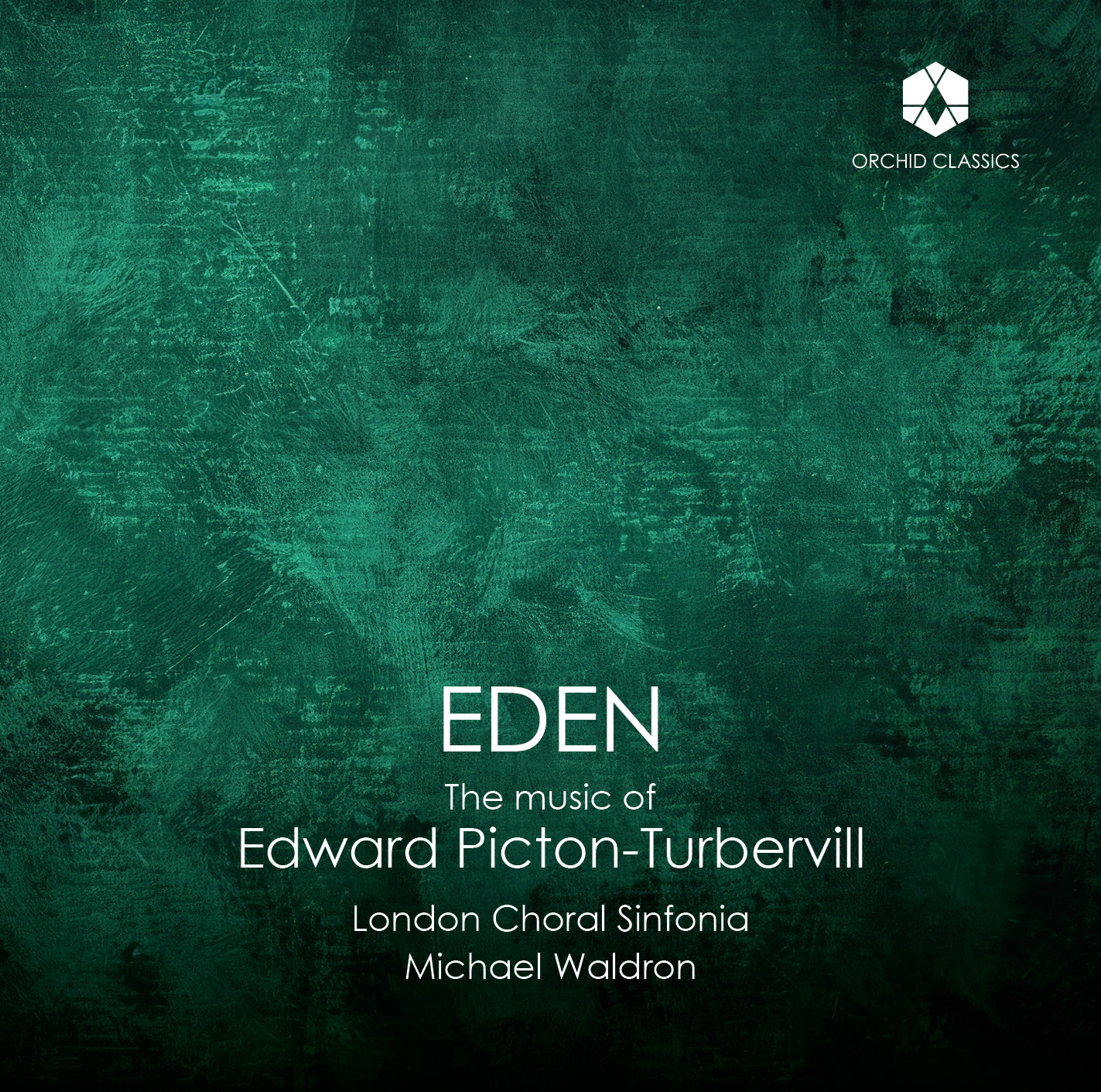
EDEN: THE MUSIC OF EDWARD PICTON-TURBERVILL
London Choral Sinfonia
Michael Waldron, conductor
Release Date: June 26th
ORC100453

Edward Picton-Turbervill (b.1993)
1. Spell of Creation
2. Spell of Sleep
Songs of Eden
3. I Solitude
4. II Reliquary
5. III Kindred
6. IV Incandescence
7. V Migration
8. VI Hallowed
Out of Eden
9. I Out of Eden
10. II Silent Spring
11. III Lamentations
12. IV Miserere
13. V Trisagion
14. VI The Valley of the Dry Bones
15. VII The Trees
London Choral Sinfonia
Michael Waldron, conductor
Katie Bray, mezzo-soprano
Ed Lyon, tenor
Hugo Herman-Wilson, baritone
Michael Foyle, violin
Hannah Watson Emmrich, piano
Hugh Rowlands, organ
George English, percussion
I’ve known Ed for several years, having (almost) overlapped at University and subsequently crossing paths frequently on London’s musical scene.
I had been admiring Ed’s compositions from a distance – particularly the numerous very finely-crafted songs for voice and piano (which I’m delighted to see receiving high-quality recordings of their own) – when a chance conversation between us about a larger-scale work ended up providing the catalyst for this whole project.
We chatted about him wanting to work on an environmental-based, multi-movement work which could reflect the human exploitation (and destruction) of our planet using both sacred and secular texts. I had already been thinking about a nature theme for an LCS concert at Easter 2025, and this seemed like a perfect fit. The hour-long programme was prefaced by a few unaccompanied choral pieces by other composers before Ed’s premiere. It’s fair to say this was one of the most extraordinary responses from an audience I’ve ever experienced: the sold-out hall rose to its feet spontaneously and the feeling that the music had touched people was palpable.
Out of Eden had been launched into the world, and we both felt it deserved to be recorded, especially as so much work had been put in by the musicians learning it for the premiere. Ed and I had to plan the repertoire for the remainder of the disc. Acting as a prelude to the album, the two choral pieces which open the disc are both beautifully conceived and the sound-world created by Spell of Sleep is nothing short of magical. Following is the instrumental Songs of Eden, which I’m delighted Ed was keen to write. It sets the mood for what follows, as well as profiling the unusual combination of instruments we had at our disposal. The textures and sonorities Ed creates are hypnotic and very beautiful.
Ed’s own programme notes best describe all this music, so I’ll avoid providing an inferior commentary. What Ed is too modest to admit is just how incredibly skilled and efficient his writing is. Listening back now it’s hard to believe Out of Eden is scored for just a few instruments (organ, piano, percussion and violin) alongside the choir and soloists. The colours and textures are endlessly surprising and inventive and Ed has the amazing ability to make it all sound like a massive symphony orchestra. I sincerely hope this modern masterpiece enters the mainstream repertoire and will be picked up by choirs across the land: it deserves to be.
Michael Waldron
________________________
When deciding what to pair with Out of Eden on this disc, my mind went immediately to Kathleen Raine’s poetry, and in particular her Spell for Creation. I have always felt an affinity for her writing, and her mystical sensitivity to the land (which foreshadows spiritual ecology) made her poetry seem to me a perfect complement for Out of Eden. I quickly settled on the idea of a part-song to showcase London Choral Sinfonia, and in hunting for a companion poem, I came across the Spell of Sleep, which I thought would work perfectly as a kind of Alto rhapsody, with the choir, piano and organ providing a sumptuous backdrop to Katie Bray’s voice. I imagined it as a spell of protection for my Goddaughters, and kept them in mind whilst writing.
Michael Waldron suggested that it might also be nice to write a small instrumental suite of music that would be more readily digestible for a listener, and so the Songs of Eden were born. For inspiration, I turned to the apocryphal speech given by the Suquamish Chieftain Seattle in 1854. Although Seattle almost certainly did give such a speech, none of the surviving versions is seen as a particularly reliable indication of what he might actually have said. Nevertheless, I have long found the speech a moving example of a powerful and profound environmental ethic, which seems to surface through the variant versions. Seattle’s reproach of the settlers paints a radiant vision of a land thronging with the ghosts of his people, where the soil is made of the ashes of his ancestors, and the whole Earth is humming with vitality, sacred and inviolable. Each movement of Songs of Eden is based on a line from the speech, with the lines rendered into a single word for the titles.
As for Out of Eden, I trace its origins to Heidelberg in September 2016, when I boiled over with frustration, stormed out of a lecture on environmental economics, crossed the street to a piano shop, and sat down to play. It was at this precise moment that I realised whatever my contribution to the environmental crisis might be, it wasn’t going to be writing economic policy. A few years later, as part of my application for a creative fellowship in Oxford, I proposed the idea of writing a Requiem for the natural world. I envisaged a duet with an extinct animal, and wrote Silent Spring, which eventually came to form the basis for Out of Eden. In Holy Week of 2024, it struck me that the Lamentations might be a better framework for the piece of art that I wanted to create than the Requiem; the text is an intense mixture of grief, shame, and desperation, and I felt that mirrored my feelings on the environmental crisis more closely. I had mentioned the idea in passing to Michael in a meeting in January that year, and in September he asked me to write the piece to be included in the Easter Festival at Smith Square in 2025.
The original Lamentations are thought to have been written to mourn the destruction of Jerusalem in 586 BCE, adopting aspects of the older Mesopotamian City Laments, which date from 2000 BCE onwards. This text was later famously repurposed by Tallis, Byrd and others, who found a resonance in the texts, and used them to express a profound sadness at the loss of the Catholic faith in England. I was very attracted by the thought that my piece might join this long line of using ancient texts to address present fears.
As a chorister, I sang the psalms every day; the words took root somewhere deep inside me, and their repetition was a core part of my education. Even as a child I was drawn to the beauty and drama of the language in the Old Testament, and so it seems entirely natural to me that I would use these texts to speak about the crisis. Indeed, the major creative act in writing Out of Eden was actually the conception and construction of the libretto – once the text felt right, the music followed. I think these texts still speak so directly to us precisely because they are abstract. As the American Theologian Walter Brueggemann says, ‘the Old Testament Prophets hardly ever discuss an issue. They go underneath the issues that preoccupy people to the more foundational assumptions, which can only be [reached] through very elusive language’.
Since my MPhil, I have wanted to get to the roots of the environmental crisis, and over many years of reading, listening, talking and thinking, I have come to view it primarily as a crisis of relationship. I do not believe it will be solved by technical means, but only by fundamentally altering the architecture of our society’s relationship with the natural world. It seems to me that the way we relate to the Earth is deeply and intrinsically flawed, and that the manifestation of this mistaken pattern of thought on a planetary scale has become inimical to our wellbeing.
We have achieved marvels over the last century, but at what cost? We have long since uprooted ourselves, transgressed planetary boundaries, and find ourselves spinning in the zero-gravity derangement of end-stage capitalism. I feel that the gospel of growth currently preached by economists is nearly as outlandish as the resurrection narrative, and a good deal more destructive.
As the novelist Jarett Kobek writes, to be alive in the 21st century is to have been ‘born into complex and impossible systems of unfathomable evil’ – we are, paradoxically, both wholly responsible and yet essentially powerless. Confronted by the immensity of the challenge, I believe that most of us have (quite understandably) chosen to look the other way. I have written Out of Eden to try and help us to look the situation calmly in the face, and I hope it will be a cathartic experience for the listener.
The first movement gives the context of the Fall, and the second forces us to confront the results of our actions. The last Kauai O’O, a Hawaiian bird which you will hear singing in the second movement, died in 1987, within the lifetime of many who will read this. This extinct bird’s song forms a leitmotif throughout the rest of the work. The third movement is an outpouring of grief and a cry for God’s help, which goes unanswered. The fourth movement opens with a moment of self-reflection; for me, the image of Death seated on a white horse has always called to mind the echoing absence of the mega-fauna, and all our extinct Hominid brethren.
The second half of that movement is conceived as a participatory and sacramental act of penance. I believe we must acknowledge our complicity if we are to move forward; whether the request for forgiveness goes out to our neighbours, the Kauai O’O or God, I don’t think it much matters.
Having asked for mercy, the piece begins to turn towards the light. The Trisagion is a gesture of humility, an acknowledgment that we are one among many, and a rejection of the rampant anthropocentrism that shapes our view of the world. Ezekiel’s vision of the Valley of the Dry Bones is a potent metaphor for the Earth’s power to heal itself, and that movement ends with some sublimely beautiful words of comfort from God, reframing the curse from the first movement.
Can we solve this crisis? I don’t think so anymore – I think we must live through it. In many Native American cultures, the whole of creation is understood as medicine, and the collapse of the global ecosystem may be the most bitter medicine of them all. We will eventually either change, or we will die. I want to use my voice as an artist to mark the magnitude of the unfathomable loss that we are living through, which now seems to me unstoppable. I want to bear witness to it, to acknowledge our brothers and sisters who are passing away all around us. I have poured sixteen years of preoccupation into Out of Eden – it is my testimony. It is an acknowledgement of our complicity, a desperate cry for help, a call to wake up, and a vision of hope.
Edward Picton-Turbervill
London Choral Sinfonia
‘Fast becoming the go-to champions for contemporary British choral music’ (Gramophone), the London Choral Sinfonia has secured a reputation as one of the leading chamber choir and orchestral ensembles. A busy performance schedule throughout the year sees the group appearing at venues including Cadogan Hall, St Paul’s Cathedral, Kings Place and Sinfonia Smith Square.
Aside from many of the major cornerstones of the repertoire, the LCS also seeks to champion new music, having premiered new works and recordings with numerous composers including Tarik O’Regan, Owain Park, Richard Pantcheff and Ian Assersohn. Recent premieres include former Composer-in-Residence Oliver Rudland’s Christmas Truce, with a libretto by Poet Laureate Carol Ann Duffy.
Recent performance highlights include Bach Jauchzet Gott with Katherine Watson (soprano) and Crispian Steele-Perkins (trumpet), Bach Motets and Cello Suites with Guy Johnston (cello), Mozart Exsultate Jubilate with Mary Bevan (soprano), Britten St Nicolas with Nick Pritchard (tenor), and Brahms Ein Deutsches Requiem with Matthew Brook (baritone).
In addition to a busy concert schedule, the extensive LCS discography includes the three-volume collection of works for choir and orchestra by Richard Pantcheff and the award-winning Christmas album, O Holy Night. Their album, Colourise, featuring baritone Roderick Williams and tenor Andrew Staples, was released to critical acclaim. Described by Gramophone as ‘intensely moving’, the album reached over a million streams within the first months of its release. Sword in the Soul was described as ‘beautifully judged’ (Gramophone) and ‘sublime’ (BBC Radio 3).
Their double-disc release of works by Samuel Coleridge-Taylor in July 2023 features many world-premiere recordings, and was praised for its ‘fine recordings’ (The Sunday Times). Their recording of music by Stephen Hough was received to great critical acclaim: ‘Waldron directs his fresh-voiced choir with energising, always scrupulous ardour’ (BBC Music Magazine), and was selected as both Editor’s Choice and one of the ‘Best Albums of 2023’ (Gramophone). Their album, Retrospect: Vaughan Williams, was again selected as Editor’s Choice and one of the ‘Best Albums of 2024’, alongside featuring in the Top 20 Vaughan Williams recordings of all time (Gramophone).
_______________
Michael Waldron
Conductor
Michael is founder and Artistic Director of the London Choral Sinfonia (LCS), and has worked with many of the top choirs and orchestras in the UK and beyond, including the Philharmonia Orchestra, Hamburg Symphony Orchestra, Royal Philharmonic Orchestra, Britten Sinfonia, Academy of Ancient Music, the Orchestra of the Age of Enlightenment, Polyphony, London Mozart Players, Holst Singers and City of London Choir. He held the post of Interim Director of Music with the Choir of Trinity College, Cambridge, in 2023. He is Musical Director of Islington Choral Society, Artistic Director of London Lyric Opera and Musical Director of Epworth Choir.
His debut album release with the London Choral Sinfonia, O Holy Night, was selected by The Guardian as one of their top Christmas albums. Together with the LCS, he has since embarked on a multi-album project for Orchid Classics recording orchestral and choral music by Richard Pantcheff. His album, Colourise, features a previously unrecorded cantata by Lennox Berkeley, and the first recording of Vaughan Williams’ Five Mystical Songs in an original chamber orchestration, featuring baritone Roderick Williams. Colourise was selected by The Times as one of their Best Albums of 2022. His album of music by Stephen Hough, Mirabilis, was selected by Gramophone as one of their Top Albums of 2023. Michael’s recording with LCS, Retrospect, which features many lesser-known works by Vaughan Williams was selected by Gramophone as Editor’s Choice, and appears in their list of Top 20 recordings of Vaughan Williams.
Michael Waldron began his musical training as a chorister at St Ambrose College, Hale Barns. After a gap year Organ Scholarship at Worcester Cathedral, he held the Organ Scholarship at Trinity College, Cambridge, for four years. Here he studied under Stephen Layton, during which time he was involved with the Choir’s numerous international tours, concerts, broadcasts and recordings.
More information can be found at: www.michael-waldron.com
_______________
Edward Picton-Turbervill
Composer
Edward Picton-Turbervill is a composer and pianist who is rapidly establishing himself as one of the most creative, imaginative and versatile musicians of his generation. Since his return to music in 2021, he has swiftly developed a significant presence in the world of classical music, and now regularly collaborates with some of the leading singers of the moment. 2025 was a landmark year for him: he released an EP with Platoon, All Shall be Well, from which his solo piano track Count it all Joy achieved over a million streams; a major new work, Out of Eden, was premiered in Smith Square Hall and subsequently recorded; and his cantata The Pool of Bethesda premiered to great acclaim. January 2026 saw the release of his debut portrait album of song cycles on Delphian Records, featuring rising stars including Helen Charlston and Alex Chance.
Edward studied Music and Environmental Policy at St John’s College, Cambridge, where he was organ scholar. He then went on to study Piano Accompaniment at Guildhall, graduating with a distinction and the concert recital diploma. He is a City Music Foundation Artist and a Britten Pears Young Artist.
_______________
Katie Bray
Mezzo-soprano
Winner of the Dame Joan Sutherland Audience Prize at Cardiff Singer of the World, British mezzo-soprano Katie Bray has become known for her magnetic stage presence and gleaming, expressive tone: ‘Katie Bray’s Rosina, who sets off sparks at the top and bottom of her voice and plays the role as a deliciously skittish “live wire”, a classic screen goddess’ (Richard Fairman, Financial Times).
In the opera house her roles have included Rosmira/Eurimene (Partenope), Hansel (Hansel and Gretel), Rosina (Il barbiere di Siviglia), Varvara (Katya Kabanova), Nancy (Albert Herring), Zerlina (Don Giovanni), Juno (Semele), Zenobia (Radamisto), Minerva (Il ritorno d’Ulisse in patria), Zaida (Il turco in Italia), Isolier (Le comte Ory) and the title role in Vivaldi’s Griselda for companies including English National Opera, Irish National Opera, Welsh National Opera, Scottish Opera, Garsington Opera, Grange Park Opera and Opera Holland Park. Her interest in the music of Weill and cabaret has led to staged productions of this music, including Effigies of Wickedness, based on songs banned by the Nazis, at the Gate Theatre Notting Hill. Her debut Weill album was released with Chandos Records in January 2026.
Highlights this season include singing Rosmira (Partenope) at English National Opera under Christian Curnyn, Medoro (Orlando) at Longborough Festival Opera under Christopher Moulds, Bach’s B Minor Mass with Irish Baroque Orchestra under Peter Whelan, a Messiah tour to Tenerife and Madrid with The Sixteen, Dido (Dido and Aeneas) with Royal Northern Sinfonia directed by Bjarte Eike and also performing the St Mark Passion with the Arctic Philharmonic.
_______________
Ed Lyon
Tenor
Ed Lyon performs repertoire ranging from baroque to contemporary. He appears in leading opera houses including Covent Garden, Glyndebourne, Bayerische Staatsoper, Netherlands Opera, Teatro Real, La Monnaie, and at festivals including Edinburgh, Aix, Salzburg, Aldeburgh and BBC Proms.
Highlights on the opera stage include Lurcanio (Ariodante), Septimius (Theodora) and Walther (Tannhäuser) for Royal Opera House, Covent Garden; the title role in Candide for Welsh National Opera, Septimius and Jacquino (Fidelio) in Madrid; Quint (The Turn of the Screw), the title role in Orfeo and Grimoaldo (Rodelinda) for Garsington; Ferdinand (Miranda) for Oper Köln; Tamino (Die Zauberflöte) and Don Gomez (Henry VIII) for La Monnaie, Brussels; Števa (Jenůfa), for Opera North; Don Ottavio (Don Giovanni) and Lurcanio for Scottish Opera; Alessandro (Eliogabalo) for Netherlands Opera and the title role in La clemenza di Tito in concert for the Opéra de Rouen.
Concert highlights have included tours worldwide with Les Arts Florissants, Beethoven’s Ninth Symphony with the Monteverdi Choir and John Eliot Gardiner in Europe and US as well as repertoire including The Dream of Gerontius with the RPO, Britten’s War Requiem, Elgar’s The Apostles with The Hallé, Evangelist in both Bach Passions with various ensembles, and Messiah with orchestras and ensembles all over the world.
_______________
Hugo Herman-Wilson
Baritone
British baritone Hugo Herman-Wilson is rapidly gaining recognition for his versatile performances in both opera and concert. A former member of the Young Artist Programme of Les Arts Florissants and a Britten-Pears Young Artist, Hugo is also a recipient of the Help Musicians UK Maidment Award. He studied at King’s College, Cambridge and the Royal College of Music.
Recent seasons have seen Hugo make notable debuts, including the Lucerne, George Enescu, and Tanglewood festivals, and the BBC Proms. He also performed at Lincoln Center New York, La Scala Milan, and the Philarmonie de Paris in a production of Purcell’s The Fairy Queen with Les Arts Florissants. This season, Hugo creates the role of Papageno in Damon Albarn’s The Magic Flute II: The Curse at Théâtre du Lido, Paris. Hugo will also perform The Fairy Queen with Vox Luminis in Europe, and with Les Arts Florissants in South America and make his Glyndebourne debut in Monteverdi’s L’Orfeo.
On the concert platform, Hugo has performed a wide range of repertoire, including a programme of Schütz and Praetorius with Jonathan Cohen at Wigmore Hall. He has also appeared at the Aldeburgh Festival and the SmorgasChord Festival, and was an audience prize winner at the Somerset Song Prize. He has performed solos in various Bach Cantatas with the Orchestra of the Age of Enlightenment and appeared at the London Handel Festival. On the operatic stage, Hugo’s recent and upcoming roles include The Notary (The Sorcerer) and Don Basilio (Il barbiere di Siviglia) for Charles Court Opera, as well as covering Monsieur Presto (Les mamelles de Tirésias) and The Notary (Don Pasquale) for Glyndebourne Opera. He has also covered Bartolo (Il barbiere di Siviglia) and Krušina (The Bartered Bride) for Garsington Opera, and performed Dottore Grenvil (La traviata) for Nevill Holt and Oxford Opera.
similar Artists & Albums