
Press Release
For press enquiries please contact alex.patel@orchidclassics.com. Tel: +44 7717 663481
DOUBLE CONCERTOS
Catalogue Number: ORC100434
Release Date: April 17th 2026

Click the button above to download all album assets.
Across this album, Nathan sets present-day musical language in conversation with older forms and gestures, drawing on spatial placement, texture, and timbre to create music that is intimate in scale yet expansive in feeling. Themes of mentorship, partnership, love, and loss run quietly through these works, performed here by long-time collaborators and musicians closely connected to the music’s origins.
DOUBLE CONCERTOS
Eric Nathan (b.1983)
1. Double Concerto (2019) for solo violin, solo clarinet and strings
Stefan Jackiw, solo violin
Yoonah Kim, solo clarinet
New York Classical Players
Dongmin Kim, conductor
2. Just a Moment (2021) for two antiphonal oboes
John Ferrillo, oboe
Amanda Hardy, oboe
Double Concerto No. 2 (2023) for two solo violas and strings
3. I A dialogue; intimately
4. II Brilliantly; vibrantly
5. III Vigorously; racing
6. IV Embracing; with warmth
7. V Dancing; joyous
8. Coda Freely, with rubato; like wind
Hsin-Yun Huang, solo viola
Misha Amory, solo viola
Musicians from Yellow Barn, Ariel Quartet, Jupiter String Quartet
& Parker Quartet
Eric Nathan, conductor
The Music
Over the past five years, I’ve found myself on a journey exploring how two voices interact in sound. I’ve sought meaning in how two people can come together, separate, console, exhort, celebrate, and remember one another through music. This search has been deeply rewarding musically and personally, as it has opened new paths in my work and new friendships through collaboration.
I didn’t set out to compose a cycle of duos. This body of work emerged organically, each project arriving and unfolding step by step. Through the matchmaking and support of longtime collaborators – Dongmin Kim (New York Classical Players), Seth Knopp (Yellow Barn), and Michael Sporn – I paired with three sets of soloists whose own relationships run deep: violinist Stefan Jackiw and clarinettist Yoonah Kim, who are married; violists Misha Amory and Hsin-Yun Huang, also married; and oboists John Ferrillo and Amanda Hardy, who are not married, but share a teacher-student bond and now perform together as colleagues frequently with the Boston Symphony Orchestra.
Furthering these webs of connection, Double Concerto No. 2, commissioned in memory of Roger Tapping – beloved teacher and former violist of the Juilliard and Takács Quartets – was premiered and recorded by an orchestra composed of his students. Members of the Ariel, Jupiter, and Parker quartets, along with many former students, came together in Boston in New England Conservatory’s Jordan Hall to honor Tapping at the world premiere.
Themes of relationship, mentorship, remembrance, love, and loss infuse the music on this album. I have imagined the sonic connections between two voices engaging with forces larger than themselves – whether the orchestra and the resonance of the hall, or, outside the musical realm, the pairings of husband and wife, teacher and student, individual and collective, living and deceased, distance and closeness, past and future. To explore these ideas, I set music of the past in dialogue with sounds of the present, evoked the natural world through exploring the lines between pitch and noise, and choreographed spatial movement of sound across the stage and performance space.
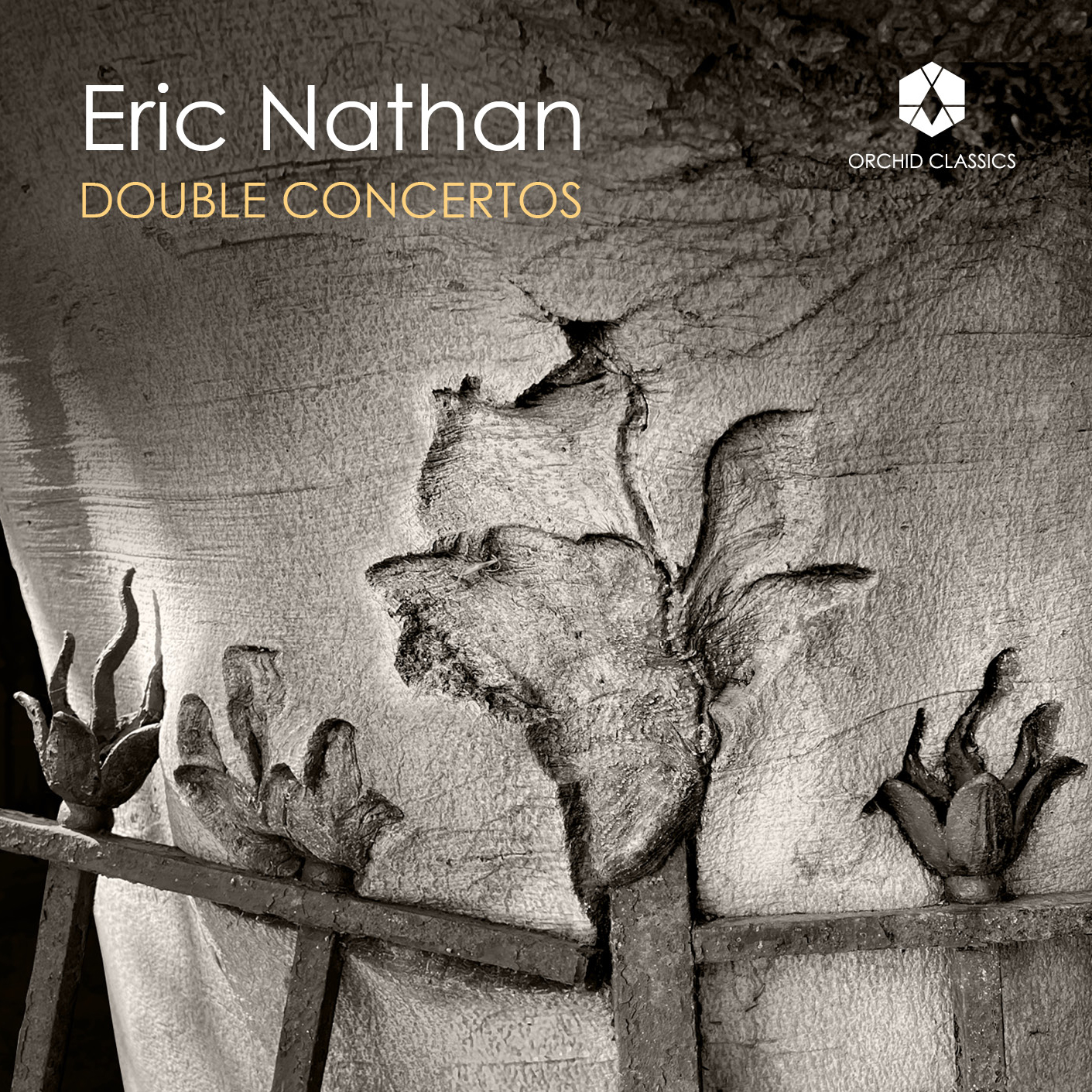
While composing Double Concerto No. 2, I thought of Ovid’s myth of Baucis and Philemon – a couple who, following their long lives together, grew into a single tree. Denise Burt’s cover art for this recording, taken in a cemetery where her husband’s parents are buried, shows a tree growing around a metal fence whose top resembles an ossified flame. Its fragile beauty captures a small part of what I hope these pieces express.
Double Concerto (2019)
for solo violin, solo clarinet, and string orchestra
Co-Commissioned by the New York Classical Players (Dongmin Kim, Music Director) and the New England Philharmonic (Richard Pittman, Music Director)
Dedicated to Stefan Jackiw and Yoonah Kim
The concerto begins in desolation, evoking a vast stillness. The string orchestra grows from nothing into a soft, embracing ambience spanning its full range. The sound is more felt than heard: the double bass’s lowest C paired with the first violins’ high B – wind-like, almost beyond pitch.
I sought to evoke an austere natural landscape, and the solitude that lives atop a lonely mountain. In hindsight, these two pitches – C and B – became emblematic of the entire series of works on this recording. Scale degrees 1 (do) and 7 (ti), they hover one step from resolution yet remain worlds apart in register and color. Distinct and independent, they combine into something otherworldly.
The violin enters with a plaintive soliloquy, a lamenting theme that descends only to reach higher before falling again. Behind it, the orchestra unleashes cascading, weeping glissandi – like a time-lapse photograph of stars streaking across the night sky. The orchestra often serves like a Greek chorus, standing with the soloists and narrating their struggles.
The violin’s opening phrase introduces a second idea: a rising theme traversing a sonic staircase – three steps up, one step back – pressing upward toward its destination. These descending and ascending motives remain in dialogue throughout the single-movement concerto.
My thinking about the solo roles grew from early conversations with Stefan and Yoonah. Stefan described the clarinet in string chamber music, such as in Mozart’s Clarinet Quintet (K.581), as an “invited guest.” In my work, I imagined the clarinet as an apparition or inner voice of the violin. It only first enters nearly halfway through, altering the course of the concerto. I pictured its arrival as a lone flower blooming in a harsh landscape where nothing else survives.
The clarinet then leads the violin into a racing middle section, the two skirting past orchestral interjections at high speed until orchestra and soloists take flight. At the climax, the ensemble erupts into “bariolage” bowing, bows seesawing ecstatically across the strings – like beating wings taking flight across the orchestra.
The duo’s cadenza turns inward, its virtuosity intimate. The clarinet teaches the violin its rising theme again one note at a time until the violin can stand on its own to greet the orchestra, which arrives in a tall, luminous chord.
Just a Moment (2021)
for two antiphonally positioned oboes
Commissioned by the Chelsea Music Festival and Dr. Michael Sporn
Dedicated to John Ferrillo and Amanda Hardy
Just a Moment meditates on distance and closeness. The invitation to compose it arrived in summer 2020, at the height of the pandemic. Michael Sporn – who previously commissioned my Dancing with J.S. Bach suites – asked for a work for Amanda Hardy to support new artistic collaboration during a difficult time in the music world, with physical distancing often required in performance. We soon invited John Ferrillo, Amanda’s mentor and my collaborator on Why Old Places Matter for the Boston Symphony Chamber Players.
Immediately before writing this piece, I had been composing Opening for Ken-David Masur and the Milwaukee Symphony Orchestra to inaugurate their new hall. That work includes an oboe duet between an onstage player and one in a balcony, drawing lines of sound across the hall to connect a community. Longing to hear that music take life – that premiere having been delayed due to the pandemic – I developed the idea further in this duet for two distanced oboes.
In Just a Moment, the oboes call out to each other – note by note, phrase by phrase – creating an unfolding melody that catches and embraces each other’s tones and the space between them. Subtle unisons and half-step dissonances mingle in echo. The music holds a trance-like contemplation that gradually finds dancing joy.
In performance, one oboe is onstage and the other in a balcony, their sounds embracing the audience in a choreography that meets in the air between them. The piece taught me to appreciate fleeting moments of connection and how they sustain us. This recording was made in Jordan Hall with the same spatial arrangement.
Double Concerto No. 2 (2023)
for two solo violas and string orchestra
Co-Commissioned by Yellow Barn (Seth Knopp, Artistic Director) as part of its project in memory of Roger Tapping; The Juilliard School; The New York Classical Players (Dongmin Kim, Music Director), and Rhode Island Chamber Music Concerts
Dedicated to Misha Amory and Hsin-Yun Huang, and to the memory of Roger Tapping
This concerto emerged through a fortuitous confluence. Dongmin Kim introduced my Double Concerto to Misha Amory and Hsin-Yun Huang, who then requested a concerto for themselves to premiere; around the same time, Seth Knopp asked me to write a viola duo in memory of Roger Tapping for the same pair. Yellow Barn’s larger commissioning project in memory of Roger focused on new works for respected viola pedagogues, with the hope these works would ultimately pass down to their students. These connections, and Roger’s legacy as a teacher, shaped my initial ideas for the piece. I cherish memories of working with Roger at Yellow Barn during my first summer there, when he performed my viola quintet Omaggio a Gesualdo, another work in dialogue with the past.
I began this concerto while on sabbatical in 2022 at the Civitella Ranieri Foundation in Umbria, Italy, housed in a 16th-century castle built on the site of an 11th-century church. Each day I walked along a path that sits atop a ridge in the Italian countryside and is lined with trees on both sides: towering cypresses that stand tall and erect like ancient living pillars or guarding giants, and younger lindens that reach across to each other and gently entwine their branches above. The path stretches straight from a castle on one end across the ridge and through a gate to a forest beyond where the eye can see. Walking down this path evoked in me a sense of a procession through time. It was only after completing this work did I realize how much the experience of my daily walks had seeped into my conception of this concerto.
At its heart, Double Concerto No. 2 is an exploration of the intertwining relationships between discrete and sometimes opposing forces. I contemplate various acts of weaving-together: of one life with another, of the human and natural worlds, of stasis and movement, of the past and present, and of feelings such as love, loss, joy and remembrance. The two soloists often thread their counterpoint like the oak and linden of Baucis and Philemon. While the concerto is symphonic in scope, its central focus is the two soloists and their interactions between each other and the orchestra.
The work unfolds in five movements with a coda, connected by interludes in which waves of sound ripple across the ensemble. Some of these interludes are “painted” by the conductor’s sweeping gestures: a notated staff indicates the motion of the conductor’s hand from left to right at specific speeds, cueing players to perform uncoordinated rustling sounds. Each performance is slightly different, evoking the impermanence of the natural world – you might imagine leaves rustling, waves breaking, sand blowing across a path. The use of this technique is inspired by Walter Thompson’s musical sign language, Soundpainting.
The first movement, “A dialogue; intimately,” begins with the two soloists slowly unfolding a melody. Behind them, orchestra members slowly pass pitch-less air sounds on their instruments from one another across the stage. These very subtle sounds of wind or breath gradually enliven, arriving in a wave painted by the conductor across the ensemble at the height of the rising melody.
The two solo violists are often put into conversation with a Renaissance-like consort of three violists from the orchestra. In movements II (“Brilliantly; vibrantly”) and V (“Dancing; joyous”), this trio consort introduces quotations from music of the past, reimagined and reframed throughout the concerto: 16th-century composer John Dowland’s Flow My Tears (originally Lachrimae pavane, c. 1596), and 11th-century composer Pérotin’s Viderunt Omnes (“All the Ends of the Earth,” c. 1198).
Dowland’s lamenting lute song was originally composed in the form of a pavane, a slow processional dance for couples that often precedes a faster, joyous dance. Its main theme is built on a leap followed by lamenting steps down a scale. This motif, a compressed cousin of the larger laments in Double Concerto, is re-harmonized and reimagined across the second and third movements. In the third movement (“Vigorously; racing”), a rising three-to-four note fragment from the following Dowland stanza becomes the thematic material, rushing through the orchestra in imitative fugato textures. It imbues with urgency the most heartbreaking lines of Dowland’s song: “And tears and sighs and groans my weary days” and “And fear and grief and pain for my deserts.”
The fourth movement, “Embracing; with warmth,” emerges from an intimate duo cadenza centered on a single shared pitch, that gathers into a tall F-major chord, marked molto appassionato. The movement revisits and expands the melodic evolution of the first movement, with the soloists switching roles in a higher octave, now harmonized by a lush string accompaniment. Orchestral rustling leads to an impassioned tutti arrival, with a Mahlerian emotionality (the Adagietto of his Fifth Symphony was not too far from mind, itself a love letter to his wife, Alma).
An interlude with a new collection of fluttering sounds, one described in the score as “like a flock of seagulls,” leads to the fifth movement, which quotes from Pérotin’s Viderunt omnes. Pérotin’s luminous setting of a Gregorian chant is one of the first known instances of polyphony in Western European music. His work features a trio moving in subtle counterpoint, with one stepping slightly out of line at various points, evoking a lilting dance, with a fourth voice intoning a drone underneath. The orchestra loops and paraphrases this ancient groove while the solo violas build new lines above it, creating a new world atop music nearly a millennium old. Sweeping rustling gestures return and erupt into wild waves of bariolage rushing across the orchestra. A final interlude leads to the coda, “Freely, with rubato; like wind,” where the solo violists ascend into fragile harmonics as the viola trio dances away into the distance.
Double Concertos brings together three works by composer and conductor Eric Nathan, each exploring the expressive possibilities of paired solo voices in dialogue with space, memory, and one another.
Written between 2019 and 2023, the pieces on this album grew from Nathan’s long-standing fascination with how two individuals interact through sound—coming together, diverging, supporting, and remembering. The Double Concertos for violin and clarinet, and for two violas, are shaped by close personal relationships between the soloists, while Just a Moment for two antiphonal oboes reflects on distance and connection, both physical and emotional.
Across the album, Nathan sets present-day musical language in conversation with older forms and gestures, drawing on spatial placement, texture, and timbre to create music that is intimate in scale yet expansive in feeling. Themes of mentorship, partnership, love, and loss run quietly through these works, performed here by long-time collaborators and musicians closely connected to the music’s origins.
Eric Nathan
Composer & Conductor
Eric Nathan’s (b.1983) music has been called “as diverse as it is arresting” with a “constant vein of ingenuity and expressive depth” (San Francisco Chronicle), and “a marvel of musical logic” (Boston Classical Review). His work has received international acclaim with performances by the National Symphony Orchestra, Scharoun Ensemble Berlin, Dawn Upshaw, and Jennifer Koh, as well as at Carnegie Hall and the Aldeburgh Festival.
Recent highlights include three commissions from the Boston Symphony Orchestra, including the space of a door, premiered by Andris Nelsons and released on Naxos, and Concerto for Orchestra, which opened the 2019–20 season. Opening (2021), co-commissioned by the Milwaukee Symphony Orchestra and Koussevitzky Music Foundation, was broadcast nationally on PBS. In 2023, the Brown Arts Institute commissioned Open again a turn of light for choir and orchestra to open the inaugural performance at Brown’s Lindemann Performing Arts Center. His flute concerto The Seas Between Us will be premiered by four Mexican orchestras with flutist Alejandro Escuer. National Sawdust and VisionIntoArt commissioned Division of Time, an evening-length work for cellist Jeffrey Zeigler and Gandini Juggling for premiere in 2026.
Nathan has been commissioned by the New York Philharmonic, Chamber Music Society of Lincoln Center, Eighth Blackbird, Tanglewood, Tonhalle Düsseldorf, Yellow Barn, and Aspen Music Festival. He is a recipient of the Rome Prize, Guggenheim Fellowship, and Goddard Lieberson Fellowship from the American Academy of Arts and Letters, and has held residencies at MacDowell, Copland House, and Civitella Ranieri. His portrait albums appear on Albany Records, BMOP Sound, and New Focus.
Nathan is Associate Professor of Music at Brown University, where he received the Wriston Fellowship for teaching excellence. He is Artistic Director of Collage New Music and was Composer-in-Residence with the New England Philharmonic (2019–25). He holds degrees from Yale, Indiana University, and Cornell. Eric Nathan’s compositions are available worldwide for rental and sale by Just a Theory Press.
Stefan Jackiw
Violin
Stefan Jackiw is one of America’s foremost violinists, captivating audiences with playing that combines poetry and purity with impeccable technique. Hailed for playing of “uncommon musical substance” that is “striking for its intelligence and sensitivity” (Boston Globe), Jackiw has appeared as a soloist with the Boston, Chicago, Cleveland, New York, Philadelphia, and San Francisco symphony orchestras, among others and performed in numerous major festivals around the world, including the Aspen Music Festival, Ravinia Festival, Caramoor International Music Festival, Schleswig-Holstein Music Festival, Lincoln Center’s Summer for the City Festival, and the Celebrity Series of Boston. Jackiw frequently tours with his musical partners, pianist Conrad Tao and cellist Jay Campbell, as part of the Junction Trio. He is the recipient of a prestigious Avery Fisher Career Grant and plays a violin made by Domenico Montagnana “ex. Rossi” c. 1730, generously loaned by a private foundation.
Yoonah Kim
Clarinet
Hailed by The New York Times for her “inexhaustible virtuosity”, clarinetist Yoonah Kim is an artist of uncommon musical depth and versatility. She enjoys a diverse career as solo clarinetist, chamber musician, orchestral musician, and educator. Yoonah launched her career when she won the 2016 Concert Artist Guild International Competition – the first solo clarinetist to win CAG in nearly 30 years; she is also the first woman to win first prize at the Vandoren Emerging Artists Competition and is a first prize winner of the George Gershwin International Competition and the Vienna International Competition.
Committed to new music, she has commissioned and premiered works such as Eric Nathan’s Double Concerto for Violin and Clarinet, Texu Kim’s Rhapsody in Blue for Solo Clarinet, and Andrew Hsu’s Erebus for Clarinet and Piano.
Yoonah has given recitals at Carnegie Hall’s Weill Recital Hall, Chicago’s Dame Myra Hess Memorial Concerts series, Washington Performing Arts’ Music in the Country series, among others. She has also appeared as concerto soloist internationally with the Maui Chamber Orchestra, New England Philharmonic, Busan Chamber Orchestra, and more.
Yoonah regularly performs as guest principal clarinet with Orpheus Chamber Orchestra, Albany Symphony, Princeton Symphony, and The Orchestra San Antonio and has also appeared as guest principal clarinet with the Saint Paul Chamber Orchestra. From 2016 to 2018, Yoonah was a member of Ensemble Connect, a highly selective two-year fellowship program under the joint auspices of Carnegie Hall, The Weill Institute, and The Juilliard School. With Ensemble Connect, she performed regularly at Carnegie Hall, often in collaboration with renowned musicians such as Sir Simon Rattle, Mark Padmore, and Natalie Dessay at the Philharmonie de Paris. She is also a regular guest with chamber music ensembles such as NOW Ensemble, Jupiter Chamber Players, and Manhattan Chamber Players.
Yoonah is on the clarinet faculty at New York University and she is a Vandoren Artist.
John Ferrillo
Oboe
John Ferrillo joined the Boston Symphony Orchestra as principal oboe at the start of the 2001 Tanglewood season, occupying the Mildred B. Remis Principal Oboe Chair, and having previously appeared with the orchestra several times in previous seasons as a guest performer.
From 1986 to 2001 he was principal oboe of the Metropolitan Opera Orchestra. Ferrillo grew up in Bedford, Massachusetts, and played in the Greater Boston Youth Symphony Orchestra. He is a graduate of the Curtis Institute, where he studied with John de Lancie and received his diploma and artist’s certificate. He also studied with John Mack at the Blossom Festival and has participated in the Marlboro, Craftsbury, and Monadnock festivals. Prior to his appointment at the Metropolitan Opera, Ferrillo was second oboe of the San Francisco Symphony, and was a faculty member at Illinois State University and West Virginia State University. He also formerly served as a faculty member at the Mannes School of Music and Juilliard School of Music in New York City and has taught and performed at the Aspen and Waterloo festivals. He currently serves on the faculties of New England Conservatory, Boston University, and Boston University Tanglewood Institute.
His previous BSO appearances as soloist have included Ligeti’s Double Concerto for Flute and Oboe with BSO colleague Elizabeth Rowe; Richard Strauss’s Concerto for Oboe; two collaborations with violinist Pinchas Zukerman at Tanglewood in music of J.S. Bach; Mozart’s Sinfonia Concertante for Oboe, Clarinet, Bassoon, and Horn in E-flat major, with BSO colleagues on the opening program of the 2014-15 season; and in May 2018, Marcello’s Concerto for Oboe in C minor with Moritz Gnann conducting.
As principal oboe of the BSO, Ferrillo is also a faculty member at the Tanglewood Music Center and a member of the Boston Symphony Chamber Players, with whom he can be heard in BSO Classics recordings.
Amanda Hardy
Oboe
Amanda Hardy joined the Portland (Maine) Symphony Orchestra as principal oboe in November 2013 where she occupies the Clinton Graffam Chair. An in-demand artist in New England and beyond, Amanda is a frequent performer with the Boston Symphony Orchestra and the Boston Pops, with whom she has both toured internationally and recorded. She has performed as guest principal oboe with the Boston Symphony Orchestra and the Boston Pops, A Far Cry Chamber Orchestra, Emmanuel Music, the Des Moines Symphony, and the Boston Philharmonic.
Amanda has appeared as soloist with the Boston Pops in Symphony Hall (2009), the Portland Symphony, the Chelsea Music Festival, the Bach Virtuosi Festival, the NEC Bach Ensemble, and the Drake Symphony Orchestra. As a recipient of the Gillet Scholarship and Tourjée Alumni Scholarship Award, Amanda studied with BSO principal oboist John Ferrillo at the New England Conservatory (NEC). Amanda was winner of the 2010 Borromeo String Quartet Guest Artist Award Competition. As a chamber musician, she co-founded the St. Mary’s Quarantine Series with soprano Tamra Grace Jones, a chamber music series during the pandemic that both raised money for a food pantry in Dorchester and employed musicians during the pandemic.
Amanda recently joined the faculty at Boston University as Lecturer in Oboe, is Assistant Professor of Oboe at the Boston Conservatory at Berklee, and is on the faculty of New England Conservatory Preparatory School. She holds a Bachelor of Music in oboe with a piano minor from Drake University and a Master of Music and Graduate Diploma from NEC. Previous festivals include the Masterworks Festival, the Chelsea Music Festival, the Aspen Music Festival and School, and Tanglewood Music Center in 2010 and 2011 where she was awarded the Mickey L. Hooten Memorial Award both summers. Her solo work can be heard on, Dancing with J.S. Bach (2019), on the Chelsea Music Festival Live label. Her teachers include John Ferrillo, Marilyn Zupnik, Anne Gabriele, and Jay Light; summer studies with Elaine Douvas and Richard Woodhams.
Hsin-Yun Huang
Viola
Hsin-Yun Huang is recognized as one of the foremost violists of her generation, admired for her artistry on international stages, her advocacy for new music, and her dedication to mentoring young musicians. She has appeared as soloist with leading ensembles including the Berlin Radio Orchestra, Bavarian Radio Orchestra, Tokyo Philharmonic, Bogotá Philharmonic, Beijing’s NCPA Orchestra, Taiwan Philharmonic, and Taipei City Symphony, performing under conductors such as David Robertson, Osmo Vänskä, Xian Zhang, and Max Valdés. She was also the first violist to appear as a concerto soloist at Beijing’s National Center for the Performing Arts. Festival appearances include Marlboro, Santa Fe, Music@Menlo, Chamber Music Northwest, La Jolla, and the Seoul Spring Festival, as well as tours with the Brentano String Quartet, highlighted by Mozart’s complete string quintets at Carnegie Hall.
A passionate advocate for education, Ms. Huang founded VivaViola!, a hybrid platform dedicated to expanding the viola repertoire and preserving musical traditions through dialogue with distinguished artists. Recent creative projects include Strings of Soul with pipa virtuoso Wu Man; FantaC, a collaboration with Ashkenazy Ballet; and the upcoming sisila ila ila: saying goodbye, an environmental work with composer Shih-Hui Chen and director Doug Fitch.
Her recent commissions include James MacMillan’s Viola Quintet with the Brentano Quartet and Eric Nathan’s Double Concerto No. 2 for Two Violas. Her recordings include Viola Viola (Bridge Records), praised by Gramophone and BBC Music Magazine, FantaC (2020), and Viola Lens (2019).
Ms. Huang serves on the viola faculties of The Juilliard School and The Curtis Institute of Music. She performs on a 1735 Testore viola.
Misha Amory
Viola
Since winning the 1991 Naumburg Viola Award, Misha Amory has been active as a soloist and chamber musician. He has performed with orchestras in the United States and Europe, and has been presented in recital at New York’s Tully Hall, Los Angeles’ Ambassador series, Philadelphia’s Mozart on the Square festival, Boston’s Gardner Museum, Houston’s Da Camera series and Washington’s Phillips Collection. He has been invited to perform at the Marlboro Festival, the Seattle Chamber Music Festival, the Vancouver Festival, the Chamber Music Society at Lincoln Center and the Boston Chamber Music Society, and he has released a recording of Hindemith sonatas on the Musical Heritage Society label. Mr. Amory holds degrees from Yale University and the Juilliard School; his principal teachers were Heidi Castleman, Caroline Levine and Samuel Rhodes. Himself a dedicated teacher, Mr. Amory serves on the faculties of the Juilliard School in New York City and the Curtis Institute in Philadelphia.
Dongmin Kim
Conductor
Dongmin Kim is emerging as one of today’s most versatile and thoughtful conductors, appearing on major stages such as the Kennedy Center, Lincoln Center, Carnegie Hall, Jordan Hall, Herbst Theatre, Seoul Arts Center, and Lotte Concert Hall. As the founding Music Director of the New York Classical Players, he has led the orchestra through more than 250 performances, three international tours across Asia and South America, and a major US tour after stepping in on short notice to lead NYCP in place of the canceled English Chamber Orchestra tour.
Dongmin’s career highlights include an appearance with the National Symphony Orchestra at the Kennedy Center and widely praised performances of The Magic Flute at the Seoul Arts Center. He has also appeared with the Philadelphia Orchestra, Minnesota Orchestra, Baltimore Symphony, Indianapolis Symphony, Jacksonville Symphony, San Antonio Symphony, Virginia Symphony, and Winnipeg Symphony. He is a frequent returning guest at the Round Top Music Festival, working regularly with the Texas Festival Orchestra.
He has collaborated with many of today’s leading artists, including Sumi Jo on a national US tour, as well as Miriam Fried, Donald Weilerstein, Kim Kashkashian, Cho-Liang Lin, Pamela Frank, Carter Brey, Richard O’Neill, Clara Jumi Kang, and Stefan Jackiw.
Dongmin was a recipient of the Herbert von Karajan Fellowship and previously served as the Schmidt Conducting Fellow with the Indianapolis Symphony Orchestra. His recent recording of chamber works by Samuel Adler on Toccata Classics received strong critical praise. A native of Seoul, Dongmin studied Orchestral Conducting and Viola at Indiana University Jacobs School of Music. His musical mentors include Kurt Masur, Janos Starker, Alan de Vertich, Leonard Slatkin, Imre Pallo, Thomas Baldner, and David Effron. Dongmin resides in New York City with his wife, Sally.
New York Classical Players
New York Classical Players (NYCP) is a dynamic chamber orchestra redefining how classical music lives in our time. Founded in 2010 by music director Dongmin Kim, NYCP brings together exceptional musicians committed to artistic excellence, collective music-making, and public access.
With over 250 performances across the United States, South America, and Asia, NYCP has collaborated with renowned artists such as Miriam Fried, Donald Weilerstein, Kim Kashkashian, Pamela Frank, Charles Neidich, Sumi Jo, Stefan Jackiw, Yekwon Sunwoo, and many others.
At the heart of NYCP’s mission is a belief that music should be shared freely. Every season, the orchestra presents bold new commissions, reimagined classics, and hidden gems – all offered without charge to the public. This approach creates space for discovery, dialogue, and connection through music.
NYCP is based in New York City and guided by a dedicated board of directors and community of supporters.
Yellow Barn
Yellow Barn, an international center for chamber music, encourages discovery in the studio, classroom, and concert hall; explores the craft of musical interpretation; and illuminates our world through the unique experience of music. Twice awarded the ASCAP/Chamber Music America Award for Adventurous Programming, Yellow Barn’s approach to lifelong education for musicians and audiences, commitment to quality and a unique philosophy, and programs that focus listeners in new ways, set it apart from any other chamber music center in this country.
Based in Putney, Vermont with a national agenda and an international presence, Yellow Barn draws young professional musicians from the United States, Europe, Middle East, and Asia. Under the leadership of Artistic Director Seth Knopp, participants in Yellow Barn’s summer festival explore music spanning a wide range of eras and genres alongside faculty members who are among the most highly regarded performers and pedagogues of our time.
Click the button above to download all album assets.