
Press Release
For press enquiries please contact alex.patel@orchidclassics.com. Tel: +44 7717 663481
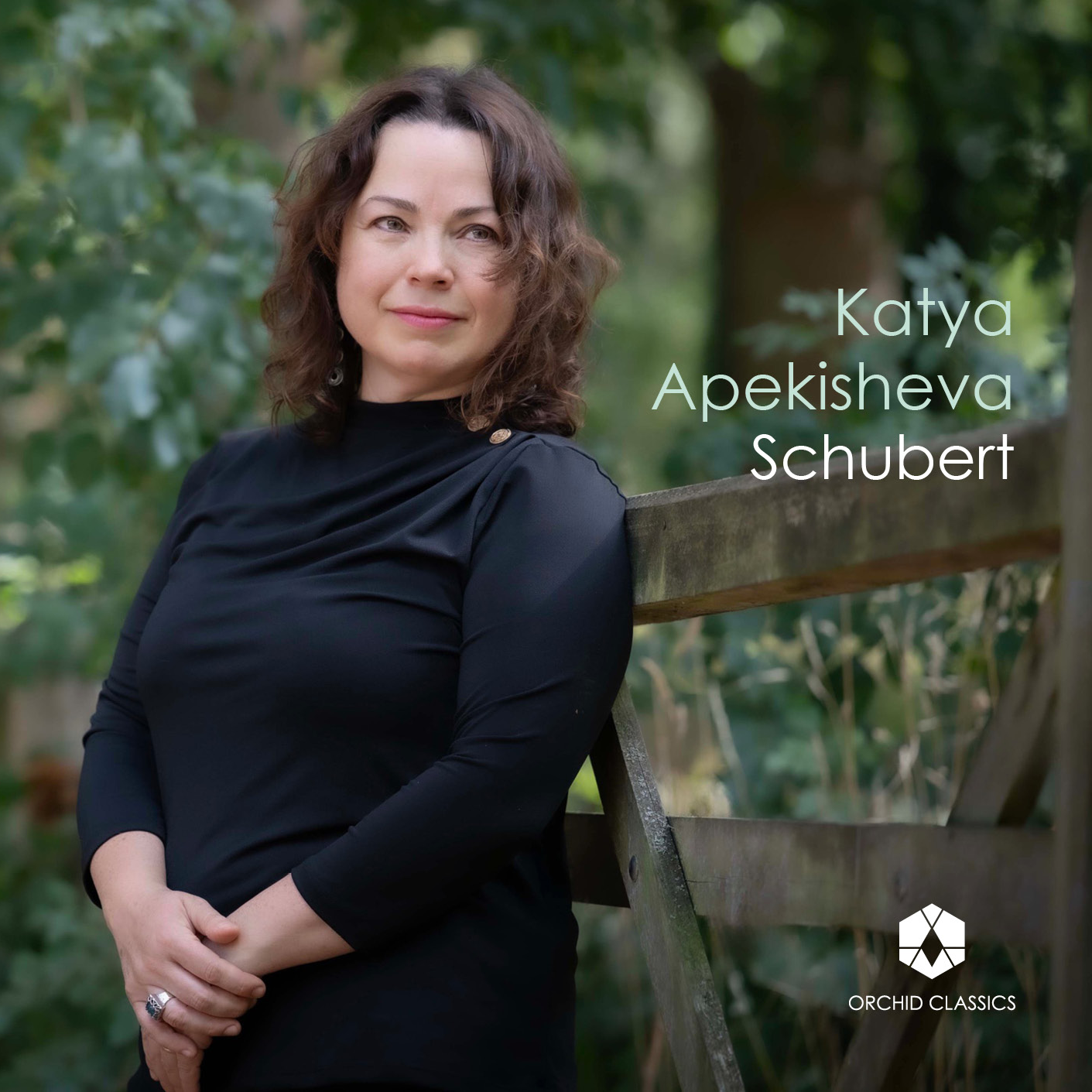
Schubert
Katya Apekisheva, piano
Catalogue Number: ORC100422
Release Date: March 27th 2026

Click the button above to download all album assets.
For pianist Katya Apekisheva, Schubert has been a lifelong companion. This recording represents a deeply personal homage, shaped by years of performing and living with this music. Recorded on a Steinway Model D at Syde Manor, the album offers a thoughtful, finely judged reading of some of Schubert’s most inward and compelling piano writing.
Franz Schubert (1797-1828)
1. Allegretto C minor, D.915
Six Moments Musicaux, D.780
2. I Moderato
3. II Andantino
4. III Allegro Moderato
5. IV Moderato
6. V Allegro Vivace
7. VI Allegretto
Drei Klavierstucke, D.946
8. I Allegro Assai
9. II Allegretto
10. III Allegro
Katya Apekisheva, piano
I was surrounded by Schubert’s music from early childhood. Amongst my earliest memories, I can clearly recall listening to Lieder sung by Dietrich Fischer-Dieskau and sight-reading four-hands pieces with my parents, both of whom are pianists.
Schubert is much more than one of my favourite composers. I think of him as my lifelong companion on a musical journey. I have performed Schubert’s music regularly since my teens and continue to include his works in most of my programs. His unique musical language, most beautiful melodies, enchanting harmonies, purity of emotion and otherworldly magical atmosphere truly speak to my heart.
It took me years to find the courage to record Schubert. I have so much admiration and respect for the iconic interpretations of his music by such great artists as Alfred Brendel, Imogen Cooper, Arcady Volodos, Grigory Sokolov and Maria Joao Pires, to name a few.
This CD is my humble personal homage to his genius.
Katya Apekisheva
______________________________
Early in 1826, the Viennese firm of Anton Pennauer published Schubert’s Piano Sonata in A minor D.845. Although he had already completed nearly a dozen sonatas, it was Schubert’s first to appear in print, and was duly published as his Première Grande Sonate. Almost as a symbolic gesture, the title page bore a dedication to Beethoven’s most ardent champion and patron, Archduke Rudolph. Beethoven, of course, was a law unto himself, but for the rest public appetite for large-scale sonatas was at low ebb.
Although a Seconde Grande Sonate by Schubert appeared a few months later, he is unlikely to have been pleased by the title page of another of his works of the kind, which was issued in the spring of 1827. Ignoring the word ‘Sonata’ which Schubert had written in large letters on the cover of his manuscript, the publisher, Tobias Haslinger, marketed the work as Fantasie, Andante, Menuetto und Allegretto. Haslinger was a canny businessman (it was he who, shortly after Schubert’s death, issued a collection of his late songs under the catchpenny title of ‘Schwanengesang’), and he must have known that his sales figures for the new sonata were likely to be healthier if potential purchasers were promised a series of individual character-pieces. Perhaps it was this experience that led Schubert to concentrate in the remainder of 1827 on short piano pieces of the kind designed to appeal to the domestic market. In the early part of the year he had begun work on his Winterreise cycle, setting the first twelve of Wilhelm Müller’s poems in February. The remaining twelve songs followed in the autumn, and between the two halves of the bleak song cycle Schubert composed his first set of Impromptus, as well as, in all likelihood, four of his six Moments musicaux. (The remaining two, as we shall see, are earlier compositions.) A second Book of Impromptus followed at the end of the year.
The first of the ‘Moments musicaux’ D.780 to be composed – and ever since, one of Schubert’s most popular piano pieces – was No.3, which first appeared in an album of Christmas and New Year music issued in December 1823. Schubert’s piece was given the fanciful title of Air russe, and was bound together with such items as a new cavatina by Rossini, a cotillon by Count Gallenberg (the husband of Countess Guicciardi, to whom Beethoven dedicated his ‘Moonlight’ Sonata), and a Plaisanterie sur des thèmesoriginaux espagnols by one Auguste Louis.
The success of this album prompted its publisher to bring out a second one the following year. This time, the purchaser was regaled with vignettes of scenes from Weber’s Der Freischütz, as well as two further contributions from Schubert: the song ‘Die Erscheinung’ (later known under the title of ‘Erinnerung’), which had been composed as early as July 1815; and a new piano piece called Les Plaintes d’un Troubadour. The latter, a simple Allegretto with trio, replete with characteristically Schubertian key-changes, eventually became the last of the ‘Moments musicaux’.
The complete collection of six pieces was issued in the summer of 1828 in two volumes, each describing its contents, in pidgin French, as ‘Momens musicals’. The pieces Schubert had added in the previous year are generally more complex and emotionally more ambiguous than the two he had composed earlier. The ‘yodelling’ theme of the opening C major piece eventually gives way to a smoother, more lyrical middle section; but both are tinged with Schubert’s characteristic swings between major and minor. The second piece alternates its gentle opening theme with a melancholy barcarolle which is transformed into a passionate outburst when it reappears towards the end; while the F minor third number – the so-called Air russe – has a ‘trotting’ accompaniment that continues uninterruptedly throughout. With typical Schubertian tenderness the music fades away in the major at the close.
The stark two-part texture of the outer sections in the C sharp minor fourth piece stands in strong contrast to the lilting dance-like middle section in the major. This gently syncopated middle section is played for the most part pianissimo, and it makes a fleeting reappearance in the coda of the piece, following the reprise of the opening section, in the form of a haunting echo – as though a tiny snatch of the dance were being heard through a door which is opened and rapidly closed again.
No.5 is the only genuinely quick piece in the collection; and with its awkward leaps for the two hands in opposite directions, also technically the most demanding of them. Its driving dactylic rhythm scarcely lets up for an instant, and there is no room this time for a consolatory middle section. The music’s violent, abrupt style stands in strong contrast to the intimate last piece in the series, whose sighing phrases and yearning dissonances sound like profound expressions of regret. Having begun the piece in the major, Schubert takes the very unusual step of ending it with a last moment turn to the minor, deep in the bass of the piano.
Schubert is one of the few composers (Mozart is another) in whom the change from minor to major can bring with it an increase in poignancy, as it does in the melancholy Allegretto in C minor D.915. Schubert wrote it on 26 April 1827, as a pièce d’occasion – a farewell to his lawyer friend Ferdinand Walcher, who was being posted to the Austrian navy. (Given the country’s landlocked status, its navy was based in Venice.) Walcher was a talented amateur singer, and he performed several of Schubert’s songs, including the well-known ‘Auf dem Wasser zu singen’. Both the key of the Allegretto’s middle section – A flat major – and its gently swaying two-note phrases may remind us of the last of the Moments musicaux.
Schubert’s autograph score of the Three Pieces D.946, composed in May 1828, lacks the final touches he habitually gave his music when preparing it for publication. Nor do we know if he intended the pieces to form a coherent group, along the lines of the two sets of Impromptus. At any rate, when Brahms edited them for publication for the first time, forty years after Schubert’s death, he gave them the neutral heading of ‘Drei Klavierstücke’. They can be thought of as impromptus in all but name.
Schubert initially cast the first of the pieces as a five-part rondo, with two contrasting episodes. However, he ultimately deleted the second episode – partly because he must have realised it was weaker than the surrounding material, and partly perhaps in order to avoid too close a parallel with the form of the second panel of the triptych. The piece begins in turbulent mood, and in the dark key of E flat minor; and from the swirling triplet motion of its accompaniment, it seems that Schubert must have been familiar with Beethoven’s early Op.7 sonata, whose third movement has a similarly agitated triosection in this unusual key. Schubert’s middle section, on the other hand, is an expansive and warmly lyrical slow movement in a luminous B major.
The second piece has a main section in the style of a barcarolle, and two episodes in the minor, the second of them bringing with it a change of metre, though not of pulse. A similar rhythmical change is brought into play in the last piece, which offers the same overwhelming contrast between agitation and calm as does the opening number of the triptych. Its outer sections are in a bright C major, the music’s breathless urgency conveyed through the aid of a syncopated main theme; while the middle section, with its hypnotically repeated rhythmic pattern, is almost hymn-like in nature. For this, the music slides up into D flat major, and the resulting juxtaposition of keys a semitone apart is of a kind Schubert had invoked in two previous C major works – the ‘Wanderer’ Fantasy (whose slow movement and scherzo are in C sharp minor), and the String Quintet with two cellos, where the scherzo’s trio is again in a solemn D flat major.
© Misha Donat 2025
This recital brings together three late piano groupings by Franz Schubert, works that distil his distinctive blend of intimacy, lyricism and emotional ambiguity. The programme centres on the complete Six Moments musicaux D.780, framed by the poignant Allegretto in C minor D.915 and the Drei Klavierstücke D.946, composed in the final year of Schubert’s life.
Rich in expressive depth, the Moments musicaux move effortlessly between simplicity and complexity: gentle lyricism gives way to sudden shadows, major and minor coexist in close tension, and fleeting dance rhythms dissolve into quiet resignation. The Allegretto D.915, composed as a farewell to a close friend, exemplifies Schubert’s rare gift for finding increased poignancy in moments of apparent calm. The Drei Klavierstücke, published posthumously, stand as impromptus in all but name—restless, searching works that juxtapose turbulence with luminous stillness.
For pianist Katya Apekisheva, Schubert has been a lifelong companion. This recording represents a deeply personal homage, shaped by years of performing and living with this music. Recorded on a Steinway Model D at Syde Manor, the album offers a thoughtful, finely judged reading of some of Schubert’s most inward and compelling piano writing.
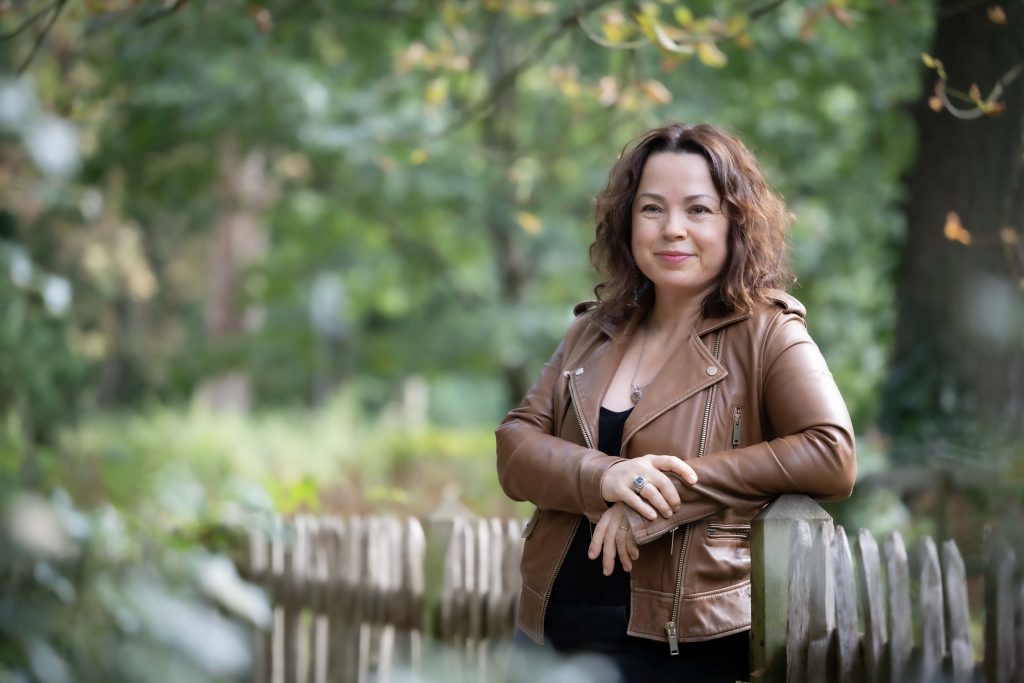
Katya Apekisheva
Piano
Described as a ‘profoundly gifted artist’ by Gramophone Magazine, Katya Apekisheva has earned her place as one of Europe’s most renowned and gifted pianists. Born in Moscow, into a family of musicians, she attended the Gnessin Music School for exceptionally gifted children making her stage debut at the age of 12. She continued her studies in Jerusalem at the Rubin Music Academy and later at the Royal College of Music in London. From these auspicious beginnings she went on to be a Prize-winner of the Leeds International Piano competition and has gone on to enjoy a career performing with many of the world’s leading orchestras, including the London Philharmonic Orchestra, the Philharmonia Orchestra, the Halle Orchestra, the Moscow Philharmonic, the Jerusalem Symphony, the English Chamber Orchestra and the Royal Philharmonic Orchestra, working with renowned conductors such as Sir Simon Rattle, David Shallon, Jan Latham-Koenig and Alexander Lazarev.
Her latest disc is a collection of impromptus of which international piano called ‘a fascinating and engrossing album’. As a recording artist, Katya has received widespread critical acclaim for her interpretations from Gramophone Magazine’s Editor’s Choice award and International Piano Magazine’s Critics’ choice to Classic FM’s CD of the week as well as a Classical Brit award to name but a few. Katya’s discography includes solo and chamber works by Mussorgsky, Shostakovich, Stravinsky, Dvorak and Rachmaninov.
Recent and future highlights include performances in Russia, Norway, Japan, Switzerland, Italy, Denmark, Germany, Australia and at home in the UK at the Bath Mozart Fest, St. George’s Bristol and the prestigious Wigmore Hall – where she is a regular presence. Her intense artistry and delicacy make Katya a most sought-after collaborative pianist, working with artists such as Janine Jansen, Natalie Clein, Guy Johnston, Maxim Rysanov, Jack Liebeck, Boris Brovtsyn, Alexei Ogrinchouk and Nicholas Daniel and she appears regularly at major chamber music festivals around the world. Katya also has a highly successful and personally rewarding piano duo partnership with Charles Owen, performing regularly at festivals worldwide. Together they are co-Artistic Directors of the London Piano Festival which began in 2016.
Click the button above to download all album assets.