Artist Led, Creatively Driven
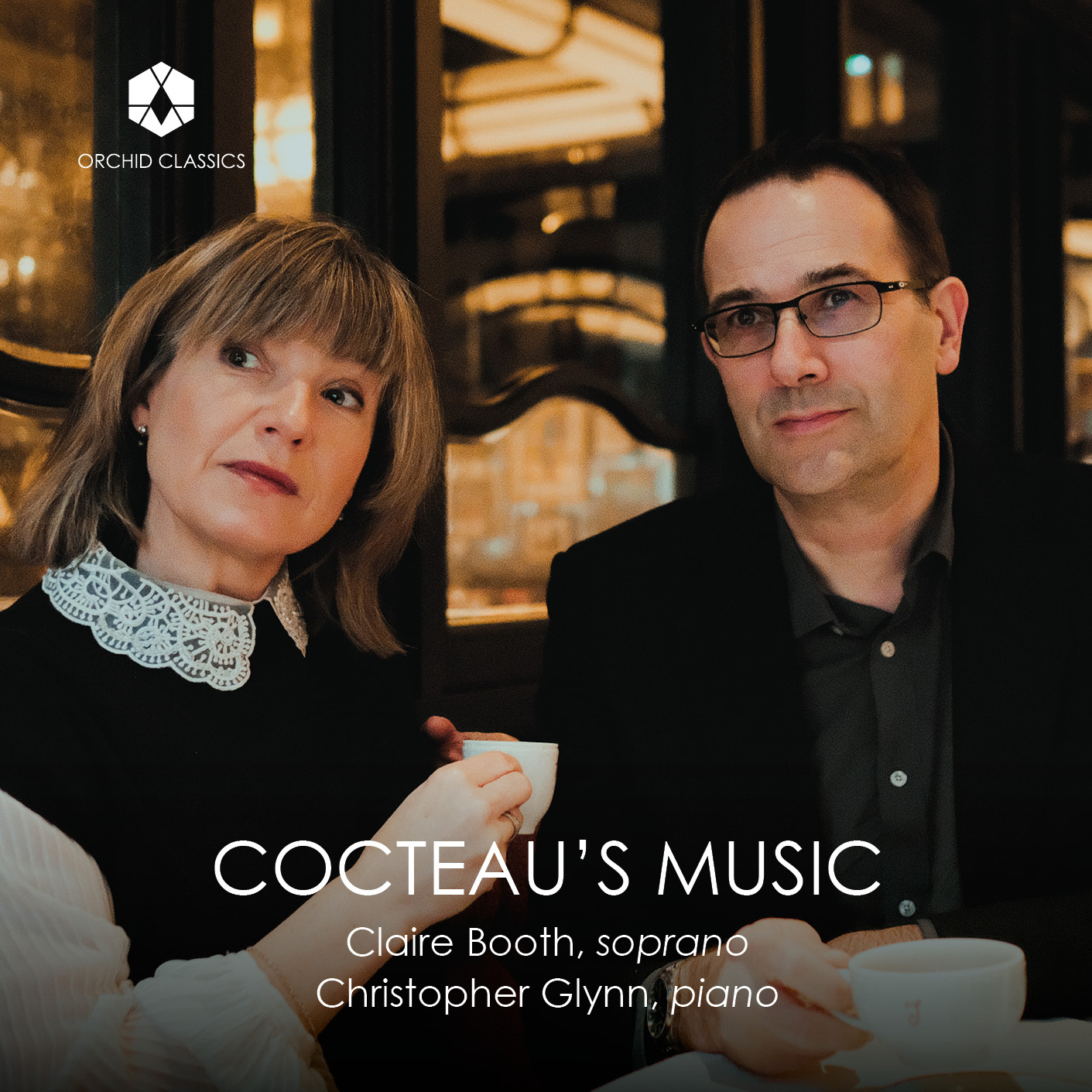
Cocteau’s Music
Claire Booth, soprano
Christopher Glynn, piano
Release Date: June 26th
ORC100460

COCTEAU’S MUSIC
A musical portrait of Jean Cocteau and the composers drawn to his restless imagination, from the Parisian avant-garde to Poulenc’s La Voix Humaine.
PART I – BROKEN GLAMOUR
Francis Poulenc (1899-1963)
1. La Dame de Monte Carlo (FP 180)
PART II – MASQUES AND MINIATURES
Francis Poulenc (1899-1963)
Cocardes (FP 16)
2. Miel de Narbonne
3. Bonne d’enfant
4. Enfant de troupe
Louis Durey (1888-1979)
5. Prière (from Chansons Basques)
Arthur Honegger (1892-1955)
6. Locutions (from Six poésies de Jean Cocteau)
Maurice Delage (1879-1961)
7. Sobre las olas
Frédéric Chaslin (b.1963)
8. Valse langoureuse (from Chansons pour Elle)
Darius Milhaud (1892-1974)
9. Caramel Mou
Guy Sacré (b.1948)
10. Que ne suis-je un de cette Egypte (from Clair-Obscur)
Georges Auric (1899-1983)
11. Hommage à Erik Satie (from Huit Poèmes de Jean Cocteau)
PART III – THE HUMAN VOICE
Francis Poulenc (1899-1963)
12-33. La Voix Humaine (FP 171)
PART IV – ENVOI
J.S. Bach (1685-1750) arr. Siloti / Jean Cocteau (1889-1963)
34. Prelude in B minor / Visite (extract, from Discours du grand sommeil)
Claire Booth, soprano
Christopher Glynn, piano
Cocteau’s Music
Jean Cocteau was many things, but above all unpindownable. Poet, playwright, artist, filmmaker, collaborator, self-inventor: each description fits, but none is sufficient. His work darts and pivots, one mask slipping as another appears. But beneath the surface, the same fixations recur, especially love, death, dependence and abandonment. This album stays close to his restlessness, touching melodrama, popular culture, prayer, aphorism, dance, cabaret and theatre, as styles collide, and the masks occasionally fall.
We first met him over twenty years ago, through Francis Poulenc’s setting of his monologue La Voix Humaine. It’s the piece we have returned to more than any other, and one we’ve long wanted to record. Finding the right context proved harder. The solution, eventually, was to build a programme around a poet rather than a composer – and we soon realised that Cocteau belongs naturally among the artistic outsiders who have preoccupied us in earlier recordings.
We open with La Dame de Monte Carlo, Poulenc’s portrait of an ageing gambler who clings to glamour as despair closes in. Her suicide note is also a love letter to the Riviera that both Poulenc and Cocteau adored, where sunlight and roulette tables can hold loneliness at bay, for a while. La Voix Humaine stands at the other end of the programme. Between these two solitary women, we’ve placed ten songs by composers drawn to Cocteau’s voice, from both his immediate circle and later generations. And as an afterword to Voix, we offer a few lines from Cocteau’s prose poem Visite spoken (in the spirit of Jean Marais, whose performances so often joined Cocteau’s words with music) over a piece by Bach, the composer Cocteau revered above all others.
We make no claim to completeness. Any attempt to engage fully with a figure like Cocteau would be doomed from the outset. Instead, this is a partial portrait, shaped by affection and curiosity. In other words, we’ve chosen some of our favourites.
Poulenc’s miniature song cycle Cocardes captures poet and composer early on, alive to the energy of the street. Slogans and absurd juxtapositions tumble forward in a breathless loop, each line beginning with the last syllable of the one before, like a verbal circus trick. High art and popular culture meet without hierarchy, and Poulenc responds with music that is playful and brilliantly theatrical.
In 1919, Louis Durey was on holiday with Cocteau in the Basque country when they heard a young shepherd singing. It inspired Cocteau’s poem Prière, to which Durey later added music. The result is a brief portrait of a soldier returning from war, speaking plainly of what he longs for. In contrast, Arthur Honegger embraces Cocteau at his most elliptical in Locutions. Here, the images arrive through fragments and utterances – falling petals, discarded masks, moments of beauty glimpsed, then gone.
In Sobre las olas, Maurice Delage shows us the sea as a place of play and possibility. Boys heave at the waves, girls flirt with the sky’s reflection, and the whole scene is set to a teasing waltz. The dance reappears, more wistfully, in Valse langoureuse from Le Bel Indifférent, the play Cocteau created for Édith Piaf. In Frédéric Chaslin’s setting it becomes a half-remembered chanson, as young lovers murmur promises that seem unlikely to outlast the night.
With Darius Milhaud, the pulse quickens, as American jazz rubs up against Parisian wit in Caramel Mou. This shimmy is steeped in the atmosphere of Le Bœuf sur le Toit, Cocteau’s favourite night-time haunt, devoted to what he called ‘life’s visceral pleasures.’ A quieter, later echo comes from Guy Sacré. Composing in 1970s Paris, he set little-known fragments of Cocteau such as Que ne suis-je un de cette Égypte, which contemplates mortality with images of ancient ritual and imagined afterlives.
Erik Satie was an inescapable presence for Cocteau and his circle. In Hommage à Erik Satie, he is honoured obliquely through the figure of Henri Rousseau, another sublime eccentric, who painted distant jungles from a Paris studio. Georges Auric’s job was simply to add the music, deftly, and with a smile Satie would surely have relished.
All of which leads us to La Voix Humaine. Cocteau’s 1930 play was a stroke of genius, diagnosing the modern ache of ‘depersonalised communication’. We are in pre-war Paris, eavesdropping on a woman, known simply as Elle, as she speaks to a lover who has left her to marry another woman. We hear only her side of the conversation, as hope, denial and desperation follow one another in quick succession. The telephone promises intimacy but delivers its opposite, as interruptions, crossed lines and silences intensify the drama, making technology itself complicit in emotional cruelty. The problem feels uncannily familiar to our social media age where connection is easier than ever, but intimacy can feel harder.
When Poulenc transformed the play into a tragédie lyrique, he did so under intense personal strain, having already lost one partner and fearing the loss of another. The role was written for Denise Duval, his favourite singing actress, and became, in Poulenc’s words, a shared ‘diary of suffering’.
Elle’s predicament mirrors Cocteau’s deepest anxieties too. Unrequited love was the great obsessive fear of his life and poetry became a way of testing whether he could still be heard across the distances he feared – even, as in Visite, from the far side of silence. For all his masks and poses, what he craved was contact. Each work was a renewal, a bet against indifference. The signal has to be sent again, because silence is always possible. Or worse, the line goes dead.
Christopher Glynn
A word about the musicians
Performing internationally for over twenty years, Claire Booth and Christopher Glynn are established as one of today’s most innovative and imaginative song duos. In recent years, their trailblazing programming has also been captured on disc in a series of acclaimed single-composer surveys on Orchid Classics and Avie Records. Folk Music celebrated the maverick genius of Percy Grainger and was credited with spearheading a revival of interest in a much-neglected composer. “It’s the sparkle they give,” said BBC Radio 3’s Record Review, “it’s the care, it’s the attention to detail, the love of the music and the incredible characters that they manage to draw out of every song.” Lyric Music was dedicated to the music of Edvard Grieg and singled out by BBC Music Magazine as “revelatory”, while Gramophone noted “Booth and Glynn are on fire here”. Their third album, Unorthodox Music traced a ‘cradle to grave’ arc through the songs and piano pieces of Modest Mussorgsky, described by the Guardian as “brilliantly conceived” and by the Irish Times as “a vivid treasure trove of vivid storytelling”. Their most recent album Expressionist Music was a deep dive into the music of Arnold Schoenberg, celebrating his 150th birthday in an “immaculate recording”, with Gramophone describing Booth as a “natural communicator”. Having performed Poulenc’s La Voix Humaine for almost two decades, it was natural to turn their attention to this searing monologue for their latest recording. However, contextualising it within the heady and inspirational world of Jean Cocteau lends a new perspective to this most poignant of heroines. Cocteau’s Music – a musical portrait in song – from smoky Parisian cabarets to the shadowy realms of psychological theatre, presents Cocteau as poet, provocateur and more: a man who truly captured the fractured beauty of his age.
similar Artists & Albums