Artist Led, Creatively Driven
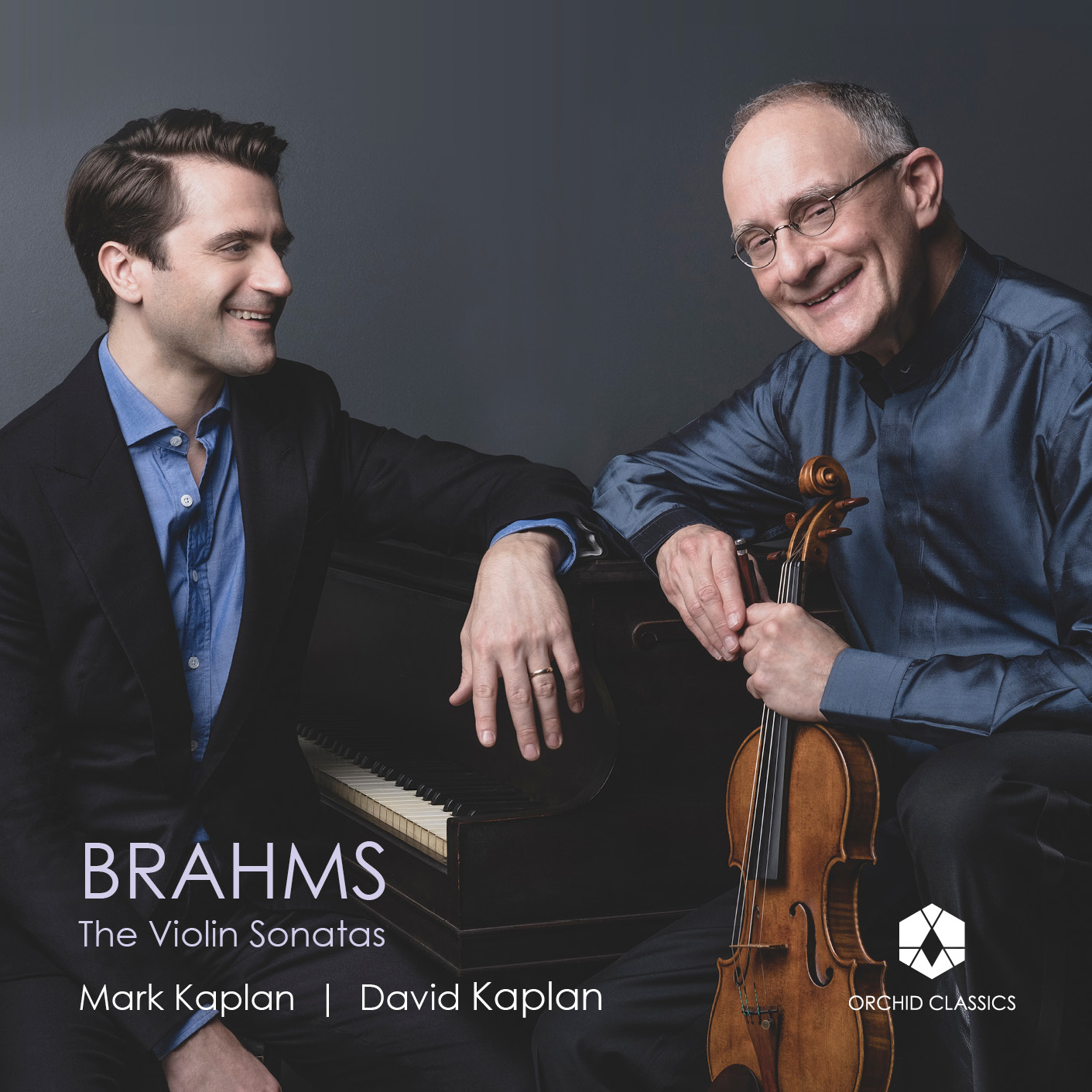
BRAHMS
The Violin Sonatas
Mark Kaplan, violin
David Kaplan, piano
Release Date: June 19th
ORC100454

Johannes Brahms (1833-1897)
Violin Sonata No. 1 in G major, Op. 78
1 I Vivace ma non troppo 10.39
2 II Adagio 7.59
3 III Allegro molto moderato 8.55
Violin Sonata No. 2 in A major, Op. 100
4 I Allegro amabile 8.27
5 II Andante tranquillo – Vivace 6.18
6 III Allegretto grazioso (quasi andante) 5.27
Violin Sonata No. 3 in D minor, Op. 108
7 I Allegro 7.46
8 II Adagio 4.36
9 III Un poco presto e con sentimento 3.03
10 IV Presto agitato 5.47
Mark Kaplan, violin
David Kaplan, piano
THE VIOLIN SONATAS OF JOHANNES BRAHMS
By William Kinderman
Brahms’s first Violin Sonata in G major, Op. 78, mainly composed during the summers of 1878 and 1879 in the Austrian mountains at Lake Worth in Pörtschach, is a masterpiece touched by melancholy reminiscence. The perfectionist composer earlier composed as many as three violin sonatas, which he suppressed as unworthy. This G major Sonata was a project paired with his demanding Violin Concerto, Op. 77, which was dedicated to his longstanding friend, the violinist Joseph Joachim. Brahms once described his Op. 78 ironically to Joachim as just a “little sonata to be played for relaxation,” but this landmark composition held special personal significance for Brahms.
The sonata’s final movement quotes a pair of songs Brahms composed six years earlier, the “Regenlied” and “Nachklang” (“Rain Song” and “Echo”), Op. 59 nos. 3 and 4, written to poems by his friend Klaus Groth. The “Rain Song” melody with its characteristic dotted rhythmic figure and its steady, gently drizzling figuration in the piano accompaniment, are absorbed into the finale of the violin sonata; their poetic association evokes an intense memory from childhood, deepened to tears in “Echo”. Somber emotions invest not just the sonata’s finale, but more profoundly its slow movement, marked Adagio, whose middle section evokes a funeral march. A long overlooked note from Brahms to Clara Schumann written on a decorative sheet (“Schmuckblatt”) clarifies these emotional associations: after copying music from the sonata’s second movement he adds: “Dear Clara, If you play this very slowly, it conveys to you perhaps more clearly my heartfelt thoughts about you and Felix – and even about his violin, which is surely silent.” Clara’s son, Felix, was then incurably ill; he died at the age of 25, a few days after the date of Brahms’s message. Brahms had been his godfather; Joachim gave him the Guarneri instrument that fell silent at his death.
These depths of personal meaning are embedded in a work that nonetheless glistens with sensuous lyricism and embodies a remarkable sense of integration, a quality that Schoenberg described as “developing variation”. Brahms himself once implied that the serene lyricism of Op. 78 owes something to the lovely landscape around Lake Worth: according to Alfred von Ehrmann, the composer said that “Here the melodies are flying so thick that one must be careful not to step on one.” From the opening of the first movement, the dotted figure and descending contour akin to the “Rain Song” are heard. Audible motivic connections enrich the music, but broader interrelationships also emerge: in the finale, Brahms recalls the main theme of the Adagio in its original key (m. 84), evoking that quality of thoughtful reminiscence already conspicuous in his preexisting pair of songs from years earlier.
Brahms’s violin sonatas Op. 100 and Op. 108, composed during the summer of 1886 at Lake Thun in Switzerland, form yet other recombinant work-pairs. Like Op. 78, the A major Sonata Op. 100 is evocatively linked to songs, and this time even to a specific singer, the young alto Hermine Spies. Hermine’s sister Minna Spies recalled vividly their visit to Brahms, who accompanied her sister at the piano:
It was late summer. The late afternoon sun was descending, casting its golden glow to us over the water and through the open windows. Hanging flowers, draped around the edge of the lake, lent their fresh luminous colors and fragrance. Hermine sang in this setting. Two new, still unpublished songs lay on the music stand at the grand piano.
One of those unpublished songs was surely Brahms’ setting of Groth’s poem “Wie Melodien zieht es” (“How Melodies Entice”), Op. 105 no. 1, which he evidently composed for Hermine Spies. A melodic similarity links the opening of this song with the beginning of the second subject of the sonata’s first movement (mm. 51-52). The sonata’s opening motive also displays an affinity to “Kommt bald” (“Come soon”), Op. 97 no. 5, a song Brahms had composed earlier in connection with Hermine Spies. Brahms himself acknowledged such a relation in a letter to his physician friend Theodor Billroth, stating that he was “enclosing a song setting of Groth linked to the A major Sonata.”
Whereas the A major Sonata has been dubbed a “Liedersonate” or “Song Sonata,” Brahms’s final Violin Sonata in D minor dispenses with any direct connections to his Lieder. This piece is dedicated to the pianist and conductor Hans von Bülow, who had performed Brahms’s Piano Sonata Op. 1 but whose close ties to Brahms’s rival Richard Wagner had imposed distance. By the 1880s, this had changed: Bülow’s attitude toward Wagner and his legacy had cooled, and Brahms’s dedication of his D minor Sonata to Bülow was warmly received as a gesture of meaningful reconciliation.
Brahms expands the formal design of this final violin sonata from three to four movements. The focus of lyricism comes in the slow secondmovement, an Adagio in D major, the key in which the first movement ends. In this gentle Cavatina–a tender song without words–the violin conveys an introspective, aspiring poignancy, a touching quality Donald Tovey sought to capture in observing that “such simplicity comes of the concentration of a life’s experience.” The third movement in F# minor is a mischievous, scherzo-like intermezzo in 2/4 meter, marked Un poco presto e con sentimento. Its sidestepping, chromatically falling patterns motivate a striking key-change which also drops by half-step, to F major.
Brahms’s art of “developing variation” is richly embodied in the outer movements. In the opening Allegro, the quietly agitated sotto voce character of the opening theme arises from rhythmic and harmonic tensions that evolve as the work unfolds. The development section is restrained, held at a soft dynamic level with a mysterious dominant pedal point sustained in the piano; one is reminded distantly of the immense tonic pedal point at the outset of Brahms’s First Symphony. At the transition to the second theme in the recapitulation, Brahms expands the form with another developmental section marked by powerful exchanges between violin and piano.
Following the witty, understated close of the third movement, the finale opens with a frenzied, tarantella-like subject galloping in 6/8 meter, whose returns suggest a rondo inlaid into the sturdy sonata form design. This virtuosic movement was vividly described by Brahms’s biographer Max Kalbeck as a “grandiose, weather-glowing night-piece driven by passionate storms, blending the gravity of German Romanticism with the sensuous allure of Italian exuberance.”
Internationally acclaimed for his scholarship on Beethoven, Brahms, Mozart, Wagner, and others, William Kinderman is a Distinguished Professor in Performance Studies as well the inaugural holder of the Elaine Krown Klein Chair in Performance Studies at The UCLA Herb Alpert School of Music.
ABOUT MARK & DAVID KAPLAN
A soloist of international distinction, violinist Mark Kaplan has performed with nearly every American, European and Australian orchestra, and with many of the world’s great conductors, including Ormandy, Rattle, Maazel, Masur, Dutoit, Salonen, Semkov, Skrowaczewski, and Tennstedt. He has made highly acclaimed concerto and recital appearances in all the musical centers of America and Europe, as well as in Australia, New Zealand, Malaysia, Hong Kong, China and Singapore. Kaplan is also devoted to chamber music, appearing with pianist Yael Weiss and cellist Peter Stumpf as the Weiss-Kaplan-Stumpf Trio, with recordings and concert tours world-wide. Prior to that he performed and recorded extensively for two decades in the Golub-Kaplan-Carr Trio with cellist Colin Carr and the late pianist David Golub. Especially known for interpretations of 20-21st century works and the great German classics, his extensive discography of over 45 commercial CDs includes concerti, solo and chamber works from Paganini, Bartok, Berg, Sarasate and Nono to Schubert, Brahms and Schumann, as well as two complete recordings of Bach’s solo violin works. Since 2005 he has been Professor of Violin at Indiana University Jacobs School of Music, following a decade as Professor at UCLA. Kaplan is a graduate of The Juilliard School, where he studied with Dorothy DeLay.
David Kaplan is a New York-born piano soloist and chamber musician, widely acclaimed for recital programs artfully connecting new and old music. He has performed concerti at London’s Barbican, Berlin’s Philharmonie, and with the Symphony Orchestras of Baltimore, Hawaii, and San Antonio. His recording of Valerie Coleman’s “Revelry” was nominated for a 2025 GRAMMY, and his 2024 solo debut, “New Dances of the League of David,” was lauded by Financial Times, Gramophone, Fanfare, and more. His solo recitals have brought him to the Ravinia Festival, Strathmore, Washington’s National Gallery, and New York’s Carnegie and Merkin Halls. Kaplan is a passionate advocate for contemporary American composers – he has commissioned new works from Timo Andres, Christopher Cerrone, Anthony Cheung, Donnacha Dennehy, Caroline Shaw, Augusta Read Thomas, and many others. Kaplan’s numerous collaborators include Tessa Lark, Colin Carr, and the Ariel, Attacca, Formosa, and Tesla String Quartets. He has performed at La Jolla SummerFest, Chamber Music Society of Lincoln Center, and is a founding member of Decoda, the affiliate ensemble of Carnegie Hall. Kaplan is the Associate Professor and Inaugural Shapiro Family Chair in Piano Performance at the UCLA Herb Alpert School of Music, where he has taught since 2016. Kaplan’s teachers included Claude Frank and Walter Ponce. Away from the keyboard, he loves cartooning and cooking, and is mildly obsessed with classic cars.
_________________
FAMILY BUSINESS
By David Kaplan
When you imagine typical father-son activities, perhaps you picture a game of catch. Fishing. Building something in the yard. Biking. Or maybe the activities are headier: a game of chess, sparring over politics, discussing a book. In our family, we had some of those rituals, but the most typical activity was reading and playing chamber music. For my brother (now violist of the Tesla Quartet), our parents (who originally met as teenagers studying with Dorothy DeLay), and myself, playing chamber music was part pastime, part bonding, part education.
In that early stage, dad and I even collaborated professionally a handful of times, at the Seattle Chamber Music Festival, Chamber Music Northwest, Barge Music in NYC and elsewhere, but it would be many years before we began playing concerts together as two adults. The three Brahms Sonatas had meanwhile become separate preoccupations for each of us, with different duo partners.
These Sonatas are indeed central works for most musicians. They represent a zenith of interactivity, equality, and textural complexity between the two instruments. In Mozart the violin often accompanies the piano; in Franck the piano mostly accompanies the violin; but in Brahms neither instrument accompanies for more than a few bars. He treats the violin and piano as co-equal actors, each representing diverse voices and characters, engaged in multifaceted conversations, moods, and worlds.
As dad and I planned programs for our first concerts together since those very early outings, the Brahms Sonatas came to mind right away for us both. So while any recording in some sense represents a culmination, this recording also represents a beginning. We hope you hear these performances as if entering into the middle of a decades-long conversation.
similar Artists & Albums