
Press Release
For press enquiries please contact alex.patel@orchidclassics.com. Tel: +44 7717 663481
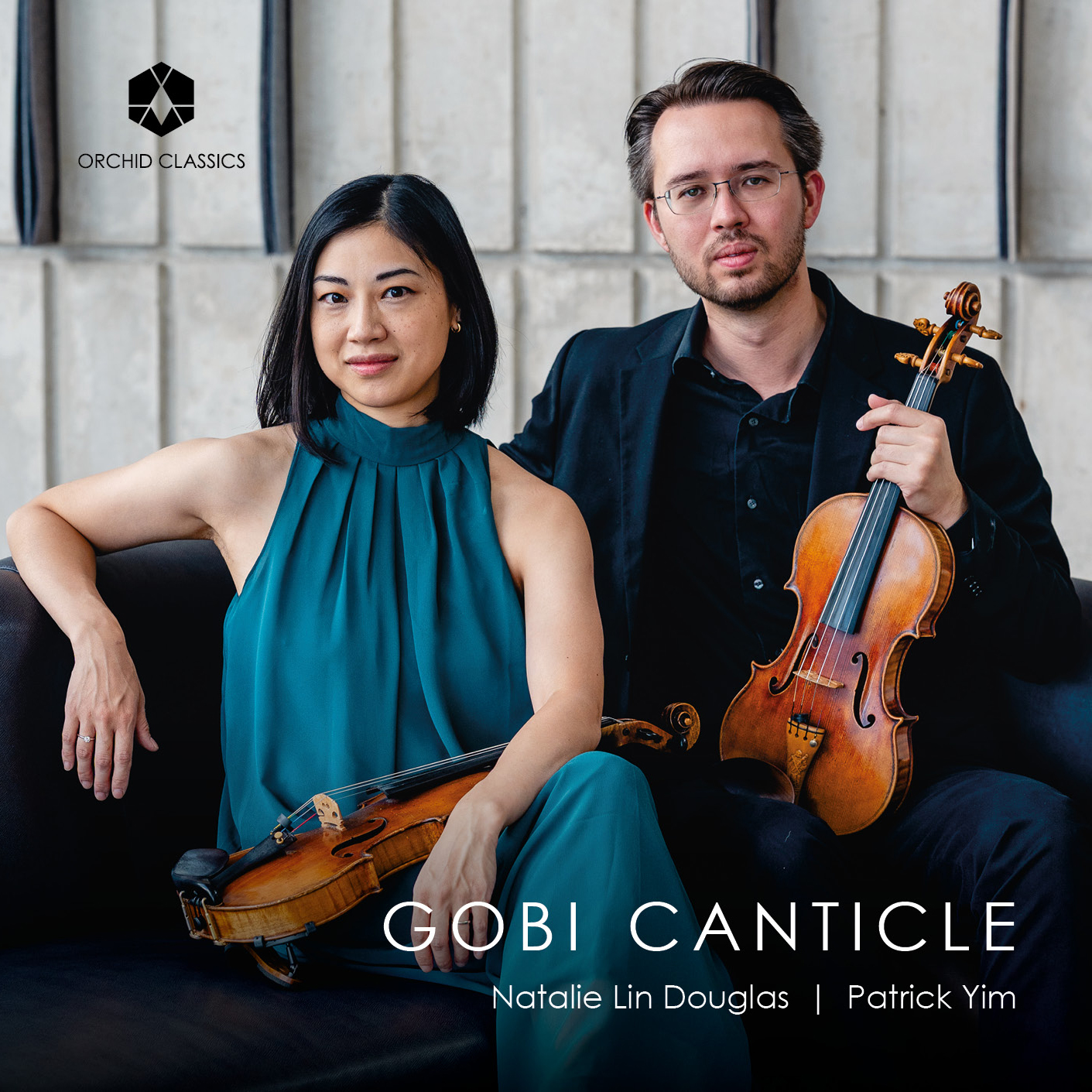
GOBI CANTICLE
Natalie Lin Douglas, violin
Patrick Yim, violin & viola
Catalogue Number: ORC100426
Release Date: April 24th 2026

Click the button above to download all album assets.
GOBI CANTICLE brings together eleven works for violin, viola and violin, and violin duo by ten composers of Asian heritage, many presented here in first recordings. Performed by Natalie Lin Douglas and Patrick Yim, long-standing advocates for new music with extensive experience commissioning, premiering, and recording contemporary repertoire, the album spans a wide expressive range from ritual and folk-derived sound worlds to contrapuntal studies and contemporary virtuosity.
Lei Liang (b.1972)
1 Gobi Canticle (2005/2010)
Natalie Lin Douglas, violin; Patrick Yim, viola
Zhou Tian (b.1981)
2 Duo (2006)*
Natalie Lin Douglas, violin; Patrick Yim, viola
Chen Yi (b.1953)
3 Energetic Duo (2016)*
Patrick Yim, violin 1; Natalie Lin Douglas, violin 2
Kai-Young Chan (b.1989)
4 Echoes of the Autumn Night (2018)*
Patrick Yim, violin 1; Natalie Lin Douglas, violin 2
Yao Chen (b.1976)
5 Four Mini Duets: Chinese Dolls (2008)*
Natalie Lin Douglas, violin; Patrick Yim, viola
Texu Kim (b.1980)
6 Homage to Anonymous Ancient Fiddlers (2015)*
Natalie Lin Douglas, violin 1; Patrick Yim, violin 2
Meilina Tsui (b.1993)
7 Etude for Violin and Viola (2015)*
Natalie Lin Douglas, violin; Patrick Yim, viola
Clarence Mak (b.1959)
8 The Approach of the Day (2004)*
Natalie Lin Douglas, violin; Patrick Yim, viola
Lei Liang (b.1972)
9 Lakescape III (2014)* 5.57
Patrick Yim, violin 1; Natalie Lin Douglas, violin 2
Doming Lam (1926-2023)
10 Retrograde (1959)*
Patrick Yim, violin 1; Natalie Lin Douglas, violin 2
Jungyoon Wie (b.1990)
11 Dan Poong (Autumn Leaves) (2022)*
Natalie Lin Douglas, violin 1; Patrick Yim, violin 2
Natalie Lin Douglas, violin
Patrick Yim, violin & viola
*Denotes First Recording
We are excited to present this first collection of string duo works that bring focus to the musical voices of ten composers of Asian heritage. The album features music inspired by a rich array of sources, from the ritual chants and folk melodies of Mongolia in Lei Liang’s Gobi Canticle and the meditative stillness of moonlit lakes in Lakescape III, to the fleeting beauty of autumn leaves in Jungyoon Wie’s Dan Poong, the contrapuntal mastery of Bach in Doming Lam’s Retrograde, and the poetic worlds of Du Mu reflected in Chan Kai‑Young’s Echoes of the Autumn Night. These works combine personal experience, seasonal imagery, and cultural tradition, showcasing the rich heritage of Asia and the innovative, colorful, and exciting voices of today’s leading composers.
We are grateful to these composers, our recording engineer Joel Gordon, and Orchid Classics for their collaboration and support in realizing this project.
Patrick Yim & Natalie Lin Douglas
__________________
Composed for violin and cello in 2005 and adapted for violin and viola in 2010, Chinese-American composer Lei Liang, a Pulitzer Prize finalist and winner of the Grawemeyer Award, writes that Gobi Canticle “belongs to a series of compositions that grew out of my admiration for Mongolian music.” The piece begins with an extended solo violin melody accompanied by an instruction from the composer that all minor third tremolo ornamentations should be played with a quarter-tone sharp intonation, evoking the microtonal inflections of Eastern folk instruments. The melody is later played against its inversion and alludes to various genres of Mongolian music, including long songs (urtiin duu), dance music, and shaman rituals. In a section marked con fuoco, the score calls for the violist to use the left-hand fingers to strike the center of the strings creating a percussive effect; juxtaposed with Bartók pizzicato snaps, it evokes a rustic energy. The piece concludes with a folk song learnt by the composer during a visit to the Nei Monggol region in 1996, first played by the violin, then viola, in a marvelous setting employing the natural harmonic series and ricochet bowing technique–conjuring images of a horseback ride in an open expanse.
Grammy-nominated Zhou Tian’s Duo is a virtuosic showpiece described by the composer as a “thrill ride.” Energetic passagework, precise interlocking rhythms, and a quick tempo lend a propulsive energy, and unexpected meter shifts make for exciting twists and turns as the instruments alternate leading and following. Zhou’s knack for double- and triple-stops allows for a surprisingly full sonority from just two instruments. The piece turns to a cantabile tune inspired by Chinese folk songs, adroitly exploiting the rich, sultry lower register of the viola. The music gradually slows to a brief reprieve (“tempo molto rubato”) in which the viola plays col legno battuto and pizzicato (“like a guitar”) before rushing to an exciting finish.
A short work in her prolific output, Chen Yi’s Energetic Duo–” composed in celebration of [violinist] Ron Blessinger’s 50th birthday”–is teeming with sizzling vitality. A stunning violinist in her youth who performed as concertmaster of the Beijing Opera Troupe in Guangzhou during the Cultural Revolution, Chen’s writing showcases her intimate familiarity with the instrument, and her inventive use of the two violins calls to mind the sounds of a Chinese percussion ensemble. Much like the composer herself, the piece exudes generous ebullience and enthusiasm.
Kai-Young Chan’s Echoes of the Autumn Night was commissioned by the author and premiered with Joel Smirnoff, former violinist of the Juilliard Quartet, in Hong Kong in 2018. The work draws its pitch materials and structure from the Tang Dynasty poet Du Mu’s poem Autumn Night, with melodic lines determined by a Cantonese reading of the text—reflecting Chan’s ongoing exploration of the melodic potential of the tonal Cantonese language. The images of autumnal glow, fireflies, and stars are depicted musically by the violin’s shimmering harmonic trills. The theme is presented pointillistically in harmonics and later played molto espressivo with supporting harmonic flutterings. An impassioned climax is followed by a resigned denouement depicting the loneliness of a palace servant whose fan is left purposeless with the arrival of autumn.
Yao Chen – a composition professor at the renowned Central Conservatory of Music in Beijing, noted for his contemporary integration of Eastern and Western influences–wrote Chinese Dolls as an exercise at Tanglewood in 2008. The colorful and capricious vignette calls for ricochet and col legno bowing, extensive glissandi, pizzicato, frequent timbral shifts, hockets, and a stretto episode before a passionate apex.
Virtuosity is the feature of Texu Kim’s Homage to Anonymous Ancient Fiddlers, the composer’s program note mentioning specifically Paganini and Liszt whilst also acknowledging more “unknown heroes in music history.” The hocket writing calls for ensemble precision, while the ricochet bowing, virtuosic passagework, and triple- and quadruple-stops showcase the players’ technical brilliance. The microtonal tuning (the score calls for the second violin to be tuned “about a quarter tone” lower) is a nod to the centuries-old practice of scordatura (altering the normal tuning of the instrument for desired effects) intended by the composer to add an “ancient flavor.”
Kazakhstan-born, Hong Kong-American composer Meilina Tsui’s agitated and unsettled Etude for Violin and Viola is written in a ternary form. Beginning with conversational interplay, the agitato outer sections are chromatic and abundant in dissonant intervals, lending an air of unease. The lyrical middle section makes imaginative use of pizzicato–first in a tremolo texture and later with Bartók pizzicato punctuations–offering a colorful timbral contrast to the singing viola line. The pair engage in an urgent back-and-forth marked “molto vibrato, espressivo” before the opening section returns.
The longtime Head of Composition and Electronic Music at the Hong Kong Academy for Performing Arts, Clarence Mak’s joyous and effervescent The Approach of Day is filled with glistening harmonics, rhythmic drive, and surging crescendo gestures. Undulating harmonics punctuated by crisp pizzicati are featured alongside an awakening melody derived from the Guangdong nanyin singing style. A dueling ricochet passage evolves into a vigorous hocketing episode, followed by the violin dancing around a steady viola pizzicato groundwork. The music shifts to a serene polyphonic texture of long-held, slowly shifting stacked perfect fifths replete with dialoguing left-hand pizzicato, and eventually trails off to a tranquil close.
Liang’s Lakescape III is an otherworldly, meditative piece in which the composer reflects on his relationship with silence. Hushed and ever changing, the gradual shifting of intervals evokes the subtly shifting reflections of light on a water surface, revealing an endless, magical spectrum of colors. Microtonal inflections give rise to poignant “slow beating” dissonances. As of this writing, Liang has composed nine Lakescapes for various instrumentations, the latest published in 2024 for solo piccolo.
Until his recent passing in 2023, Doming Lam was the “father of Hong Kong modern music” and Honorary President of the Hong Kong Composers’ Guild. A former student of Miklós Rózsa at the University of Southern California, Lam was inspired by the crab canon in Bach’s The Musical Offering and set about to compose his own canon. Played from a single sheet of music read from two ends, Retrograde is a lighthearted work featuring graceful melodies, playful twists, and, in Lam’s words, a “distinctive Chinese touch.”
Written in 2022 and one of the many creative works born from the emotional isolation and strain of the global COVID-19 pandemic, Jungyoon Wie’s Dan Poong (단풍)–referring to the phenomenon of green leaves changing color to yellow, orange, and brown in the late autumn–is pensive and reflective. Gentle glissando shapes depict falling leaves, and the piece makes liberal use of the resonant open strings of the violins. The largely free and unmetered work slowly gains momentum until its vibrant close.
Patrick Yim
GOBI CANTICLE brings together eleven works for violin, viola and violin, and violin duo by ten composers of Asian heritage, many presented here in first recordings. Performed by Natalie Lin Douglas and Patrick Yim, long-standing advocates for new music with extensive experience commissioning, premiering, and recording contemporary repertoire, the album spans a wide expressive range from ritual and folk-derived sound worlds to contrapuntal studies and contemporary virtuosity.
At its centre is Lei Liang’s Gobi Canticle, shaped by Mongolian musical traditions, microtonal inflection, and percussive string techniques. Zhou Tian’s Duo provides a compact, high-energy showpiece, while Chen Yi’s Energetic Duo distils rhythmic drive and colour into a striking miniature. Several works draw on literary and seasonal imagery: Kai-Young Chan’s Echoes of the Autumn Night reflects Tang-dynasty poetry through Cantonese speech rhythms, and Jungyoon Wie’s Dan Poong traces the quiet transformation of autumn leaves.
Across the programme, composers engage imaginatively with string technique—scordatura, harmonics, ricochet bowing, hocketing, and microtonal tuning—creating a palette that is both refined and immediate. The result is a coherent collection that highlights individual compositional voices while revealing shared concerns with timbre, gesture, and cultural memory.
Recorded in Watertown, Massachusetts, Gobi Canticle documents a significant body of contemporary duo repertoire and showcases two performers deeply committed to new music and collaboration.
Natalie Lin Douglas
Violin
New Zealand-born violinist, educator, and arts entrepreneur Natalie Lin Douglas is the founder and artistic director of Kinetic Ensemble, which has been coined “Houston’s indie, conductorless orchestra” (Houston Public Media) and praised for its “visually arresting… brilliantly executed” performances (Arts+Culture Texas). With Kinetic, she has overseen the curation of ten concert seasons, and has commissioned and premiered over two dozen new works. The ensemble’s recordings, including its Billboard chart-topping debut album from 2023, have been released by Bright Shiny Things, Capella Records, Centaur Records, and Orchid Classics.
A versatile chamber musician, Lin Douglas has toured throughout New Zealand in concerts presented by Chamber Music New Zealand and in the UK with the Scottish Ensemble. She has performed alongside such diverse and acclaimed artists as Clarice Assad, Iva Bittova, Kyung Sun Lee, Jon Kimura Parker, Miguel Zenón, and Evan Ziporyn. An adventurous program curator, her current projects include recording under-performed works for string duo, and commissioning new works for violin and percussion. A prizewinner at the 2013 Michael Hill International Violin Competition and 2012 Klein International Strings Competition, Lin Douglas holds degrees from Rice University (DMA) and Cleveland Institute of Music (MM, BM), and is currently an Associate Professor of Music at Massachusetts Institute of Technology.
Patrick Yim
Violin & Viola
Praised for his “deeply expressive, finely nuanced playing” (The Strad), “dazzling technique and passionate interpretations” (The Whole Note), and “vivid imagination” (Fanfare), Honolulu-born violinist Patrick Yim made his solo debut with the Honolulu Symphony and has since collaborated with members of the Juilliard, Emerson, St. Lawrence, Pacifica, and Ying Quartets, as well as musicians from the Chamber Music Society of Lincoln Center, the Cleveland Orchestra, and the New York Philharmonic. He has toured with the Cleveland Orchestra in the United States and Europe and performed with the Emerson Quartet violinists at Carnegie Hall. His recordings—featuring numerous world premieres—appear on Albany, Naxos, Navona, New Focus, Ravello, and Acis. A committed advocate for new music, Yim has commissioned more than 50 works, including a significant repertoire for violin and non-Western instruments. In 2024, he premiered Bamboo Grove, an unaccompanied violin work by Pulitzer Prize winner Zhou Long commissioned for him by the University of Notre Dame, and he will premiere Zhou Long’s first violin concerto in 2026. His albums include Onslow: String Quintets, Vol.5 (Naxos, 2026), One (New Focus, 2024), New Waves (Albany, 2023), Digital Mist (Naxos, 2022), and Memory (Navona, 2020). Yim holds degrees from the Cleveland Institute of Music and Stony Brook University and is currently Assistant Professor of Violin at the University of Notre Dame.
Click the button above to download all album assets.