
Press Release
For press enquiries please contact alex.patel@orchidclassics.com. Tel: +44 7717 663481
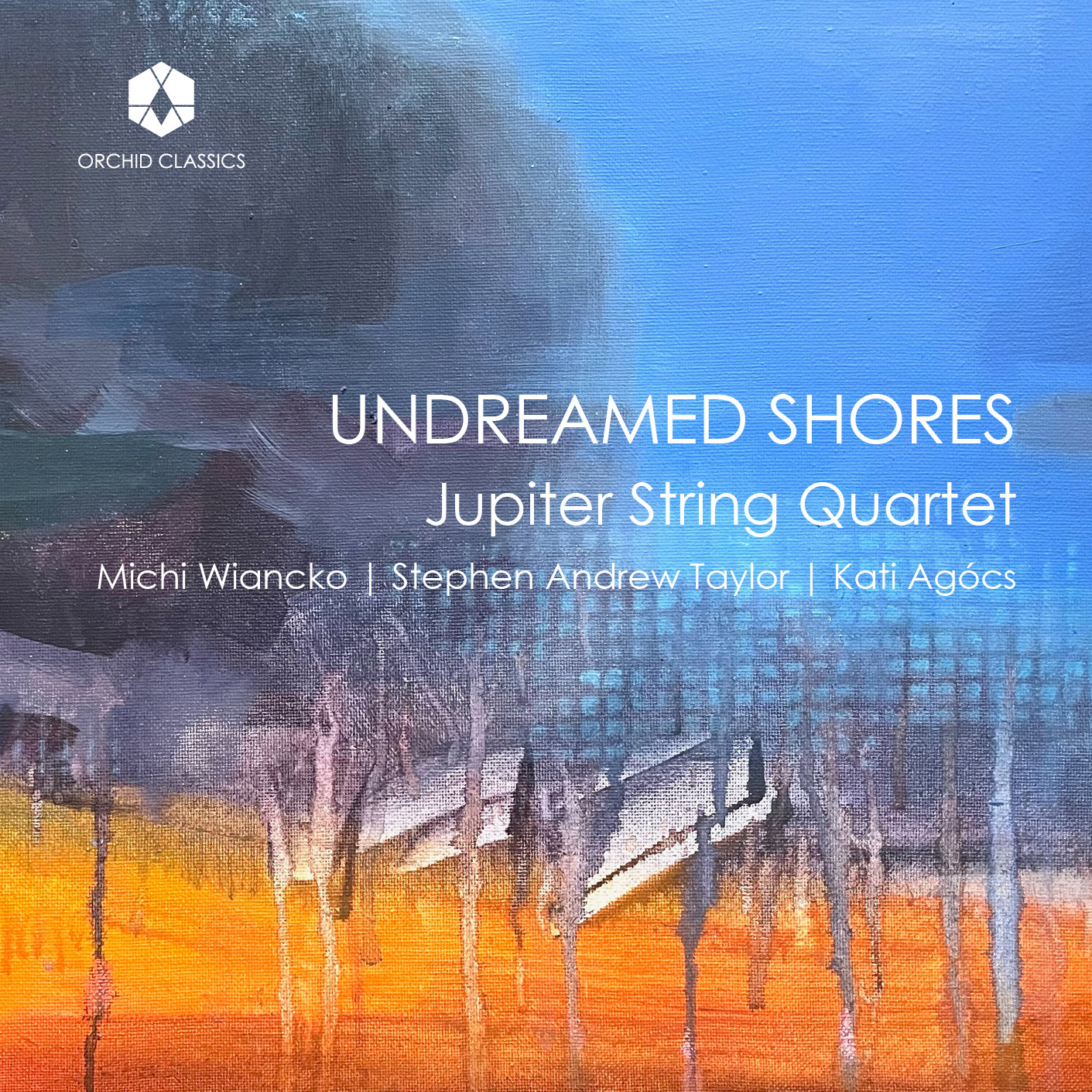
UNDREAMED SHORES
Jupiter String Quartet
Catalogue Number: ORC100444
Release Date: April 17th 2026

Click the button above to download all album assets.
UNDREAMED SHORES brings together three major contemporary string quartets written for and performed by the Jupiter String Quartet, works the ensemble has lived with in performance over many years.

Michi Wiancko
To Unpathed Waters, Undreamed Shores
1. I Pelagic Within
2. II Dream of the Xerces Blue
3. III Central Park Microbial
4. IV Invisible Eviction
5. V Crying, Together
6. VI Follow the Water
7. VII Rise Up
Stephen Andrew Taylor
8. Chaconne/Labyrinth
Kati Agócs
9. Imprimatur (String Quartet No. 2)
Recitative
I. Ostinato
II. Enraptured Troping
III. Meditation – Crystal Chains
IV. Wild Dance
V. Quodlibet
Coda
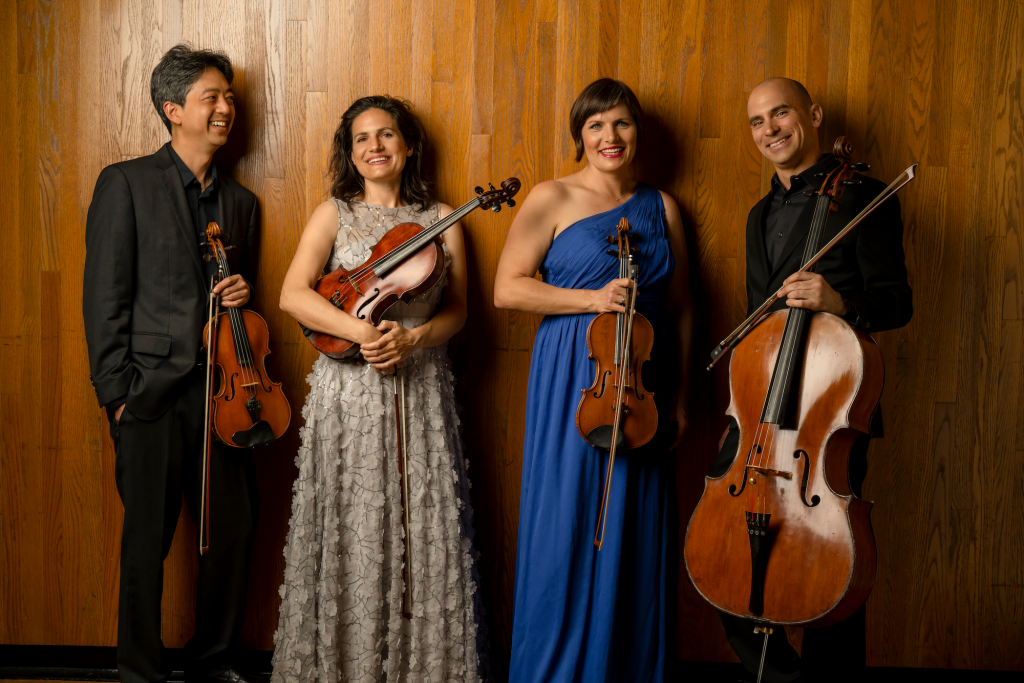
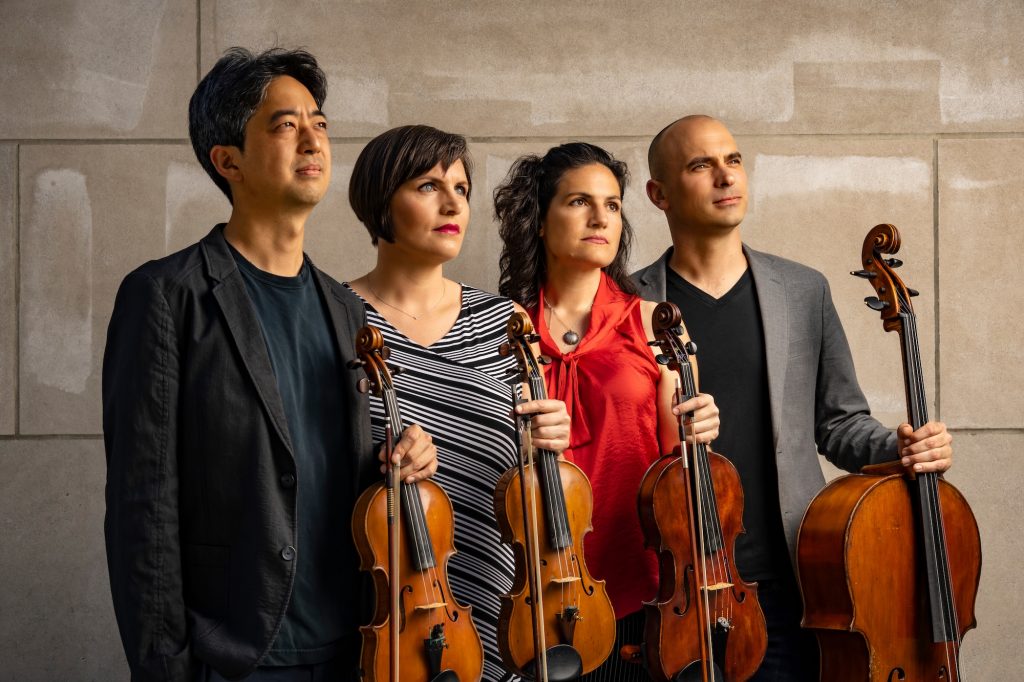
Jupiter String Quartet
Nelson Lee, violin
Meg Freivogel, violin
Liz Freivogel, viola
Daniel McDonough, cello
The Jupiter String Quartet is excited to share these three wonderful works written for us, all of which find space for hope and light in challenging times. Commissioning and programming new musical works for the concert hall has always been a core part of our mission and we believe these contemporary works are able to speak to our current times in unique ways. We have lived and performed these works dozens of times over the last decade, in concert halls, schools, symposia, and virtual spaces. We are delighted to now present them in one album.
While each compositional voice represented on this album is distinct and original, the three quartets find common ground in their desire to reach for something that transcends our often difficult and fraught modern-day society. Each work offers space for us to consider our collective humanity.
Michi Wiancko, our friend and classmate from college, wrote To Unpathed Waters, Undreamed Shores before the pandemic struck. We were all interested in collaborating on a piece that would address issues around the changing climate and offer a musical space for listeners to reflect on the beauty of the natural world and humankind’s relationship with it. The premiere was virtual but we have played it in many unique spaces since: for scientists, for children, and even for a community in California directly impacted by wildfires. Michi imaginatively depicts aspects of our natural world through a collection of short, colorful musical portraits and the whole work is drawn together by tender and optimistic musical ideas that ask us to “Rise Up” and work together.
Our friend and colleague at the University of Illinois, Steve Taylor, wrote Chaconne/Labyrinth during the pandemic and we premiered it virtually at a watch party in his backyard. The piece uses a repetitive harmonic progression and just intonation to capture the trippy mundanity of living through the pandemic. Steve, who is deeply interested in the intersection of science and music, creates a sonification of the Coronavirus which sits in the middle of this labyrinthine work in place of Greek mythology’s Minotaur. After encountering this monster we wind our way out of the maze, following familiar paths, but now to something hopeful and bright.
Kati Agócs, who teaches at our alma mater, The New England Conservatory of Music, wrote Imprimatur (String Quartet No. 2) for our ensemble to premiere at the Aspen Music Festival in 2018. Asasdour Santourian, their Vice President for Artistic Administration at the time, suggested her music to us and we found her voice beautiful, lyrical and often profoundly mystical. We have relished returning again to this piece over multiple seasons, including during the pandemic for a virtual series on Reflection, Hope and Strength under the auspices of the Krannert Center for the Performing Arts. Unlike the previous works on this album, Imprimatur does not look to the tangible world for inspiration, but instead lives metaphorically on a rhapsodic and transcendent plane. Kati’s piece moves continuously through different re-imaginings of musical ideas, in darkness and in light, ultimately coming to a rapturous conclusion.
Thank you for listening to these pieces. We hope you find them as beautiful as we do!
____________________
Composer’s Notes
Michi Wiancko: To Unpathed Waters, Undreamed Shores
To Unpathed Waters, Undreamed Shores is a multi-movement work for string quartet that celebrates the power of the natural world while carving out space to explore the notions of regeneration, hope, and wildness in relationship to ecological grief. Central to the piece is the idea of kinship and collective humanity, and the need to help protect each other and our most vulnerable places and populations.
Movement I. Pelagic Within
Our journey begins on the water, and our exploration turns inward as we travel from shoreline to open sea.
Movement II. Dream of the Xerces Blue
Dedicated to the magic of pollinators – specifically the gossamer-winged butterfly, Xerces Blue, which became extinct after loss of its coastal sand dune habitat in San Francisco’s Sunset District. It was last spotted in the Bay area in 1943.
Movement III. Central Park Microbial
A tribute to the unique nature of the soil microbiome beneath New York City’s Central Park, discovered only in recent years to be profoundly and inexplicably diverse by global metrics.
Movement IV. Invisible Eviction
The world is on fire.
Movement V. Crying, Together
A song of kinship and mourning.
Movement VI. Follow the Water
A return to the ocean, and the rivers and waterways that flow to it. A personal watershed.
Movement VII. Rise Up
A call to action, and a meditation on our collective humanity.
To Unpathed Waters, Undreamed Shores was commissioned jointly by the Krannert Center for the Performing Arts (Urbana, IL) and Bay Chamber Concerts (Rockport, ME).
Notes by Michi Wiancko
____________________
Stephen Andrew Taylor: Chaconne/Labyrinth
“Chaconne” is an old-fashioned word for a repeating chord progression, like the 12-bar blues. My chords are a little weirder, using just intonation to find notes that don’t exist on the piano keyboard. The quartet plays a chaconne, but at the same time they are lost in a labyrinth. The chords keep returning, only to point in new directions. This is how I felt during the pandemic: stuck in a loop, but at the same time lost in a maze, desperately seeking the way out. At the center of this maze, like the Minotaur of Greek myth, lies a depiction of the coronavirus that has so profoundly changed our world. After this encounter – marked by strange, percussive sounds – the quartet traces their way, like following Ariadne’s thread, back through the labyrinth.
Chaconne/Labyrinth was commissioned by the Arizona Friends of Chamber Music, sponsored by Drs. Margot and JD Garcia, and is dedicated to Harold Weaver and Cecile Weaver.
Notes by Stephen Andrew Taylor
____________________
Kati Agócs: Imprimatur (String Quartet No. 2)
Imprimatur (String Quartet #2) is a rhapsodic suite in five movements framed by an introduction and coda. A meditation on spiritual lightness that is celebratory in tone, the piece explores how a single idea imprints itself upon the memory through rapturous re-imagination. The movements flow into one another without pause to create a fifteen-minute trajectory. The opening chords and their answer, a rhapsodic melody, develop into tropes which re-appear transmuted, even sublimated throughout, embracing a dialectic of darkness and light. The work culminates in a serene quodlibet, merging the tropes. The word imprimatur, from Roman Catholic tradition, signifies approval to print a text – an affirmation or sanctioning. Most saliently, it can also mean a mark of distinction or an imprint.
Imprimatur (String Quartet #2) was commissioned jointly by the Aspen Music Festival and School (Robert Spano, Music Director); the Harvard Musical Association; and the Krannert Center for the Performing Arts/University of Illinois at Urbana-Champaign in honour of the Fifteenth Anniversary of the Jupiter String Quartet.
Notes by Kati Agócs
UNDREAMED SHORES brings together three major contemporary string quartets written for and performed by the Jupiter String Quartet, works the ensemble has lived with in performance over many years.
In To Unpathed Waters, Undreamed Shores, Michi Wiancko traces a sequence of vividly imagined musical scenes inspired by the natural world. Across seven concise movements, the music reflects on fragility, ecological loss, and kinship, gradually moving toward a quietly hopeful call for collective responsibility.
Composed during the pandemic, Stephen Andrew Taylor’s Chaconne/Labyrinth is built around a repeating harmonic cycle, using just intonation to evoke the tension of being caught between stasis and searching. Familiar material continually returns, reshaped by a sense of uncertainty before leading toward clarity.
Completing the album, Kati Agócs’s Imprimatur (String Quartet No. 2) unfolds as a continuous rhapsodic meditation. Musical ideas are repeatedly transformed, moving between darkness and light, and culminating in a serene, luminous conclusion.
Together, these works form a thoughtful exploration of contemporary quartet writing, each offering space to reflect on our shared humanity and to find moments of hope and light in challenging times.
Jupiter String Quartet
The Jupiter String Quartet is a particularly intimate group, consisting of violinists Nelson Lee and Meg Freivogel, violist Liz Freivogel (Meg’s older sister), and cellist Daniel McDonough (Meg’s husband, Liz’s brother-in-law). Founded in 2001, this tight-knit ensemble is firmly established as an important voice in the world of chamber music, and exudes an energy that is at once friendly, knowledgeable, and adventurous. The New Yorker states, “The Jupiter String Quartet, an ensemble of eloquent intensity, has matured into one of the mainstays of the American chamber-music scene.”
The quartet has performed in some of the world’s finest halls, including New York City’s Carnegie Hall and Lincoln Center, London’s Wigmore Hall, Boston’s Jordan Hall, Mexico City’s Palacio de Bellas Artes, Washington, D.C.’s Kennedy Center and Library of Congress, Austria’s Esterhazy Palace, and Seoul’s Sejong Chamber Hall. Their major music festival appearances include the Aspen Music Festival and School, Bowdoin International Music Festival, Cape Cod Chamber Music Festival, Rockport Music Festival, Music at Menlo, Tucson Winter Music Festival, the Seoul Spring Festival, and many others. In addition to their performing career, they have been artists-in-residence at the University of Illinois Urbana-Champaign since 2012, where they maintain private studios and direct the chamber music program.
Their chamber music honors and awards include the grand prizes in the Banff International String Quartet Competition and the Fischoff National Chamber Music Competition; the Young Concert Artists International auditions in New York City; the Cleveland Quartet Award from Chamber Music America; an Avery Fisher Career Grant; and a grant from the Fromm Foundation. From 2007-2010, they were in residence at the Chamber Music Society of Lincoln Center’s Chamber Music Two.
The quartet chose its name because Jupiter was the most prominent planet in the night sky at the time of its formation and the astrological symbol for Jupiter resembles the number four.
This album was recorded with Nelson Lee, the quartet’s first violinist from 2001-2025. Lee now teaches full time at McGill University in Montreal. Dr. Mèlanie Clapiés joined the group, in the first violin chair, in the fall of 2025.
For more information, visit www.jupiterquartet.com.
____________________
Michi Wiancko
Composer
Michi Wiancko is a versatile and highly imaginative composer, violinist, and collaborator, whose multi-faceted creative projects and organizational work prioritize artistic discovery, as well as community resilience and social change.
Michi Wiancko is a multifaceted and imaginative composer, violinist, teacher, and collaborator, whose creative projects and organizational work are driven by community care and social change. Recent commissions include works for the Boston Chamber Music Society, Carnegie Hall’s Ensemble Connect, NOW Ensemble, Tucson Chamber Music Festival, Chamber Music Tulsa, Orpheus Chamber Orchestra, Seattle Chamber Music Society, violinist Alexi Kenney, harpist Julie Philips Smith, and American Ballet Theater.
An accomplished violinist, Michi was described by Gramophone Magazine as an “alluring soloist with heightened expressive and violinistic gifts” and has toured and collaborated with countless artists across numerous genres and styles. She has also released two solo albums to critical acclaim on New Amsterdam Records and Naxos label, respectively.
Michi is Artistic Director of Antenna Cloud Farm, a genre-fluid and culturally expansive music festival, artists’ retreat, and community partnership organization based in Western Massachusetts. She also founded and co-directs The Experimental Institute, a tuition-free summer intensive for early-career musicians focused on creative artistry, career mentorship, and social impact. Michi is Associate Professor of Music at the Boston Conservatory at Berklee.
____________________
Stephen Andrew Taylor
Composer
Stephen Andrew Taylor composes music that explores boundaries between art and science. His first orchestra commission, Unapproachable Light, inspired by images from the Hubble Space Telescope and the New Testament, was premiered by the American Composers Orchestra in 1996 in Carnegie Hall. Paradises Lost, an opera based on the science-fiction novella by Ursula K. Le Guin, received its Canadian premiere in 2013, conducted by the composer. In 2015 the New York Times called his piano work Variations Ascending, premiered by Ian Hobson, “persuasive and powerful.”
Taylor also works with live electronics and improvisation, most recently in incidental music for the performance piece Quantum Voyages, premiered at the 2025 American Physical Society in Anaheim. He co-directs the Illinois Modern Ensemble, and has also appeared as conductor with Sinfonia da Camera, the Nouveau Classical Project, and the Arizona Chamber Music Festival. As a theorist, he has written and lectured on data sonification, György Ligeti, African rhythm, Björk and Radiohead. In popular music he has collaborated on concerts and albums with Pink Martini, rock singer Storm Large, cabaret/performance artist Meow Meow, and pianist Lang Lang; his arrangements have been performed by orchestras worldwide, including the Oregon Symphony, the Los Angeles Philharmonic, the San Francisco Symphony, the Cleveland Orchestra, the BBC Concert Orchestra, and the Chicago Symphony. He was a 2014 Fellow of the Guggenheim Foundation.
He grew up in Illinois and studied at Northwestern and Cornell Universities, and the California Institute of the Arts. His music has won awards from the Guggenheim and Howard Foundations, the American Academy of Arts and Letters, the Illinois Arts Council, the Conservatoire Américain de Fontainebleau, Composers, Inc., the Debussy Trio, the College Band Directors National Association, the New York State Federation of Music Clubs, the American Music Center, and ASCAP. Among his commissions are works for the Grossman Ensemble, Syracuse Society for New Music, the Jupiter Quartet, Spoleto Festival, Pink Martini and the Oregon Symphony, the Chicago Symphony, Quad City Symphony, Quincy Symphony, Quartet New Generation, Piano Spheres, and the American Composers Orchestra. Taylor is Professor of Music at the University of Illinois, Urbana-Champaign, where he lives with his spouse, artist Hua Nian.
____________________
Kati Agócs
Composer
Hailed as “a composer of imposing artistic gifts” (Gramophone Magazine) and “one ofthe brightest stars in her generation of composers” (Audiophile Audition), Kati Agócs creates “sublime music of fluidity and austere beauty” (The Boston Globe). Reflecting a multicultural upbringing and her own experience as a vocalist, Kati’s music gives new expression to both folk melodies and sacred rituals––and distills diverse traditions into her own unique voice that “demands to be heard” (The New York Times).
A Guggenheim Fellow and recipient of the lifetime achievement award in music composition from The American Academy of Arts and Letters, recordings of her music have been recognized with the 2022 GRAMMY® Award, as well as two nominations for Classical Composition of the Year in the Juno Awards (AKA the Canadian Grammy Awards).
Born in Windsor, Ontario of Hungarian and American parents, Kati studied composition at the Juilliard School with Milton Babbitt, and voice privately with Adele Addison. She serves on the composition faculty at the New England Conservatory in Boston and maintains a work studio in Flatrock, Newfoundland. She has written for many premier ensembles including the Boston Symphony Chamber Players, New York Philharmonic, Toronto Symphony Orchestra, and National Youth Orchestra of Canada, and was Composer-in-Residence for the 2025 Banff International String Quartet Competition.
Click the button above to download all album assets.