
Press Release
For press enquiries please contact alex.patel@orchidclassics.com. Tel: +44 7717 663481
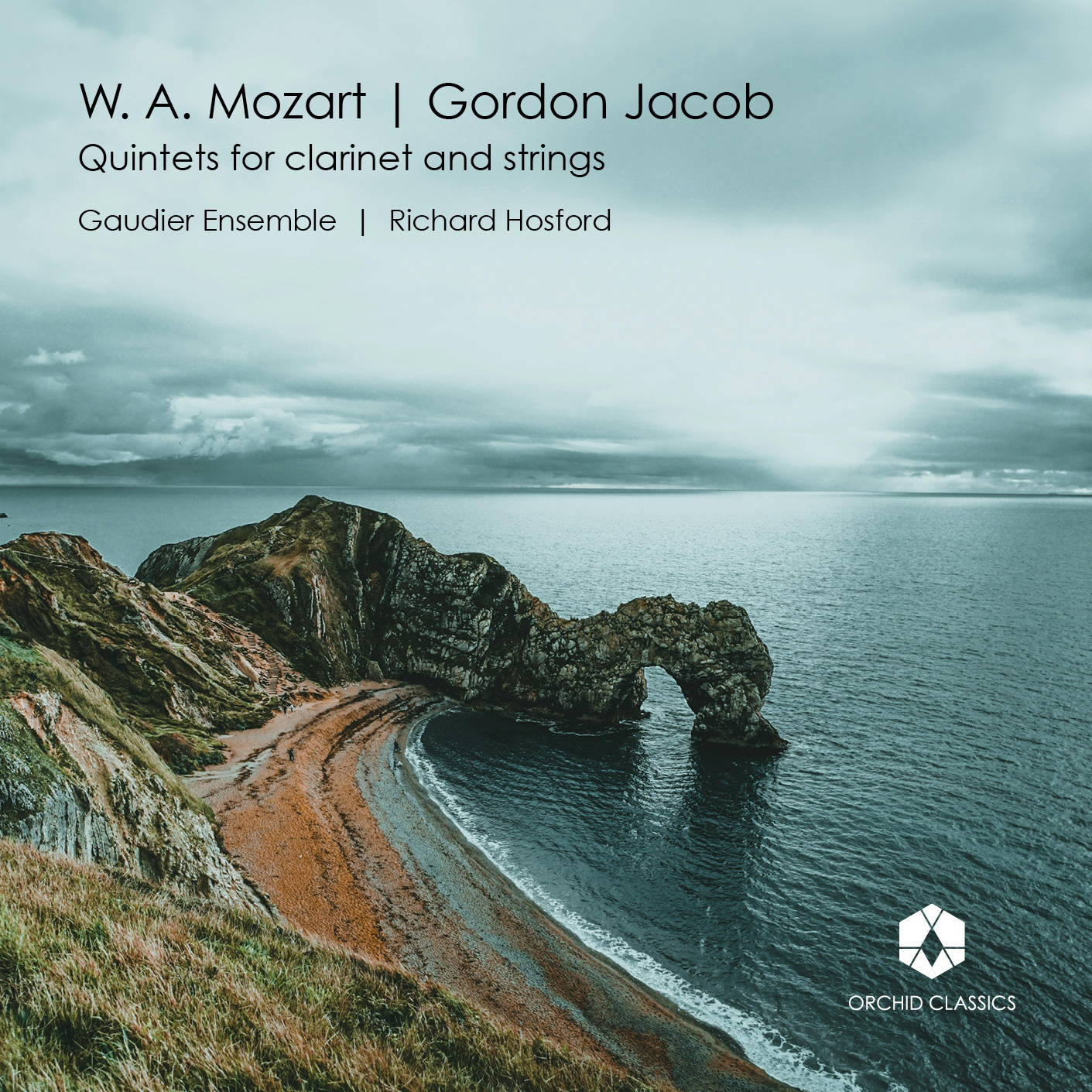
QUINTETS FOR CLARINET AND STRINGS
The Gaudier Ensemble
Richard Hosford, clarinet & basset clarinet
Catalogue Number: ORC100427
Release Date: April 10th 2026

Click the button above to download all album assets.
This recording brings together three closely related works for clarinet and strings, linking Classical elegance with 20th-century English lyricism. At its heart is Wolfgang Amadeus Mozart’s Clarinet Quintet in A major, K.581, written for Anton Stadler and one of the defining masterpieces of the clarinet repertoire. From the poised opening Allegro to the intimate, aria-like Larghetto and the finely judged closing variations, Mozart places the clarinet at the centre of a richly expressive chamber dialogue.
Wolfgang Amadeus Mozart (1756-1791)
Clarinet Quintet in A Major, K.581
1. I Allegro
2. II Larghetto
3. III Menuetto – Trio 1 – Trio 2
4. IV Allegretto con variazioni
Gordon Jacob (1895-1984)
Clarinet Quintet
5. I Tempo moderato
6. II Allegro con brio
7. III Rhapsody: Poco lento
8. IV Introduction, Theme and Variations
Wolfgang Amadeus Mozart
Clarinet Quintet Fragment in B-flat, K.516c
(completed by Duncan Druce)
9. Allegro
The Gaudier Ensemble
Richard Hosford, clarinet & basset clarinet
Marieke Blankestijn, violin
Ulrika Jansson, violin
Iris Juda, viola
Ursula Smith, cello
While Mozart and Jacob’s respective clarinet quintets are separated by over a century, there is an obvious resonance in their shared spirit. Jacob favoured the conciseness and clarity of form so demonstrated by Mozart’s quintet, building on these foundations as he carved out his own distinctly English style. In dedication to his friend and muse Anton Stadler, Mozart placed the clarinet – an instrument in the early stages of its modern developments – centre stage. Jacob too found inspiration in British clarinettist, Frederick Thurston. A third piece in this programme, a completion of the Allegro of a second unfinished Mozart clarinet quintet by Duncan Druce, offers the listener a rare imagining of what might have been another defining work of the clarinet repertoire.
Mozart Quintet in A Major for Clarinet and Strings, K.581
When Mozart crossed paths with Anton Stadler, he met one of his greatest muses. Stadler was a clarinet virtuoso employed in the Imperial Court Orchestra. It is likely the two met in 1781 when Mozart also moved to Vienna. It was not until 1785, however, when Stadler joined the Freemasonry where Mozart was a member, that their friendship was secured.
This friendship was a crucial moment in the development of the clarinet. The clarinet was a relatively young instrument in the orchestra. It had been increasingly refined throughout the early 18th century from its rudimentary predecessor, the Chalumeau, with the addition of a register key and bore holes to extend the instrument’s range. Mozart was captivated by Stadler’s playing and placed the clarinet – not previously considered a solo instrument – centre stage. The Quintet in A major (1789) is the second of three works Mozart wrote for Stadler: The “Kegelstatt” Trio (1785) and, of course, the Clarinet Concerto (1791). Mozart also wrote an extensive clarinet obbligato in La Clemenza di Tito (1791) intended for his friend. Stadler obtained a basset-clarinet from instrument maker Theodor Lotz in 1788 which extended the range four semitones below that of a normal clarinet. In both the Quintet and the Concerto, Mozart took full advantage of Stadler’s command of this instrument. Today, however, the Quintet is most often played on clarinet in A.
Mozart began writing the Quintet whilst at work on a bigger project, his opera.Così fan tutte.(1790). Though much smaller in scale, the Quintet has the charm and character of a tale fit for the operatic stage. The clarinet emerges as the protagonist from the rich string accompaniment in the opening movement, with frequent interjections from the first violin and cello.
For Mozart, the year of the Quintet’s composition was one of growing hardship. Suffering from the declining support of his wealthy patrons during the Austro-Prussian War, Mozart faced mounting debts. Meanwhile, his wife Constanze, pregnant with their fifth child, was suffering from illness. The child, Anna-Maria, would die just hours after her birth. Despite the major key and light-hearted themes set out in the opening movement, the Quintet bears glimpses of intense introspection. The Larghetto, closely resembling the Adagio of the later Concerto, is the melancholic heart of the piece. Set like an aria, the clarinet melody sings above the muted strings, entering momentarily into tender duet with the first violin. The Menuetto movement has the air of grandeur of a stately dance, before the textures of the previous movements are revisited in a set of lively theme and variations. The viola takes the unexpectedly wistful solo line in the third variation. In its first performance in December 1789, it was Mozart who played viola alongside Stadler. Mozart revisits the theme of the Larghetto, and despite the interruption of more virtuosic and technical variations, the sense of darkness persists throughout the movement. The spell of a brief, meandering clarinet cadenza is finally broken by a lively reprise of the opening theme, and the piece drives towards a joyful, yet abrupt conclusion.
Gordon Jacob Quintet in G Minor for Clarinet and Strings
In 1904, a German music critic famously declared Britain the “Land of No Music”, a sentiment that had been gaining traction in Europe for some decades before. English composers, like Edward Elgar and Hubert Parry, had begun laying the groundwork for a long-overdue musical renaissance. As their successor, Gordon Jacob inherited a musical landscape that was seeking to forge a distinctly English musical character out of a long history of sacred choral music and folk tradition.
Gordon Jacob’s composition career started unusually. At the outbreak of war in 1914, the 19-year-old enlisted in the Queen’s Royal Regiment. He was detained in a prisoner of war camp in 1917 where he found an old harmony book in the camp library. He studied it from cover to cover and began composing and arranging for a small band of fellow prisoners. Although Jacob later described these early works as “clumsy attempts at composition”, they were “very good practice” for the young, inexperienced composer. After returning from war, Jacob took up studies with Vaughan Williams and Charles Villiers Stanford at the Royal College of Music in London. He joined the teaching staff in 1924 and remained there until his retirement in 1966.
Jacob was, by all accounts, a modest and down-to-earth man. He was unconcerned with the label of “serious” music, which preoccupied some of his colleagues. Instead, he wrote exhaustively for ensembles and occasions of every type: symphony orchestra, chorus, wind band, military band, chamber ensembles, soloists, films, and radio. Unlike the lush pastoralism associated with his teachers, Vaughan Williams and Stanford, Jacob composed with a conciseness of form and clarity of structure which gave his works a distinctly neoclassical character. Jacob rarely made overt folk references, however, the influence of English folk melody is an evident undercurrent in the Quintet, as in much of his chamber music.
Written in 1940, Jacob dedicated his Clarinet Quintet in G minor to clarinettist Frederick Thurston and the Griller Quartet. They gave the first performance of the work on 28th April 1943 in Wigmore Hall. Thurston had been a fellow student of Jacob’s at the Royal College of Music, where, even as a student, Jacob recalled his “remarkable performances of concertos and chamber music”. The Quintet was later recorded in 1979 by Thea King, another gifted British clarinettist, and Thurston’s widow.
The opening clarinet theme, based on the ascending melodic minor scale, captures, in Jacob’s words, the “autumnal character” of the first movement. It is soon overtaken by a second theme which is “not melancholy, but quiet and contemplative”. His writing showcases the lyrical, mellow quality of the instrument and draws comparison to the clarinet works of Gerald Finzi or Herbert Howells.
By comparison, the Allegro con Brio has a “sense of urgency and bustle” owing to the active quartet accompaniment. A brief sombre trio is interrupted by a return to the opening scherzo before the movement ends with a quiet coda.
The Rhapsody follows with a free, fantasy-like clarinet solo, accompanied by rich string harmonies. Jacob describes “aiming to disclose the expressive eloquence inherent in this richly evocative medium”. The Introduction to the final movement emerges into a slowly unfolding Theme once again framed on the ascending melodic minor scale. A set of five Variations move through a development of the theme in the form of a march, a fugue, and even a “slightly jazzy” final variation.
Mozart Allegro Movement for Clarinet and Strings, completed by Duncan Druce
Traces of a second clarinet quintet exist in a sketch of an Allegro movement dated two years before the completion of the famous Clarinet Quintet in A Major K.581. It is not clear why Mozart never completed the composition – he abandoned it after just 93 bars.
Among the many works Mozart wrote for Anton Stadler, the unfinished quintet was intended for an early model of the basset clarinet. The technical passages of the lively, demanding exposition must have presented a challenge to Stadler, who was playing on a more rudimentary model of the basset clarinet than he would later perform the A major Quintet on.
Duncan Druce was a gifted performer, composer and musicologist, who turned his hand to several Mozart completions and reconstructions. The “finished” Allegro movement was recorded in 1984, with British clarinettist Alan Hacker. Druce’s completion of the movement was a charming and faithfully idiomatic addition to a growing number of restorations of Mozart’s unfinished works. In 1991, Druce’s reconstruction of Mozart’s Requiem on the fragments left by Mozart upon his death was performed by the London Classical Players at the Proms in 1991 to much acclaim. It was later published alongside the 1993 edition of the untouched Requiem by Novello.
Written by Hannah Findlater
_________________________
The Clarinets by Richard Hosford
The works on this CD required three different clarinets. I have always played on the larger bore ‘English style’ instruments, originally Boosey and Hawkes 1010’s and now Peter Eaton’s ‘Elite’ models. In 1988 I was given the chance to record the Mozart Concerto with the Chamber Orchestra of Europe. I was determined to play the concerto on the Basset Clarinet with the extended lower range that Mozart originally intended. At that time, Basset Clarinets were rare and there certainly weren’t any large bore instruments, so I asked the very talented Jeremy Lowe if he would extend my original Boosey 1010. After a year of trial and error, and many sessions together at his workshop, he produced a rather wonderful instrument. This is the Basset in A used for the Mozart Quintet, K.581. Some years later Charles Mackerras programmed the wonderful Mozart aria ‘Parto Parto’ with Magdalena Kozena. He encouraged me to play this on a Bb Basset Clarinet as originally intended. No such large bore instruments existed so I asked Alan Andrews, a genius in the clarinet world, to extend one of my older Peter Eaton Elites. This is the instrument used for the completed fragment K.516c. The Gordon Jacob is played on my treasured and more familiar Peter Eaton Bb clarinet. This is in the same style as the Boosey and Hawkes 1010’s played by the works dedicatee, Frederick Thurston.
This recording brings together three closely related works for clarinet and strings, linking Classical elegance with 20th-century English lyricism. At its heart is Wolfgang Amadeus Mozart’s Clarinet Quintet in A major, K.581, written for Anton Stadler and one of the defining masterpieces of the clarinet repertoire. From the poised opening Allegro to the intimate, aria-like Larghetto and the finely judged closing variations, Mozart places the clarinet at the centre of a richly expressive chamber dialogue.
Gordon Jacob’s Clarinet Quintet (1940), composed for Frederick Thurston, reflects a clear admiration for Mozart’s clarity of form while speaking in a distinctly English voice. Concise, lyrical and expertly balanced, the work moves from an autumnal opening through urgency and rhapsodic reflection to a characterful set of variations.
The programme concludes with a rarity: the unfinished Allegro of a second Mozart clarinet quintet, completed by Duncan Druce, offering an intriguing glimpse of a work Mozart never completed.
Performed by the Gaudier Ensemble with clarinettist Richard Hosford, this recording combines stylistic authority with warm, natural chamber sound, the clarinet’s expressive range and its evolution across two centuries.
The Gaudier Ensemble
Described by the Sunday Times as ‘one of the world’s elite ensembles’, The Gaudier Ensemble was formed in 1988 by a group of international musicians, founder members of the Chamber Orchestra of Europe, who wanted to perform and record the chamber music repertoire for strings, winds and piano. A two-year residency at Kettle’s Yard in Cambridge enabled the group to develop its repertoire and to establish its distinctive musical identity. Since then, the ensemble has forged an international reputation as one of the finest mixed chamber groups and its many recordings for the Hyperion label have been regularly recommended in the musical press. As individuals the ensemble’s members have distinguished themselves as soloists, chamber musicians and orchestral principals throughout Europe. In 1991 the ensemble founded the Cerne Abbas Music Festival where they have returned each year for over three decades.
Richard Hosford
Clarinet
Richard was born and brought up on a farm near Melcombe Bingham in Dorset. On gaining a scholarship to the Royal College of Music he studied with John McCaw and Thea King. He was a founder member of the Chamber Orchestra of Europe and met many of the Gaudier Ensemble there in the early 1980s. He has since been Principal Clarinet of the London Philharmonic and now the BBC Symphony Orchestra. In chamber music, he divides his time between the Gaudier and the Nash Ensembles. He has performed concertos with many orchestras, recently broadcasting the Copland Concerto with the BBCSO. His recordings of the Copland Concerto, the Brahms Quintet and the Brahms Trio have all been First Choices on the BBC’s Record Review programme in recent years. He has a large class of clarinet students at the Royal College of Music, who now visit Dorset annually for a clarinet course and concert at Ashton Farm. Richard was recently made a Fellow of the RCM and sat on the Jury of the 2025 International ARD Clarinet competition in Munich.
Marieke Blankestijn
Violin
Born in the Netherlands, Marieke studied with Herman Krebbers and SandorVegh. She is a founder member of Chamber Orchestra of Europe and has been their leader since 1985. With them she has also appeared as a soloist working with conductors including Claudio Abbado, Nikolaus Harnoncourt and Bernard Haitink. With the Chamber Orchestra of Europe, she has recorded and directed all the Brandenburg Concertos and made her own recording of Vivaldi’s Four Seasons’. She has recorded the Haydn ‘Sinfonia Concertante’ with Stephen Isserlis and the Bach ‘Oboe and Violin Concerto’ with Douglas Boyd. In 2012 Marieke was appointed Leader of the Rotterdam Philharmonic Orchestra and now commutes between Rotterdam and Dorset.
Ulrika Jansson
Violin
Originally from Vastervik, a small harbour town on the east coast of Sweden, Ulrika has lived in Stockholm since she started her musical education at the Royal College of Music aged 16. Her violin has taken her all around the world in many musical ‘constellations’: everything from jazz with drummer Max Roach’s quartet and a czardas duet with Romanian violin king Roby Lakatos, to a Schubert quartet providing interval music in Swedish television’s Eurovision Song Contest final. Membership of The Chamber Orchestra of Europe has had a profound effect on her life. The joy of making music with fantastic colleagues has never faded and lifelong friendships have ensued. It was also in the COE where she met her husband, a British trombonist, whom she snapped up and took to Sweden! Ulrika has been co-leader of the Swedish Radio Symphony Orchestra for many years. She loves the contrast this provides to her active life as a chamber musician, and she particularly enjoys her yearly visits to the unique and beautiful environment of Cerne Abbas. Ulrika spends as much time as she can at the family farm in Smaland, tending to the forestry plantations.
Iris Juda
Viola
Iris was born in Holland and studied violin with her father Jo Juda (leader of the Concertgebouw Orchestra), Hermann Krebbers in Amsterdam and then with Sandor Vegh in Salzburg. A founder member of the Chamber Orchestra of Europe, with whom she still plays regularly, she has also played with the Nash Ensemble, the Hanson String Quartet, the Endymion Ensemble and the Hagen String Quartet. In 1995, Iris moved to Salzburg where she plays in an Austrian folk group and is Principal Viola with the Camerata Salzburg. Iris says that Cerne Abbas is a highlight of her year, “celebrating the beauty of music created by the Ensemble’s mutual love and friendship”.
Ursula Smith
Cello
Ursula was principal cello of the Scottish Chamber Orchestra from 1993 for a decade, and was a member of the Zehetmaier Quartet from 2006 until 2012. Now Ursula is a member of the Fitzwilliam Quartet and is a cello professor and Senior Tutor in Chamber Music at Guildhall School of Music and Drama in London. She has played chamber music at festivals such as Aldeburgh, Cheltenham and Salzburg and venues such as the Wigmore Hall and Kings Place. She was asked to adjudicate at the international string quartet competitions in Salzburg in 2014 and in Banff, Canada in 2019.
Click the button above to download all album assets.