
Press Release
For press enquiries please contact alex.patel@orchidclassics.com. Tel: +44 7717 663481

SONGS OF ANGELS
ORA Singers
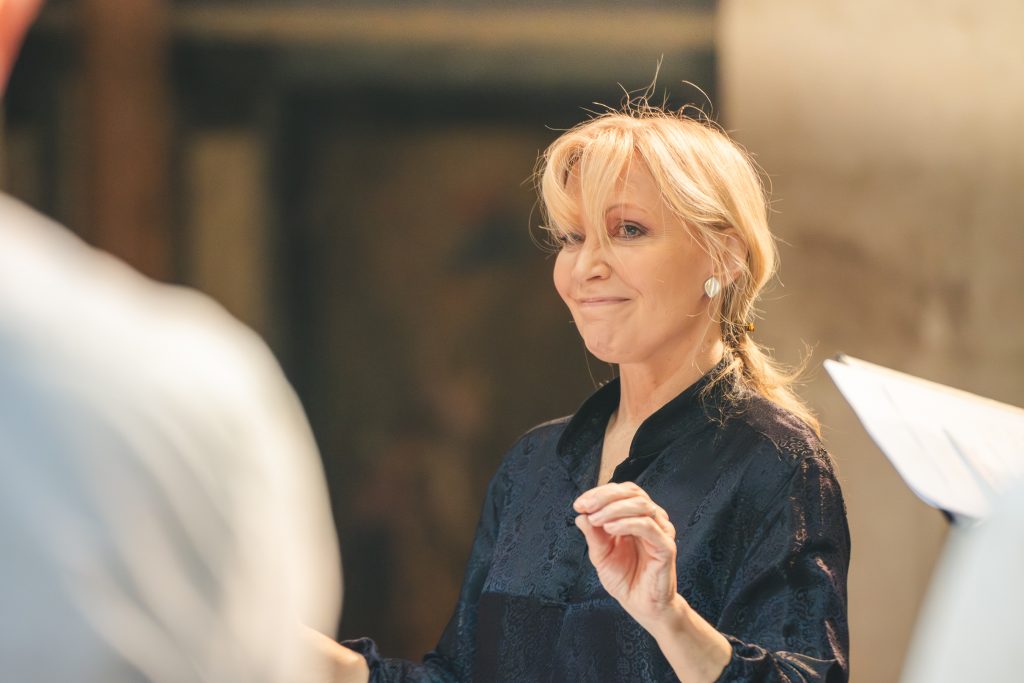
Suzi Digby OBE, conductor
Harry Baker, piano
Catalogue Number: ORC100423
Release Date: March 13th 2026

Click the button above to download all album assets.
Songs of Angels marks the 400th anniversary of Orlando Gibbons’ death, with a thoughtfully curated programme of choral music forming a landmark recording in ORA Singers’ Reflections series. Here, Renaissance masterworks inspire living composers to respond in their own voices – not in imitation of Gibbons, but in dialogue with him across the centuries.


Orlando Gibbons (1583-1625) arr. Harry Baker (b.1997)
1. Song 1 – The Song of Moses* 3.28
(A re-imagining of Orlando Gibbons – The First Song of Moses)
Lucy Cox, soprano
2. Hosanna to the Son of David 2.36
Marco Galvani (b.1994)
3. Hosanna to the Son of David*
(A reflection on Orlando Gibbons – Hosanna to the Son of David)
Isabella Gibber, soprano
Martha McLorinan, mezzo soprano
Orlando Gibbons
4. Almighty and Everlasting God
5. Deliver us, O Lord
Orlando Gibbons arr. Harry Baker
6. Song 34 – The Song of Angels*
(A re-imagining of Orlando Gibbons – The Song of Angels)
7. O clap your hands
Cecilia McDowall (b.1951)
8. O clap your hands Re-imagined*
(A reflection on Orlando Gibbons – O clap your hands)
Orlando Gibbons
9. Lift up your heads
10. O Lord, how do my woes increase
Orlando Gibbons arr. Harry Baker
11. Song 5 – The Lamentation of David over Saul and Jonathan*
(A re-imagining of Orlando Gibbons – The Lamentation of David over Saul and Jonathan)
Isabella Gibber, soprano
Martha McLorinan, mezzo soprano
Jack Granby, tenor
Eoghan Desmond, baritone
12. O Lord, in thy wrath rebuke me not
Nicola LeFanu (b.1947)
13. Be still, my soul*
(A reflection on Orlando Gibbons – O Lord, in thy wrath rebuke me not)
Julie Cooper, soprano
Jeremy Budd, tenor
Orlando Gibbons
14. Magnificat (Short Service)
15. Nunc Dimittis (Short Service)
Orlando Gibbons arr. James Weeks (b.1978)
16. Song 18 – Who’s this, that leaning on her friend
Lucy Cox, soprano
Orlando Gibbons arr. James Weeks (b.1978)
17. Song 14 – Arise thou North-winde from the North
Lucy Cox, soprano
Jeremy Budd, tenor
Orlando Gibbons arr. Harry Baker
18. Song 22 – The Song of Hezekiah*
(A re-imagining of Orlando Gibbons – The Song of Hezekiah)
Orlando Gibbons
19. O Lord, I lift my heart to thee
20. I am the resurrection
21. O Lord, in thee is all my trust
Orlando Gibbons arr. Harry Baker
22. Song 44 – Veni Creator Spiritus*
(A re-imagining of Orlando Gibbons – Veni Creator)
Will Todd (b.1970)
23. Veni Creator*
(A reflection on Orlando Gibbons – Veni Creator)
ORA Singers
Suzi Digby OBE, Artistic Director & Conductor
Harry Baker, piano
David Clegg, Artistic Advisor
*Denotes ORA Singers Commission
I have long admired the choral output of Orlando Gibbons. But it was not until we put together this album to mark the 400th anniversary of his death that I fully appreciated his unique genius.
A few of his full anthems are very well known. O Clap Your Hands, Hosanna to the Son of David and Almighty and Everlasting God are in the repertory of many church and concert choirs. But the great discovery during the making of this album were the hidden treasures of Gibbons’ output. They were a revelation to me – and to the singers. Pieces such as I am the resurrection and O Lord, how do my woes increase are mini masterpieces and deserve a far wider hearing. We hope that showcasing these, in the context of all ten complete surviving full anthems, will afford them far greater appreciation. We are indebted to David Skinner for his reconstructions of some of these pieces. We have used his invaluable editions throughout.
Scattered throughout the recording are some of Gibbons’ ‘Songs’, provided for George Wither’s 1623 publication The Hymnes and Songs of the Church. We’ve given these a 21st century twist with Harry Baker’s unique arrangements with jazzy piano accompaniment (performed by Harry himself). Gibbons originally set soprano and bass parts only, presumably allowing the organist to realise the inner parts. We have taken this as our inspiration for a freestyle re-imagining of these Songs.
We continue to put commissioning at the very centre of ORA Singers’ programming. For this Gibbons anniversary album we have commissioned four new pieces by Marco Galvani, Nicola LeFanu, Cecilia McDowall and Will Todd, each taking inspiration from their Gibbons original and we are thrilled to bring them to life here.
As ever, I am enormously grateful to ORA’s Artistic Advisor, David Clegg, for his imaginative and skilful curation of this programme and his guidance throughout.
Suzi Digby OBE, Artistic Director
____________________________
In 2025 ORA Singers marked the four-hundredth anniversary of Orlando Gibbons’ death with Songs of Angels, a programme of choral music preserved in this landmark recording in its Reflections series. Here, Renaissance masterworks inspire living composers to respond in their own voices – not in imitation of Gibbons, but in dialogue with him across the centuries.
Gibbons (1583-1625) stands among the most cultivated voices of early seventeenth-century England. Born in Oxford and brought up in Cambridge, he belonged to a professional musical family: his father was a Wait (town musician), and his elder brother Edward served as Master of the Choristers at King’s College, where Orlando first sang. He remained there to take his Bachelor of Music degree in 1606, by which time he was already associated with the Chapel Royal in London. Among colleagues such as William Byrd, John Bull and Nathaniel Giles, Gibbons developed a style distinguished by clarity, balance and expressive restraint.
His First Set of Madrigals and Motets, published in 1612, established his name. The following year he joined Byrd and Bull in Parthenia, the first printed anthology of English keyboard music. He later became organist of the Chapel Royal, served as musician to Prince Charles (later King Charles I), and in 1623 was appointed organist of Westminster Abbey. The Fantasies of Three Parts for viols, published around 1620, reveal the same thoughtful workmanship found in his church music.
Gibbons’ career was cut short in June 1625 when he died suddenly of a stroke in Canterbury, attending the royal household on the arrival of Queen Henrietta Maria. He was forty-one. His widow, Elizabeth, commissioned a memorial by Nicholas Stone that still stands in Canterbury Cathedral, while their son Christopher later continued the family tradition as a composer. A decade later, Charles I ordered manuscript copies of Gibbons’ works to be made, ensuring their preservation. His music – notably the Short Service and anthems – has remained part of English cathedral life ever since, valued for its proportion, clarity and depth of feeling.
Ten full anthems by Gibbons survive, all recorded here. Two early settings, O Lord, how do my woes increase and O Lord, I lift my heart to thee, appeared in William Leighton’s Teares or Lamentacions of a Sorrowfull Soule (1614) and already display his gift for expressive economy. Almighty and Everlasting God, setting the Collect for the Third Sunday after Epiphany, combines simplicity with quiet eloquence, while Lift up your heads (Psalm 24) shows a more celebratory manner. Others are inward in character: O Lord, in thee is all my trust is notable for its clear text-setting, and Deliver us, O Lord (Psalm 106) moves from plea to praise, closing with an exultant Amen.
I am the resurrection and the life is among his most affecting works, its arching lines and harmonic daring anticipating a later expressiveness. Although two voice-parts are lost, David Skinner’s reconstruction restores its balance with subtlety. The six-voice O Lord, in thy wrath rebuke me not (Psalm 6) shares that emotional directness, its repeated “Lord, how long wilt thou punish me?” voiced with almost personal intensity. Nicola LeFanu’s Be still, my soul takes this anthem as its point of departure. Setting a later text by Katharina von Schlegel, she traces a similar journey from unrest to stillness, translating Gibbons’s devotional sensibility into a modern harmonic language.
Two famous anthems display Gibbons at his most public. Hosanna to the Son of David conveys the excitement of Palm Sunday through overlapping cries of welcome. Marco Galvani’s new setting of the same text echoes that vitality in fresh, open sonorities, its antiphonal writing glancing towards Gibbons’ while remaining unmistakably of our time. O clap your hands (Psalm 47), probably written for the 1622 Oxford ceremony honouring Gibbons’ colleague William Heather, is answered here by Cecilia McDowall’s reflection on the same psalm. Her rhythmic agility and interplay of voices recast the anthem’s jubilation in a contemporary idiom, retaining its spirit while transforming its gesture.
A gentler kind of reflection is found in Gibbons’ collaboration with the poet George Wither on Hymnes and Songs of the Church (1622–23). The collection was dedicated to King James I – a canny move, as it resulted in a royal warrant declaring, not without controversy, that the book had to be included with every bound volume of metrical psalms. Fourteen melodies by Gibbons, published with bass but without inner parts, were intended for devotional use; several remain familiar from later hymnals. Seven appear here in new settings. James Weeks, in Who’s this that leaning on her friend? and Arise thou North-winde, treats Gibbons’s melodies with lightness and spatial clarity, allowing the original tunes to surface within translucent choral textures. Harry Baker re-imagines five others (Songs 1, 5, 22, 34 and 44), combining choir and piano in subtle dialogue. His harmonic palette ranges from gentle warmth to quiet intensity, nowhere more moving than in The Lamentation of David over Saul and Jonathan. Will Todd’s Veni Creator takes the ancient hymn as a shared point of departure, expanding Gibbons’ modal clarity into slow-moving chords of resonant colour.
Each of these reflections offers a different view of Gibbons’ art. LeFanu, Galvani, McDowall, Weeks, Baker and Todd all draw something personal from his example – his precision, his lyricism, his poise – offering music that belongs wholehearted to our own century while affirming the continuity of English choral tradition.
Songs of Angels stands, then, as both commemorative and a celebration of the new. Through ORA Singers’ performances, the music of Orlando Gibbons and his modern counterparts meets in mutual illumination. What emerges in this recording is not a ‘compare and contrast’ approach, but rather a sense of deep connection whereby the clarity, balance and expressiveness found in music written four centuries ago continues to inspire composers and move audiences today.
Dr Francis Knights
Performed by the highly acclaimed choir under Suzi Digby OBE, the album places the ten complete surviving full anthems by Orlando Gibbons at its centre—ranging from favourites such as O clap your hands and Hosanna to the Son of David to lesser-heard masterpieces including I am the resurrection and O Lord, how do my woes increase. Several works appear in modern reconstructions by David Skinner, allowing these pieces to be heard complete.
Interwoven throughout are Gibbons’ hymns from Hymnes and Songs of the Church (1623), reimagined for the 21st century in jazz-inflected arrangements by pianist and arranger Harry Baker, combining choir and piano in a fresh yet respectful sound world.
Continuing ORA Singers’ commitment to commissioning, across a stellar decade of activity as one of the UK’s foremost chamber choirs, new works by Marco Galvani, Nicola LeFanu, Cecilia McDowall and Will Todd respond directly to Gibbons’ originals—offering a vivid contemporary counterpart to his clarity, balance and depth of feeling.
ORA Singers
The award-winning ORA Singers is recognised for its modern take on the centuries-long choral tradition, and was born out of a belief that we are in a second golden age of choral music, matching that of the Renaissance. It is one of the world’s foremost commissioners of contemporary choral music, which it often performs alongside Renaissance masterpieces in its celebrated concerts and recordings. Since its description as “a musical comet”, ORA Singers has continued to blaze a trail as one of the UK’s leading vocal ensembles. Directed by Suzi Digby OBE, the group was named Ensemble of the Year at the 2018 Opus Klassik awards, and has received critical acclaim both for its “unfailingly elegant” performances and its “superb and exciting” recordings, most recently winning the Preis der deutschen Schallplattenkritik for their 2023 disc, Sanctissima.
____________________________
Suzi Digby OBE
Conductor
Suzi Digby OBE is an internationally renowned choral conductor and music educator. Born in Japan, she lived in Hong Kong, Mexico, and the Philippines before settling in the UK. Suzi has pioneered the revival of singing in UK schools and communities, founding several national organisations, including The Voices Foundation, Vocal Futures, Singing4Success, and London Youth Choir. In 2014, she launched The Golden Bridge in California, commissioning Californian composers to ‘reflect’ English Renaissance choral works. In 2016, she founded her professional vocal ensemble, ORA Singers, which won Germany’s Opus Klassik for Best Ensemble in 2018, and more recently the prestigious Preis der deutschen Schallplattenkritik for their 2023 album, Sanctissima. Suzi has conducted major choral-orchestral works with ensembles such as the Orchestra of the Age of Enlightenment and the London Mozart Players. She was the official choral conductor for The Rolling Stones, coaching and leading choirs for their 50th Anniversary Tour. Suzi was Visiting Professor at University of Southern California for 12 years. Suzi was awarded the Order of the British Empire (OBE) in 2007 for her outstanding services to music education and an honorary degree from the University of Aberdeen in 2016.
____________________________
Harry Baker
Piano
Harry Baker is an award-winning British pianist and arranger active at the highest levels of both jazz and classical performance. As a jazz musician, he has worked with Jamie Cullum, Misha Mullov-Abbado and others at venues including Ronnie Scott’s Jazz Club and King’s Place. As a classical pianist, collaborations with sopranos Fatma Said (Warner Classics), Danielle de Niese (Metropolitan Opera) and cellist Sheku Kanneh-Mason have led to performances at Wigmore Hall, Royal Festival Hall and the Verbier Festival. Recent international touring highlights include the Edinburgh International Festival, Lucerne Festival and Konzerthaus Berlin.
A versatile and high-profile arranger, Harry has written for Britten Sinfonia, Jamie Cullum, the National Youth Choirs, Gabrieli, and the Jess Gillam Ensemble. In 2024, Harry made his BBC Proms debut with an hour-long programme of his arrangements of classical, jazz and pop music for Fantasia Orchestra at the Royal Albert Hall. Harry’s arrangements have been recorded on Decca Classics and BBC Radio 3, and published by ABRSM.
In early 2020, Harry released his debut EP, The Floating Boy, a suite for big band and voices performed by the Oxford University Jazz Orchestra and vocal group The Oxford Gargoyles. The album launch was accompanied by a feature interview in London Jazz News and was played on Jazz FM, leading presenter Helen Mayhew to comment that “the future of British jazz is in very capable hands.”
Harry is in-demand as a session musician, and has appeared on the Zoe Ball Breakfast Show on BBC Radio 2, in addition to BBC1&2 with choirmaster Gareth Malone. He is also a passionate advocate for music education, and tutors Jazz & Classical Analysis at the University of Oxford.
Click the button above to download all album assets.